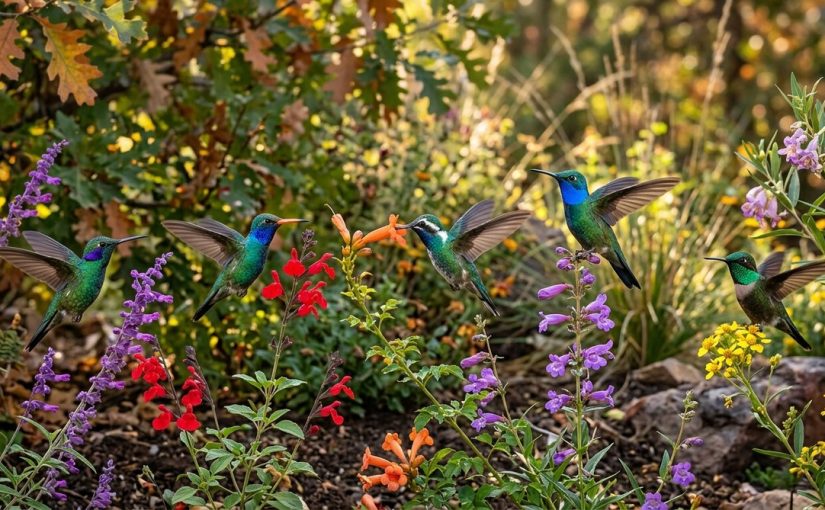
The first frost of the season can make a western garden feel quiet. The summer regulars have mostly moved on. But for birders who keep their feeders up through October and November, the reward can be something extraordinary: a hummingbird that has no business being there. These lost travelers, called vagrants, get pushed off course by storms, food shortages, or a faulty internal compass. They show up in backyards from Seattle to Tucson, and they turn an ordinary afternoon into a lifer moment.
Five rare hummingbird vagrants that could visit your western garden this fall include the Calliope, Rufous, Allen’s, Broad-tailed, and Costa’s hummingbirds. Each species has unique field marks and migration patterns. Keeping your feeders clean and available late into the season increases your odds of hosting a rarity. Always photograph and report sightings to eBird for science.
Why Vagrant Hummingbirds Appear in Fall
Most western hummingbirds migrate south to Mexico and Central America by late September. But every fall, a small percentage of birds take a wrong turn. They follow drainages that lead west instead of south. They get caught in a Pacific storm and blown inland. Or they simply run out of energy and stop at the first good feeder they find.
The science behind these movements is still evolving. Researchers at the Southeastern Arizona Bird Observatory have tracked vagrant patterns for years. They found that drought years in the Sierra Madre push more birds northward in search of food. When monsoons fail in Mexico, the birds that normally winter there end up in California, Oregon, and even British Columbia.
Climate patterns also play a role. El Nino years tend to produce more vagrant hummingbirds because shifting ocean temperatures alter insect availability. The result is a fall season that feels like a lottery. You never know what might show up.
The Five Vagrants You Should Watch For
These five species are the most likely to appear outside their normal range. Each one has been documented in unexpected places during the fall months.
1. Calliope Hummingbird (Selasphorus calliope)
The Calliope is the smallest bird in North America. It weighs less than a penny. Males have a magenta throat patch with distinct streaks. Females are paler with a pinkish wash on the flanks.
Normal range: Breeds in the mountainous West from California to British Columbia. Winters in Mexico.
Where vagrants show up: Calliopes have been recorded as far east as Georgia and as far north as Alaska. In the West, they often appear in lowland gardens during October. They seem to prefer feeders near willow thickets or creek beds.
Key identification tip: Look for the tiny size and the buzzing call note. If a hummingbird looks impossibly small and sounds like a bee, you are likely looking at a Calliope.
2. Rufous Hummingbird (Selasphorus rufus)
Rufous Hummingbirds are famously aggressive. They are also the most well documented vagrant in the West. The male has a bright orange throat and a rusty back. Females are green above with a rufous wash on the tail.
Normal range: Breeds from Oregon up through Alaska. Winters mostly in Mexico.
Where vagrants show up: Rufous hummingbirds are the most likely vagrant to appear in your garden. They have been recorded in every state in the lower 48 during fall. They are also regulars along the Gulf Coast.
Key identification tip: The rufous back and orange throat are unmistakable in good light. If the bird is chasing everything else away from the feeder, it is probably a Rufous.
3. Allen’s Hummingbird (Selasphorus sasin)
Allen’s Hummingbird looks very similar to the Rufous. The main difference is in the tail feathers. Allen’s has narrower outer tail feathers that create a different shape when the tail is fanned. Males have a green back and an orange throat. Females are green with some rufous on the tail.
Normal range: Breeds in a narrow coastal strip from Oregon to Southern California. Winters in Mexico.
Where vagrants show up: Allen’s is the classic “look alike” that causes confusion. They show up in the interior West during fall, often in the same gardens as Rufous Hummingbirds. They have been recorded in Arizona, Nevada, and Colorado.
Key identification tip: Look at the back. If the bird has a green back with a small patch of rufous at the base of the tail, it is likely an Allen’s. If the back is entirely rufous, it is a Rufous.
4. Broad-tailed Hummingbird (Selasphorus platycercus)
Broad-tailed Hummingbirds are slightly larger than the other Selasphorus species. Males have a brilliant rose red throat. Females have a green back and a white eye ring. The most distinctive feature is the wing trill. Males produce a high pitched whistle with their wings during flight.
Normal range: Breeds in the Rocky Mountains from Colorado to Montana. Winters in Mexico.
Where vagrants show up: Broad-taileds are less common as vagrants, but they do appear in lowland areas of the West during fall. They have been recorded in California’s Central Valley and in the desert Southwest.
Key identification tip: Listen for the wing trill. If a hummingbird makes a sharp, metallic sound when it flies, it is likely a Broad-tailed. No other western hummingbird has this sound.
5. Costa’s Hummingbird (Calypte costae)
Costa’s Hummingbird is a desert specialist. Males have a purple crown and throat that can look black in poor light. Females are green above and white below. They are slightly smaller than an Anna’s Hummingbird.
Normal range: Breeds in the Sonoran and Mojave Deserts of California, Arizona, and Nevada. Some populations are resident year round.
Where vagrants show up: Costa’s has been expanding its range northward in recent years. Vagrants have been recorded in Oregon, Washington, and even British Columbia. They show up in fall and sometimes stay through winter if feeders are available.
Key identification tip: Look for the purple crown. If a hummingbird has a purple cap that extends onto the forehead, it is a Costa’s. Anna’s Hummingbirds have a red crown, not purple.
How to Attract and Identify Vagrant Hummingbirds
You cannot force a vagrant to show up. But you can make your garden a place where they want to stop.
- Keep feeders clean and full through October and November. Use a solution of one part white sugar to four parts water. Do not add red dye.
- Place multiple feeders in different parts of the yard. Dominant birds will guard one feeder, leaving others open for visitors.
- Plant late blooming flowers. Salvia, penstemon, and trumpet vine provide natural nectar sources.
- Provide a water feature. A misting system or a shallow bird bath attracts hummingbirds even in cool weather.
- Be patient. Vagrants often appear at the edges of the day, early morning or late afternoon.
The table below summarizes the key identification features for each species.
| Species | Throat Color (Male) | Back Color | Distinctive Feature | Vagrant Hotspot |
|---|---|---|---|---|
| Calliope | Magenta streaks | Green | Tiny size, buzzy call | Lowland gardens, willow areas |
| Rufous | Orange | Rufous | Aggressive behavior | All western states |
| Allen’s | Orange | Green | Narrow tail feathers | Interior West, Arizona |
| Broad-tailed | Rose red | Green | Wing trill | California Central Valley |
| Costa’s | Purple | Green | Purple crown | Pacific Northwest |
Documenting Your Rare Bird Sighting
If you spot a hummingbird that looks different from the usual Anna’s or Black-chinned, take a photo. Even a blurry phone photo can help with identification. Pay attention to the throat color, the back pattern, and the shape of the tail.
Submit your sighting to eBird. This platform is used by researchers to track migration patterns and vagrant movements. Your report could help scientists understand how climate change is shifting hummingbird ranges. For a complete guide on how to document sightings properly, check out how to document and report your rare bird sighting like a pro.
“The best way to confirm a rare hummingbird is to photograph it from multiple angles. Throat color can change dramatically depending on the light. A bird that looks black throated in the shade might show brilliant purple in direct sun.” – Sheri Williamson, hummingbird researcher
Common Misidentifications and How to Avoid Them
The biggest challenge with vagrant hummingbirds is telling them apart. The Selasphorus group (Rufous, Allen’s, Broad-tailed) is especially tricky.
- Rufous vs. Allen’s: Check the back. Rufous has a solid rufous back. Allen’s has a green back with rufous only at the base of the tail.
- Broad-tailed vs. Calliope: Listen for the wing trill. Broad-tailed makes a metallic sound. Calliope does not.
- Costa’s vs. Anna’s: Look at the crown. Costa’s is purple. Anna’s is red. Costa’s also has a more slender bill.
If you are still unsure, use the female hummingbird identification guide for help with the green backed females that lack obvious throat color.
What to Do If a Vagrant Stays Through Winter
Some vagrant hummingbirds, especially Rufous and Costa’s, will stay if they find a reliable food source. This is more common in coastal California and the desert Southwest, but it happens inland too.
- Keep the feeder from freezing. Use a heated feeder or bring it inside at night.
- Provide roosting cover. Evergreen trees and dense shrubs give shelter from wind and cold.
- Do not stop feeding. Once a bird has committed to staying, removing the feeder can be fatal.
If you have a wintering hummingbird, report it to local birding groups. They will want to track it. You can also read about what makes a bird ‘rare’ in western North America to understand why some individuals choose to stay.
Your Garden Could Be the Next Hot Spot
Every fall, birders across the West post photos of hummingbirds that should not be there. A Calliope in a Portland backyard. A Broad-tailed at a feeder in Bakersfield. A Costa’s sipping from a salvia in Seattle. These sightings are not just lucky breaks. They are the result of preparation and patience.
Keep your feeders up. Watch closely. And when something unusual appears, take a moment to appreciate the journey that bird has made. It might have traveled a thousand miles to find your garden. That is worth celebrating.