
You spot an unfamiliar bird at your local park and wonder if you’ve just seen something special. Understanding what actually qualifies a bird as rare can transform how you appreciate every sighting and help you recognize when you’ve encountered something truly exceptional.
Bird rarity depends on multiple factors including population size, geographic range, breeding habitat availability, migration patterns, and observation frequency. A species can be rare globally but common locally, or vice versa. Understanding these criteria helps birdwatchers identify significant sightings, contribute to citizen science, and appreciate the conservation status of species they encounter in the field.
Population Size Defines Baseline Rarity
The total number of individuals in a species forms the foundation of rarity classification. Birds with fewer than 10,000 mature individuals worldwide typically earn rare status from conservation organizations.
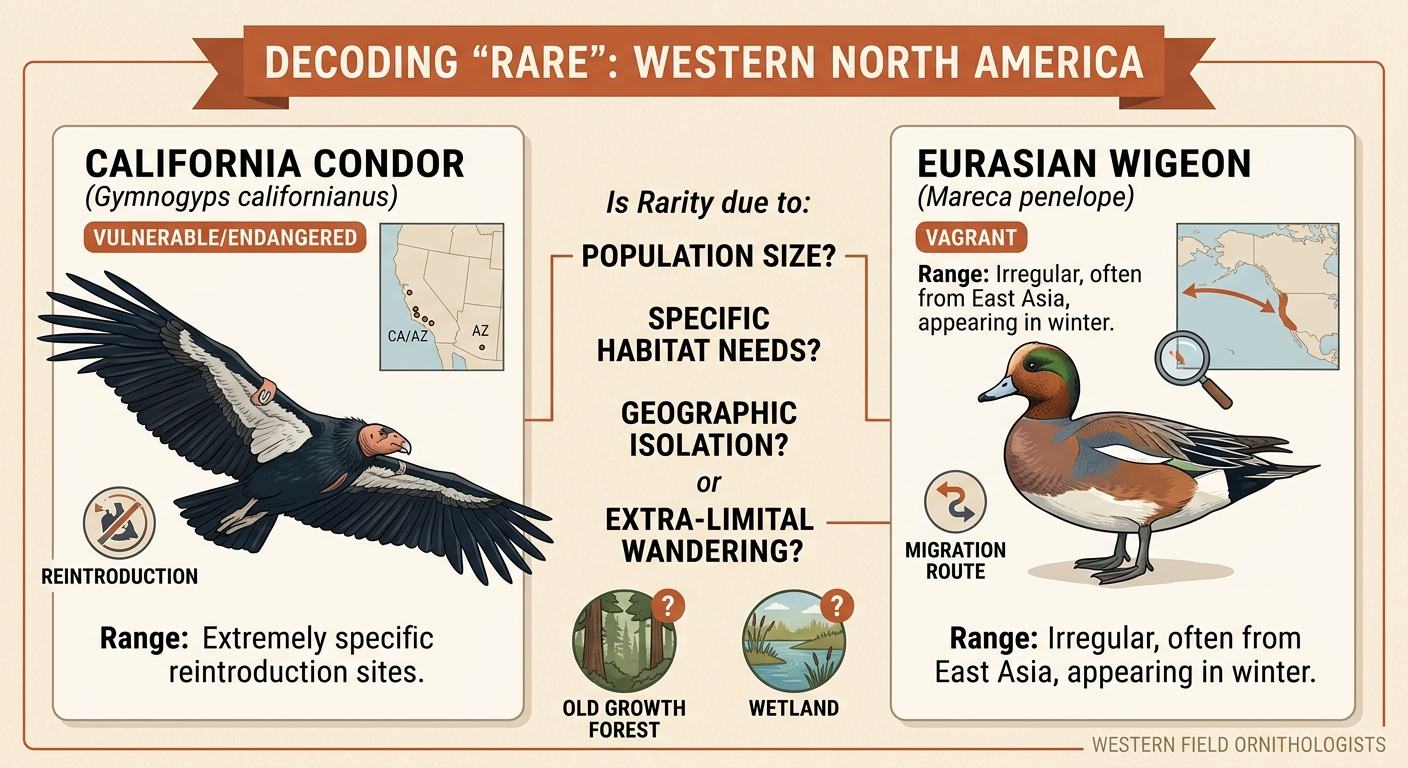
Take the California Condor. With only around 500 birds alive today, every sighting matters. Compare that to the American Robin, with a population exceeding 300 million. Numbers tell the story, but they don’t tell it alone.
Population trends matter as much as current counts. A species declining rapidly from 100,000 to 20,000 birds over a decade raises more concern than a stable population of 15,000. Ornithologists track these trends through breeding bird surveys, Christmas bird counts, and eBird data.
Some species naturally maintain small populations due to specialized habitat needs. The Kirtland’s Warbler breeds exclusively in young jack pine forests in Michigan. Its total population hovers around 5,000 birds, not because of recent decline, but because its ecological niche has always been narrow.
Geographic Range Creates Local Rarity
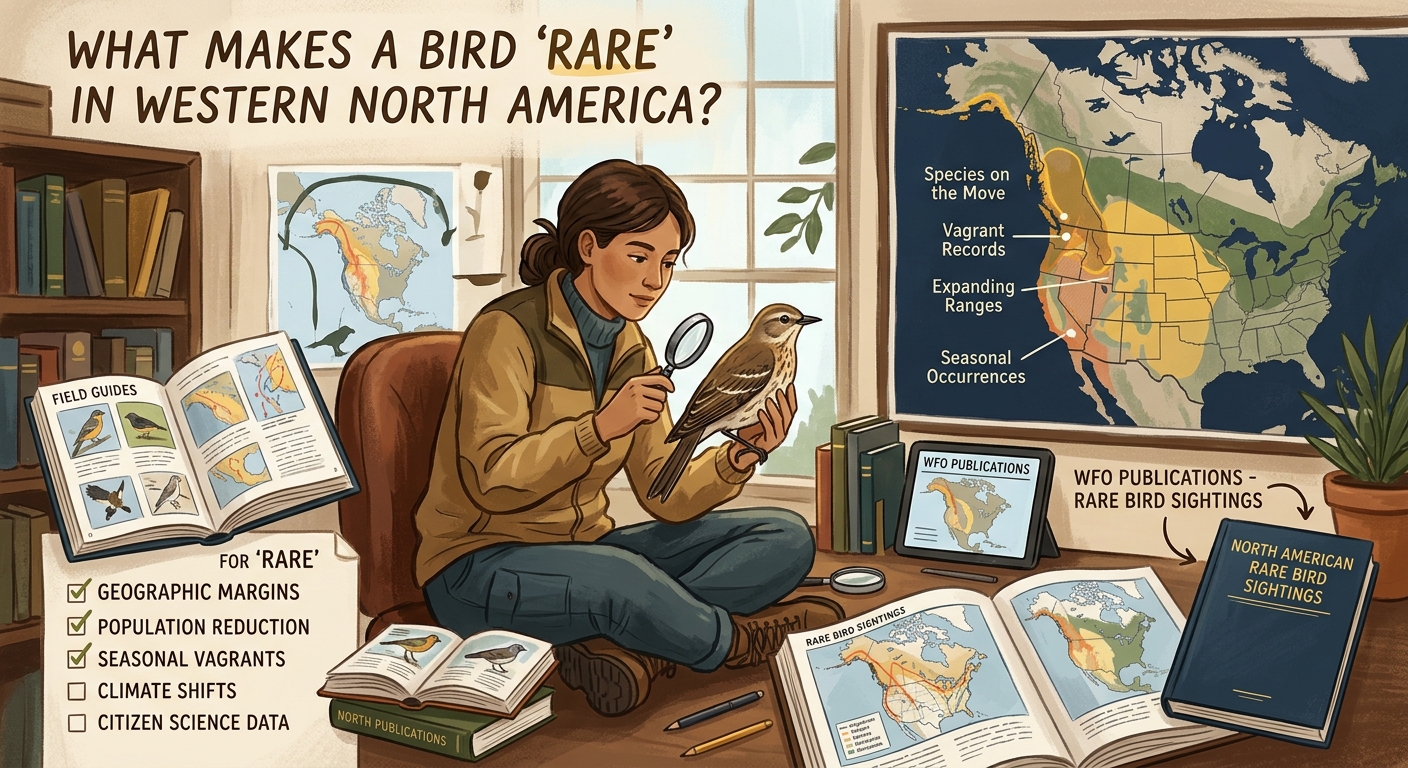
A bird can be common across its range but rare in specific regions. This geographic context matters enormously to birdwatchers planning trips or logging observations.
The Varied Thrush breeds commonly throughout Pacific Northwest forests. But spot one in Texas, and you’ve found a rare vagrant. Range maps show expected territories, but birds don’t always read maps.
Three types of geographic rarity shape birdwatching experiences:
- Endemic species confined to small areas like islands or isolated mountain ranges
- Vagrant individuals appearing far outside normal range due to storms or navigation errors
- Range edge populations where species occur sporadically at territorial boundaries
The Black Oystercatcher lives along rocky Pacific coastlines from Alaska to Baja California. Within that range, it’s predictable. But its total range is a thin coastal strip, making it geographically restricted even though locally common.
Seasonal range shifts add complexity. Many warblers breed across Canada but winter in Central America. During migration, they appear briefly in areas where they’re neither breeding nor wintering, creating temporal rarity windows.
Habitat Specificity Limits Abundance
Birds requiring highly specific habitat conditions face natural rarity regardless of total range size. The more particular a species, the fewer suitable locations exist.
Sage Grouse need intact sagebrush ecosystems with minimal human disturbance. As development fragments these habitats, populations become isolated in smaller patches. The habitat itself becomes rare, making the bird rare by extension.
Wetland specialists face similar constraints. The Yellow Rail inhabits shallow marshes with dense sedge cover. These wetlands have declined dramatically across North America, concentrating remaining populations in scattered refuges.
| Habitat Type | Example Species | Rarity Factor |
|---|---|---|
| Old growth forest | Spotted Owl | Logging reduced available territory |
| Alpine meadows | White-tailed Ptarmigan | Climate change shrinking habitat upward |
| Coastal salt marsh | Saltmarsh Sparrow | Sea level rise and development |
| Prairie grasslands | Greater Prairie Chicken | Agricultural conversion |
Habitat quality matters as much as quantity. A degraded wetland might look suitable but lack the invertebrate food base or nesting cover birds need. This creates ecological traps where birds attempt to breed but fail consistently.
Detection Probability Affects Perceived Rarity
Some birds aren’t actually rare but seem rare because they’re incredibly hard to observe. Secretive behavior, cryptic plumage, and remote habitats all reduce detection rates.
The Black Rail, North America’s smallest rail, lives in dense marsh vegetation and calls primarily at night. Experienced birders can spend years searching coastal marshes without seeing one. Yet populations exist in suitable habitats across the continent.
Nocturnal species present obvious detection challenges. Most birdwatchers operate during daylight hours, missing entire communities of owls, nightjars, and night herons. A Common Poorwill might be abundant in desert scrubland but invisible to daytime observers.
“Rarity is often in the eye of the beholder. A bird might be common but undetected, or genuinely scarce but highly visible. Understanding the difference requires knowledge of species behavior, habitat, and seasonal patterns.” — Field ornithologist perspective
Canopy-dwelling species in tall forests pose similar problems. A warbler feeding 100 feet up in a Douglas Fir might as well be invisible without careful listening and optical equipment. Population estimates for such species carry wider margins of error.
Migration Patterns Create Temporal Rarity
Birds following specific migration routes appear rare outside those corridors. Timing matters too. Miss the migration window by a week, and you miss the species entirely.
Shorebirds demonstrate this perfectly. Millions pass through key stopover sites during brief periods. At Copper River Delta in Alaska, Western Sandpipers concentrate by the hundreds of thousands in early May. Visit in June, and they’ve vanished to Arctic breeding grounds.
Three migration strategies produce different rarity patterns:
- Broad front migrants spread across wide areas, appearing uncommonly but predictably
- Concentrated corridor migrants funnel through specific valleys or coastlines in large numbers
- Leapfrog migrants skip entire regions between breeding and wintering grounds
The Blackpoll Warbler breeds across boreal forests and winters in South America. During fall migration, many fly directly over the Atlantic Ocean from New England to South America. They’re rare along the Gulf Coast despite being common at both range ends.
Weather events push migrants off course, creating unexpected rarity opportunities. Strong westerly winds during fall migration blow Pacific species eastward. A single storm can deposit Asian vagrants along the California coast.
Breeding Biology Influences Population Growth
Reproductive rates determine how quickly populations can recover from declines or expand into new areas. Species with low reproductive output face inherent rarity pressures.
California Condors don’t breed until age six and raise only one chick every two years under ideal conditions. This slow reproduction means populations recover glacially from setbacks. Compare this to American Robins, which can raise three broods of four chicks annually.
Nest site limitations constrain some species regardless of available habitat. Purple Martins in western North America depend almost entirely on woodpecker cavities in dead trees. Remove dead trees, and breeding sites vanish even if foraging habitat remains abundant.
Brood parasitism by Brown-headed Cowbirds pushes some species toward rarity. Kirtland’s Warblers suffered severe population declines partly because cowbirds laid eggs in their nests, reducing warbler reproductive success. Cowbird control programs helped warbler populations recover.
Human Observation Effort Shapes Records
A species might be genuinely rare, or it might simply occur in areas few birders visit. Observation effort dramatically affects our understanding of distribution and abundance.
Remote wilderness areas receive minimal birding coverage. A species could maintain healthy populations in backcountry areas while appearing rare in databases dominated by accessible location reports. The Northern Goshawk likely suffers from this observation bias.
Citizen science platforms like eBird have revolutionized rarity assessment by aggregating millions of observations. But coverage remains uneven. Urban parks receive hundreds of checklists weekly while vast stretches of national forest get surveyed once yearly.
Seasonal observation patterns create data gaps. Most birdwatchers are more active during spring migration and breeding season. Winter populations in harsh climates receive less documentation, potentially hiding abundance patterns.
The “pavement bias” affects records too. Birds near roads and trails get reported more frequently than those in roadless areas. This skews our perception of habitat preferences and population densities.
Conservation Status Provides Official Rarity Rankings
Organizations like the IUCN, Partners in Flight, and national wildlife agencies assign formal rarity classifications based on standardized criteria. These rankings guide conservation priorities and legal protections.
The IUCN Red List categories range from Least Concern to Extinct, with several intermediate levels:
- Least Concern: Widespread and abundant
- Near Threatened: Approaching thresholds for threatened status
- Vulnerable: High risk of endangerment
- Endangered: High risk of extinction
- Critically Endangered: Extremely high risk of extinction
These classifications consider population size, rate of decline, geographic range, and degree of fragmentation. A species qualifies as Endangered if fewer than 2,500 mature individuals remain, or if population has declined by 70% over three generations.
Partners in Flight assigns continental concern scores to landbirds based on population size, breeding distribution, non-breeding distribution, threats to breeding, and threats to non-breeding habitats. Species scoring above certain thresholds receive heightened conservation attention.
Legal designations like the Endangered Species Act provide protection but use different criteria than scientific classifications. Political and economic factors sometimes influence which species receive legal protection regardless of biological rarity.
Regional Context Changes Everything
A bird’s rarity status shifts dramatically depending on geographic scale. The Anna’s Hummingbird is common in California gardens but rare in British Columbia. Context determines significance.
State and provincial rare bird committees evaluate sighting reports based on regional occurrence patterns. A species might not warrant documentation in one state but require detailed notes and photographs in another.
Checklist categories help birders understand regional status:
- Regular: Expected annually in appropriate habitat and season
- Casual: Occurs in small numbers but not annually
- Accidental: Recorded fewer than five times in the region
- Hypothetical: Reported but lacking conclusive documentation
These categories help birdwatchers assess the significance of their observations. Finding a casual species merits careful documentation. Spotting an accidental vagrant could be a once-in-a-lifetime event worth submitting to rare bird committees.
Elevation adds another dimension. The White-tailed Ptarmigan lives above treeline in Rocky Mountain alpine zones. It’s common in suitable habitat but that habitat exists only in narrow elevation bands. Drive 2,000 feet downslope and the species becomes impossible to find.
Identification Challenges Create Apparent Rarity
Some species appear rare partly because they’re difficult to distinguish from similar species. Misidentification works both ways, hiding common birds and creating false rare records.
The Thayer’s Gull was long considered a separate species from the Iceland Gull. Birders logged rare sightings of Thayer’s along the Pacific Coast. Recent taxonomic revision merged them into a single species, instantly making “Thayer’s Gull” vanish from rare bird lists while Iceland Gull became more common.
Cryptic species complexes hide diversity within what appears to be a single species. The Western Scrub-Jay split into California Scrub-Jay and Woodhouse’s Scrub-Jay. What seemed like one common species became two, with different conservation needs and distribution patterns.
Hybrid individuals muddy identification waters. Where two species overlap, hybrids can show intermediate characteristics that confuse observers. Rare species reports sometimes turn out to be hybrids of common species.
Plumage variation within species creates identification pitfalls. First-year gulls look dramatically different from adults. Worn breeding plumage differs from fresh fall plumage. A common species in unusual plumage might trigger rare bird excitement.
Your Role in Understanding Rarity
Every observation you record contributes to our collective understanding of bird populations and distributions. Your sighting of a common bird in an unexpected location might reveal range expansion. Your documentation of breeding behavior helps track population health.
Accurate identification matters enormously. Take time to study field marks, behavior, and vocalizations. Photograph unusual birds when possible. Submit detailed notes to regional rare bird committees for species outside normal patterns.
Report your observations to eBird or similar platforms. Even “boring” checklists of common species provide valuable baseline data. Scientists use this information to detect population trends, track migration timing, and identify conservation priorities.
Respect birds and their habitats while seeking rare species. Avoid disturbing nesting birds or trampling sensitive vegetation. Follow ethical birding guidelines that prioritize bird welfare over personal listing goals.
Understanding rarity transforms casual birdwatching into meaningful participation in ornithological science. You’re not just checking off species but contributing to a global effort to monitor and protect bird populations. That common sparrow in your yard matters. That unexpected warbler during migration matters more. And the rare vagrant you carefully document and report might reshape our understanding of a species’ range and behavior.