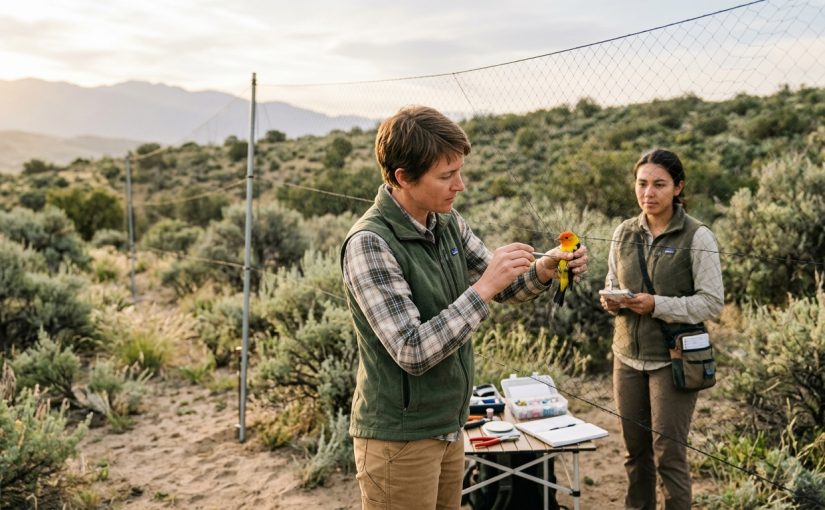
Capturing wild songbirds for research requires precision, patience, and respect for the animals in your care. Mist netting remains the gold standard for studying migration patterns, morphometrics, and population dynamics across North America. Done correctly, it yields invaluable data while minimizing stress to birds. Done poorly, it risks injury or death.
Mist netting techniques for songbirds involve strategic net placement, frequent monitoring intervals, gentle extraction methods, and standardized data collection. Ethical protocols require proper permits, training under experienced banders, and prioritizing bird welfare over data collection. Success depends on understanding target species behavior, habitat preferences, and seasonal migration timing to maximize capture efficiency while minimizing stress.
Understanding mist net fundamentals
Mist nets consist of fine mesh suspended between poles, creating nearly invisible barriers that temporarily entangle birds for scientific study. The standard 12-meter net with four shelves works well for most songbird projects, though 6-meter and 18-meter variants suit specific terrain or target species.
Mesh size matters significantly. A 30mm mesh catches warblers and sparrows effectively. A 36mm mesh better suits thrushes and tanagers. Using inappropriate mesh sizes leads to either missed captures or dangerous overcapture of non-target species.
Net height depends on your study goals. Ground-level placement targets species like towhees and sparrows. Mid-canopy placement requires extension poles and captures migrants moving through oak or willow thickets. Canopy netting demands specialized training and equipment beyond most banding stations.
Shelf depth creates pockets where birds fall after striking the net. Deeper pockets prevent escapes but require more skill to extract birds safely. Shallow pockets allow quick removal but increase escape rates, especially with strong fliers like flycatchers.
Site selection and net placement strategies
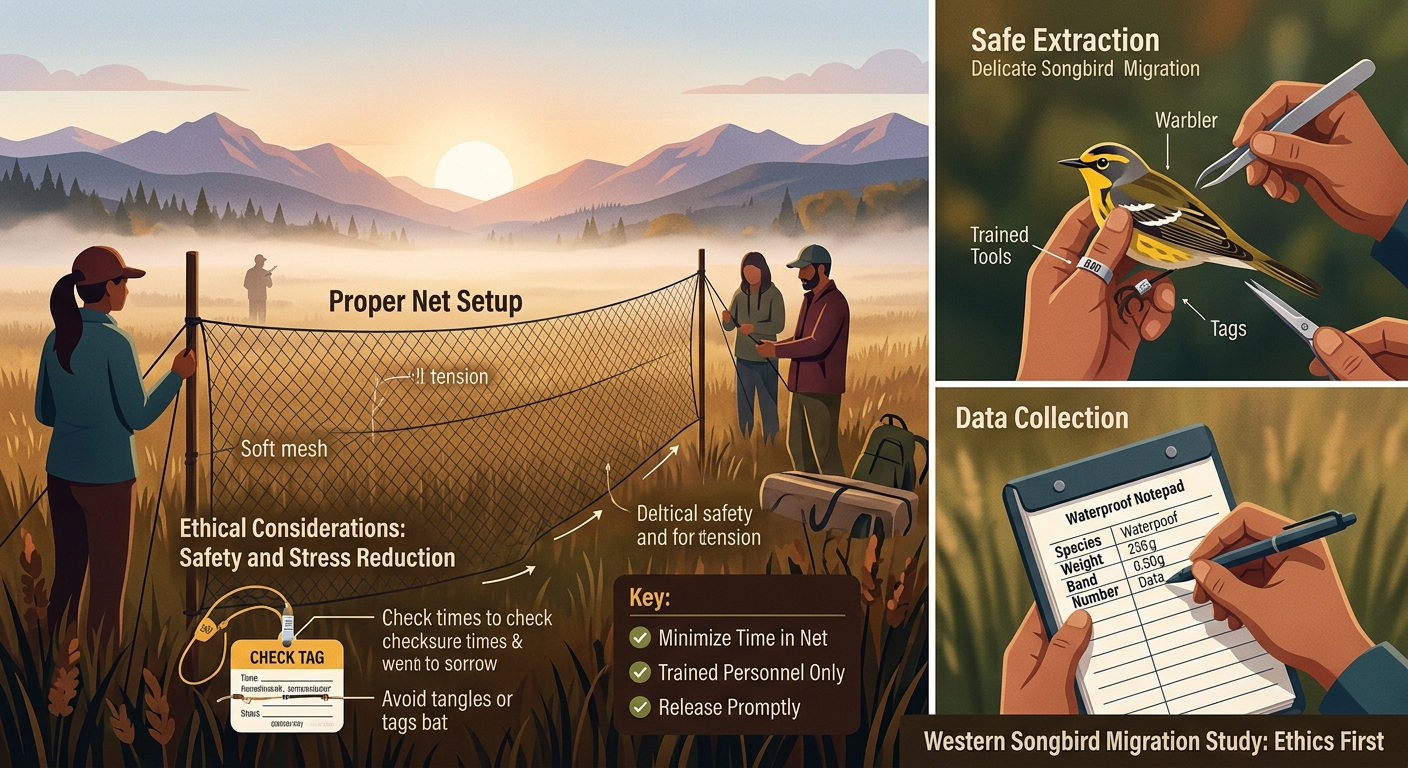
Choosing where to place nets determines capture success more than any other factor. Songbirds follow predictable movement patterns based on habitat edges, water sources, and vegetation structure.
Habitat funnels concentrate migrants naturally. A narrow corridor between forest and wetland forces birds through a confined space. Placing nets across these bottlenecks maximizes captures during peak migration.
- Position nets perpendicular to habitat edges
- Target areas with dense understory vegetation on one side
- Avoid completely open areas where birds easily see and avoid nets
- Use natural flight paths between feeding and roosting areas
- Consider sun angle to minimize net visibility during peak activity hours
Water features attract migrants for drinking and bathing. A net line 10 to 15 meters from a stream or pond intercepts birds approaching water. Morning captures peak here as birds rehydrate after overnight flights.
Vegetation density on the approach side matters enormously. Birds flying from dense cover into open areas rarely see nets until too late. Nets visible from 20 meters away catch far fewer birds.
Wind direction affects capture rates more than most researchers expect. Birds prefer flying into headwinds during migration, using updrafts for energy efficiency. Nets perpendicular to prevailing winds during migration season outperform other orientations.
Net setup protocols that prevent injury
Proper net tensioning prevents most extraction difficulties and injuries. Nets too tight create small pockets that compress birds. Nets too loose tangle birds in multiple mesh layers.
- Stretch the top trammel line taut between poles
- Attach shelf lines with moderate tension, allowing 15 to 20 cm sag
- Secure bottom trammel line loosely, permitting pockets to form naturally
- Check all knots and pole stability before opening nets
- Walk the net line to identify and remove any twigs or debris
Pole placement requires attention to ground conditions. Soft soil needs deeper insertion or guy lines for stability. Rocky ground may require specialized pole shoes or alternative anchoring methods.
Net lanes should remain clear of vegetation that could push nets sideways or create additional entanglement points. Trim branches within one meter of the net path, but avoid creating obvious clearings that alert birds.
Ground clearance affects which species you capture. Nets with bottom edges at ground level catch ground-foraging species. Raising the bottom edge 30 to 50 cm reduces captures of non-target species like quail or roadrunners while maintaining effectiveness for aerial insectivores.
Extraction techniques for different entanglement scenarios
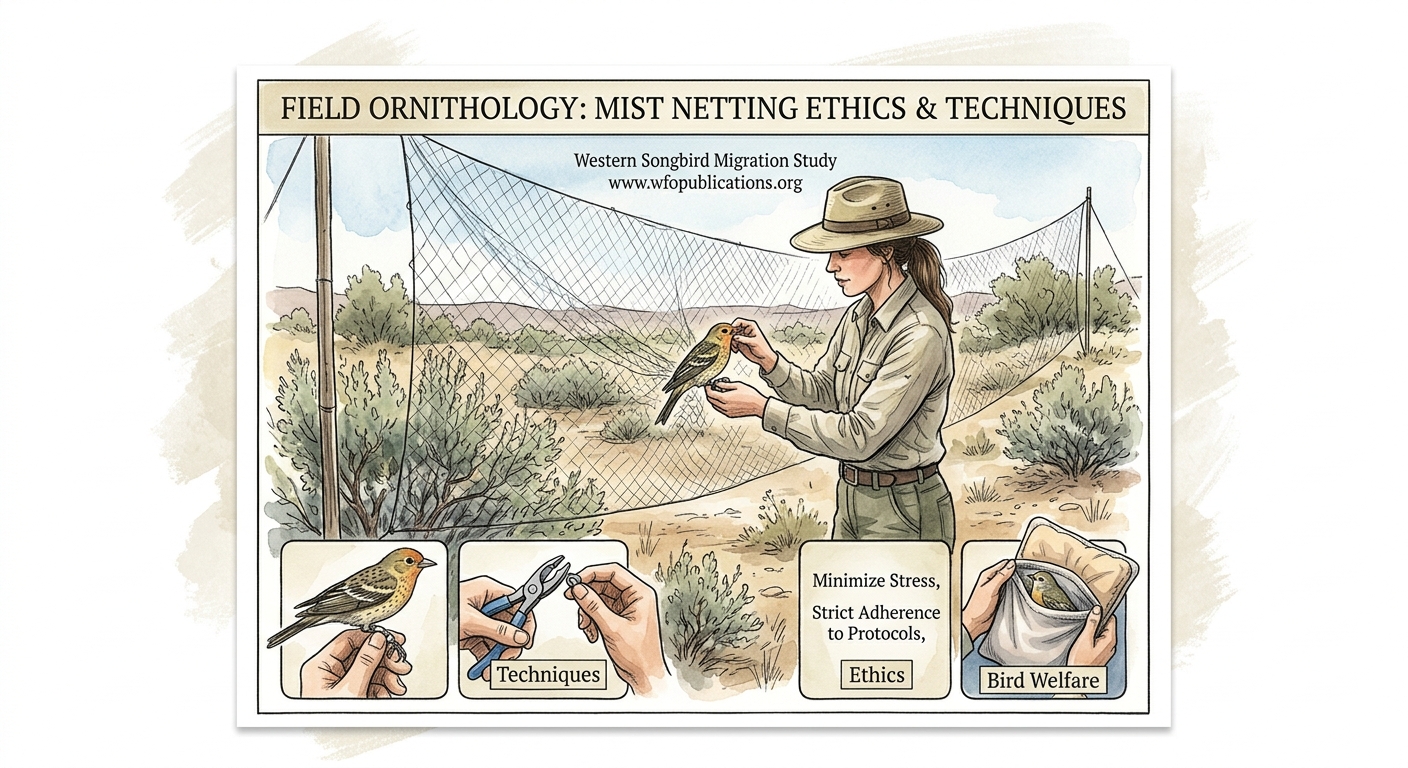
Speed and gentleness balance during extraction. Moving too slowly stresses birds unnecessarily. Rushing causes feather damage or limb injuries.
The standard extraction begins by securing the bird’s head gently between your index and middle fingers. This prevents biting and calms most species immediately. Support the body with your other hand while assessing entanglement severity.
Simple captures involve one or two body parts with minimal mesh wrapping. Remove these by tracing each mesh strand to its origin and lifting it over the caught appendage. Never pull mesh away from the bird’s body, as this tightens loops.
Complex entanglements require systematic unwrapping. Start with the wings, freeing primary and secondary feathers individually. Move to legs next, carefully unwinding mesh from tarsi and toes. Save the head for last, as most birds remain calmer while still partially restrained.
“The mark of an experienced bander isn’t how fast they extract birds, but how rarely they need help with difficult extractions. Slow down, think through the tangle, and work methodically.” — Master Bander, Point Reyes Bird Observatory
Hummingbirds present unique challenges due to their tiny size and rapid metabolism. Use magnification if available. Work in shade to prevent overheating. Complete extraction within 60 seconds when possible.
Raptors occasionally hit nets, especially Sharp-shinned Hawks pursuing songbirds. Use heavy leather gloves. Control the feet first. Expect aggression. Consider whether your permit covers raptor handling before opening nets in areas with high hawk activity.
Monitoring schedules and weather considerations
Net check intervals directly impact bird welfare. Thirty-minute checks represent the maximum acceptable interval for most conditions. Fifteen-minute intervals suit hot weather, exposed locations, or high-traffic nets.
Temperature extremes require modified protocols. Above 32°C, reduce check intervals to 10 minutes or close nets entirely. Below 5°C, monitor for hypothermia risk, especially with wet plumage.
| Weather condition | Maximum check interval | Special considerations |
|---|---|---|
| Clear, mild (15-25°C) | 30 minutes | Standard protocols apply |
| Hot (above 28°C) | 15 minutes | Provide shade for processing |
| Cold (below 10°C) | 20 minutes | Check for hypothermia signs |
| Light rain | 20 minutes | Close if plumage saturation occurs |
| Wind above 20 km/h | Close nets | Entanglement severity increases |
| Fog or mist | 15 minutes | Net visibility decreases |
Predator activity necessitates constant vigilance. Cats, foxes, and snakes learn to check nets for easy meals. Some stations use predator guards or elevated net placement in high-risk areas.
Dawn represents peak capture time for most songbird species. Open nets 30 minutes before sunrise. Activity typically declines by mid-morning, though migration fallout conditions can produce captures throughout the day.
Data collection standards and aging techniques
Standardized measurements enable comparison across studies and decades of banding records. Consistency matters more than precision to the nearest tenth of a millimeter.
Wing chord measurement uses the flattened, straightened method for most passerines. Flatten the wing against a ruler with the wrist joint at zero. Straighten without stretching. Record the longest primary tip measurement. This single measurement provides age and sex clues for many species.
Tail length helps separate similar species and age classes. Measure from the point where central rectrices emerge from skin to the tip of the longest feather. Worn or molting tails require notation.
Mass measurements need calibration checks daily. Pesola scales drift over time. Use a known weight each morning. Record mass to the nearest 0.1 gram for small species, 0.5 gram for larger birds.
- Bill length from anterior edge of nares to tip
- Bill depth at anterior nares edge
- Tarsus length from notch to last complete scale
- Fat score using standardized 0-5 scale
- Skull pneumatization percentage for aging
Aging songbirds relies primarily on plumage characteristics and skull ossification. Hatch-year birds show pointed rectrices, loosely textured body feathers, and incomplete skull windows through October. After-hatch-year birds display rounded tail feathers, dense plumage, and fully ossified skulls.
Skull windows require practice to assess accurately. Use a water-based lubricant and strong light. Check multiple skull areas, as ossification proceeds unevenly. Never assume age based solely on plumage without skull confirmation.
Species-specific handling considerations
Warblers tolerate handling well but overheat rapidly in warm conditions. Process these quickly, prioritizing essential measurements. Their fine feathers show stress bars easily, providing insights into molt timing and food availability during feather growth.
Sparrows vary enormously in temperament. Song Sparrows remain calm. Lincoln’s Sparrows panic easily. White-crowned Sparrows often bite persistently. Adjust grip pressure and processing speed accordingly.
Thrushes possess powerful legs and sharp claws. Control the feet immediately upon extraction. Their relatively large size and calm demeanor make them excellent training subjects for new banders.
Flycatchers escape easily from loose grips. Their wide bills deliver surprisingly painful bites. Empidonax identification requires careful attention to wing formula, primary projection, and bill structure, as plumage alone proves unreliable.
Tanagers and grosbeaks bite hard enough to draw blood. Maintain firm head control. Their thick bills can crack seeds, so imagine what they do to fingertips.
Training requirements and permit pathways
Federal banding permits require demonstrated competency under a master bander’s supervision. Most researchers accumulate 200 to 300 supervised captures before applying for sub-permits. Full permits typically require 500+ captures and 2-3 years of experience.
State permits often supplement federal requirements. California requires additional certification for certain sensitive species. Texas mandates specific training for handling endangered subspecies. Check your state wildlife agency requirements early in the planning process.
Institutional animal care committees review protocols for research conducted at universities or federal facilities. Your protocol must address capture methods, handling duration, sample sizes, and data management. Justify why banding provides information unavailable through observation alone.
Training opportunities exist through bird observatories, university field stations, and established banding operations. The Institute for Bird Populations offers workshops covering capture techniques, aging, and sexing for western species. Point Reyes Bird Observatory runs intensive training sessions each fall.
Common mistakes that compromise data quality
Poor net maintenance creates unnecessary complications. Holes allow escapes and invalidate capture effort calculations. Frayed trammel lines break under tension. Faded nets become more visible to birds.
Inconsistent measurement techniques destroy data comparability. Switching between flattened and natural wing chord methods mid-season makes analysis impossible. Using different calipers without cross-calibration introduces systematic errors.
Inadequate record keeping loses valuable information. Write band numbers clearly. Note unusual plumage or behavior immediately. Photograph rare species or anomalous measurements. Future researchers will thank you.
Processing birds too slowly causes unnecessary stress and affects physiological measurements. Mass drops measurably after 10 minutes of handling due to stress-induced defecation and water loss. Stress also triggers fat mobilization, potentially skewing fat score assessments.
Capture bias goes unrecognized in many studies. Nets catch bold, low-flying, or inexperienced birds preferentially. Your sample may not represent the broader population. Acknowledge these limitations in publications.
Building skills that last a career
Mist netting proficiency develops through repetition and mentorship. Your first hundred extractions will feel clumsy. Your first thousand will build confidence. After five thousand, patterns emerge that guide net placement, timing, and species-specific techniques.
Seasonal variation teaches lessons no manual can convey. Spring migrants carry less fat but show brighter plumage than fall birds. Juveniles in July handle differently than adults in October. Local breeders behave distinctly from passage migrants.
Each field season refines your understanding of how weather, habitat, and timing interact. You’ll learn which willow thickets produce Wilson’s Warblers reliably. You’ll predict when the first Orange-crowned Warblers arrive within a few days. You’ll recognize the conditions that trigger fallouts.
The data you collect contributes to continental monitoring efforts spanning decades. Band returns document migration routes, stopover ecology, and survival rates. Your careful measurements track population trends and climate change impacts. Every bird processed adds another data point to our collective understanding of songbird ecology.
Start with realistic expectations. Master the common species before attempting rare ones. Prioritize bird welfare over sample size. Build skills gradually under experienced supervision. The songbirds in your nets deserve nothing less than your complete attention and best effort.