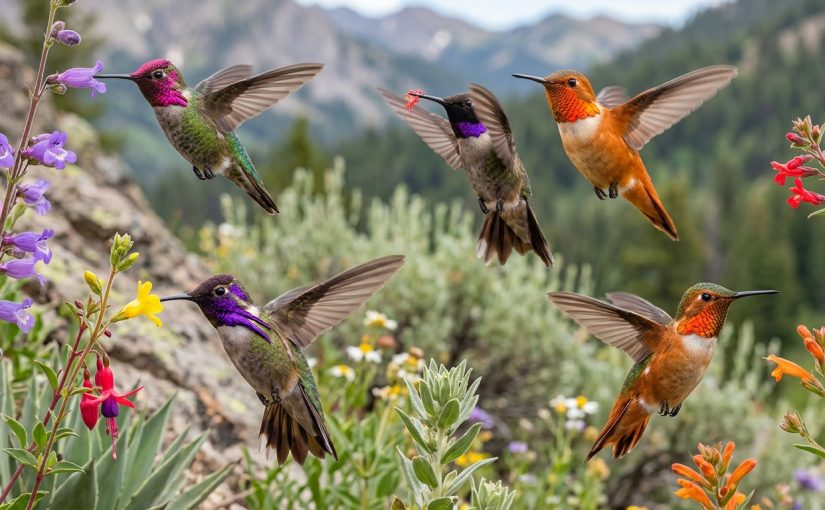
Watching a hummingbird hover at your feeder is thrilling. But can you tell if it’s a Rufous or an Allen’s? Most western hummingbirds look similar at first glance, and telling them apart takes more than spotting a flash of color. The good news is that with a few reliable markers, you can confidently name every species that visits your yard.
Western North America hosts five hummingbird species: Anna’s, Black-chinned, Rufous, Allen’s, and Calliope. Successful western hummingbird identification relies on observing [gorget](https://en.wikipedia.org/wiki/Gorget) color, tail shape, call notes, and seasonal timing. Males display distinctive throat patches, while females require careful attention to tail patterns and body size. Practice with multiple field marks to build confidence and avoid common misidentifications.
Understanding the five species you’ll see
Anna’s Hummingbird dominates year-round in coastal California and the Pacific Northwest. Males sport a brilliant rose-red gorget that extends over the crown. Females show green backs and gray underparts with scattered red spots on the throat.
Black-chinned Hummingbirds breed across the interior West from Texas to British Columbia. Males have a black throat with a thin purple band at the bottom, visible only in good light. Females are nearly identical to female Anna’s but slightly smaller with longer wings.
Rufous Hummingbirds migrate through the West each spring and fall. Males are unmistakable with orange-red plumage covering most of the body. Females show green backs, rufous flanks, and rufous at the base of the tail.
Allen’s Hummingbirds occupy a narrow coastal strip in California and southern Oregon. Males look nearly identical to male Rufous but have a green back. Females are almost impossible to separate from female Rufous without hearing their calls.
Calliope Hummingbirds are the smallest birds in North America. Males have wine-red streaks radiating across a white throat. Females are compact with a short tail and buffy flanks.
Male identification starts with the gorget
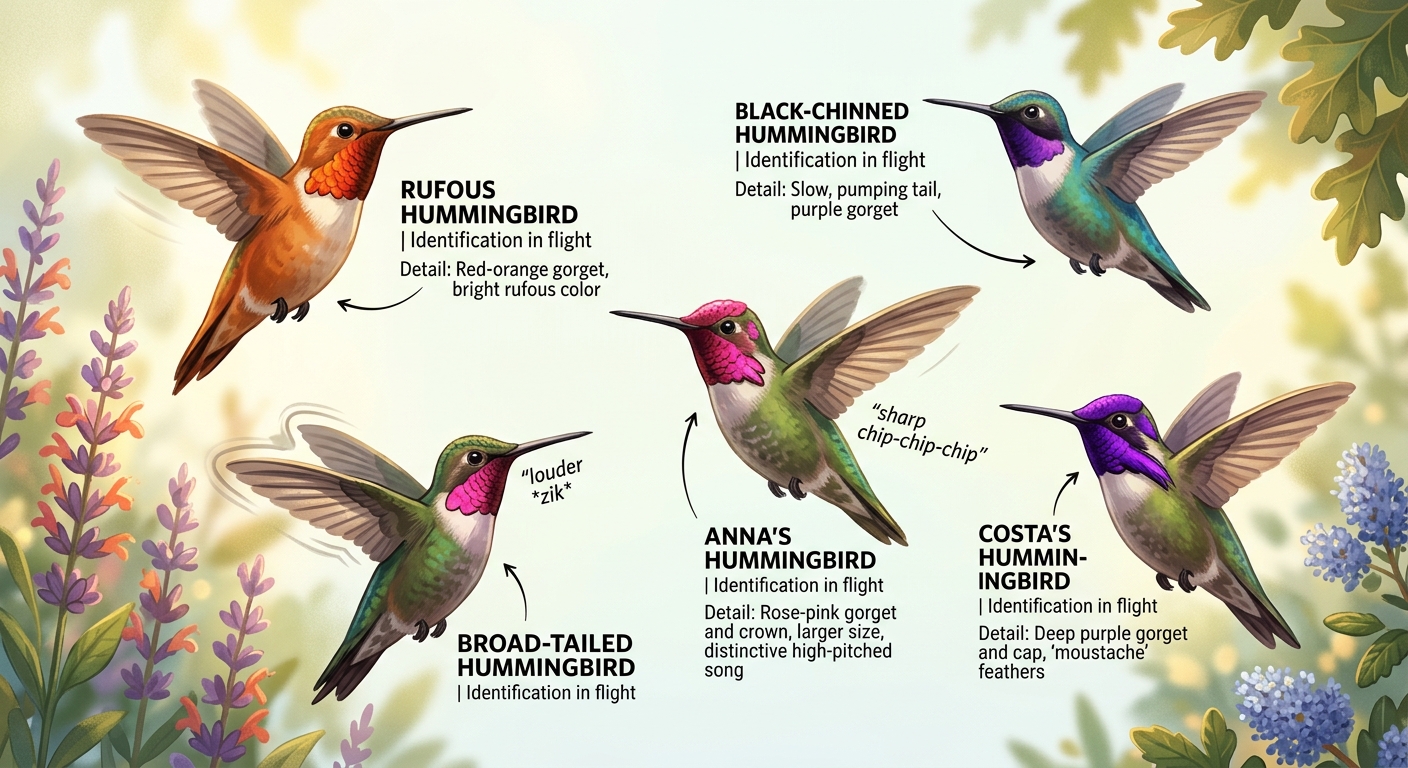
The throat patch, called a gorget, is your first clue for males. These iridescent feathers change color depending on light angle and viewing position.
Anna’s males flash rose-red across the entire throat and forehead. The color appears black in shadow but explodes into magenta-pink when sunlight hits at the right angle. No other western species has this extensive head coverage.
Black-chinned males show a solid black throat with a narrow violet band at the lower edge. You need direct sunlight to see the purple. In shade, the entire gorget looks black, which can fool you into thinking it’s a different species.
Rufous and Allen’s males both display orange-red gorgets. The color is more orange than Anna’s rose-pink. Separating these two requires looking at the back: Rufous males have rufous backs, while Allen’s males have green backs. This difference is reliable but requires a clear view.
Calliope males stand out with their unique streaked pattern. Instead of a solid patch, wine-red feathers radiate from the center of the throat like a starburst. The white background makes the pattern obvious even in poor light.
Female and immature birds need multiple clues
Female hummingbirds frustrate even experienced birders. Most species show green backs and pale underparts with minimal distinguishing marks. You need to combine several field marks for confident identification.
Tail patterns matter most. When a hummingbird hovers or perches, watch the tail carefully.
Female Anna’s have rounded tails with dark centers and gray corners. The tail lacks any rufous color. The central tail feathers are dark green.
Female Black-chinned have similar tails to Anna’s but are slightly longer and more tapered. The difference is subtle and requires practice to see consistently.
Female Rufous and Allen’s both show rufous at the base of the outer tail feathers. The amount varies by individual, making this mark less reliable than you’d hope. The tail is rounded with rufous edges.
Female Calliope have the shortest tails of any western species. The tail barely extends beyond the wingtips when perched. The outer tail feathers show rufous bases with dark tips.
When identifying female hummingbirds, never rely on a single field mark. Always confirm with at least two independent features like tail pattern, body size, and call notes before making your final identification.
Sound provides instant confirmation
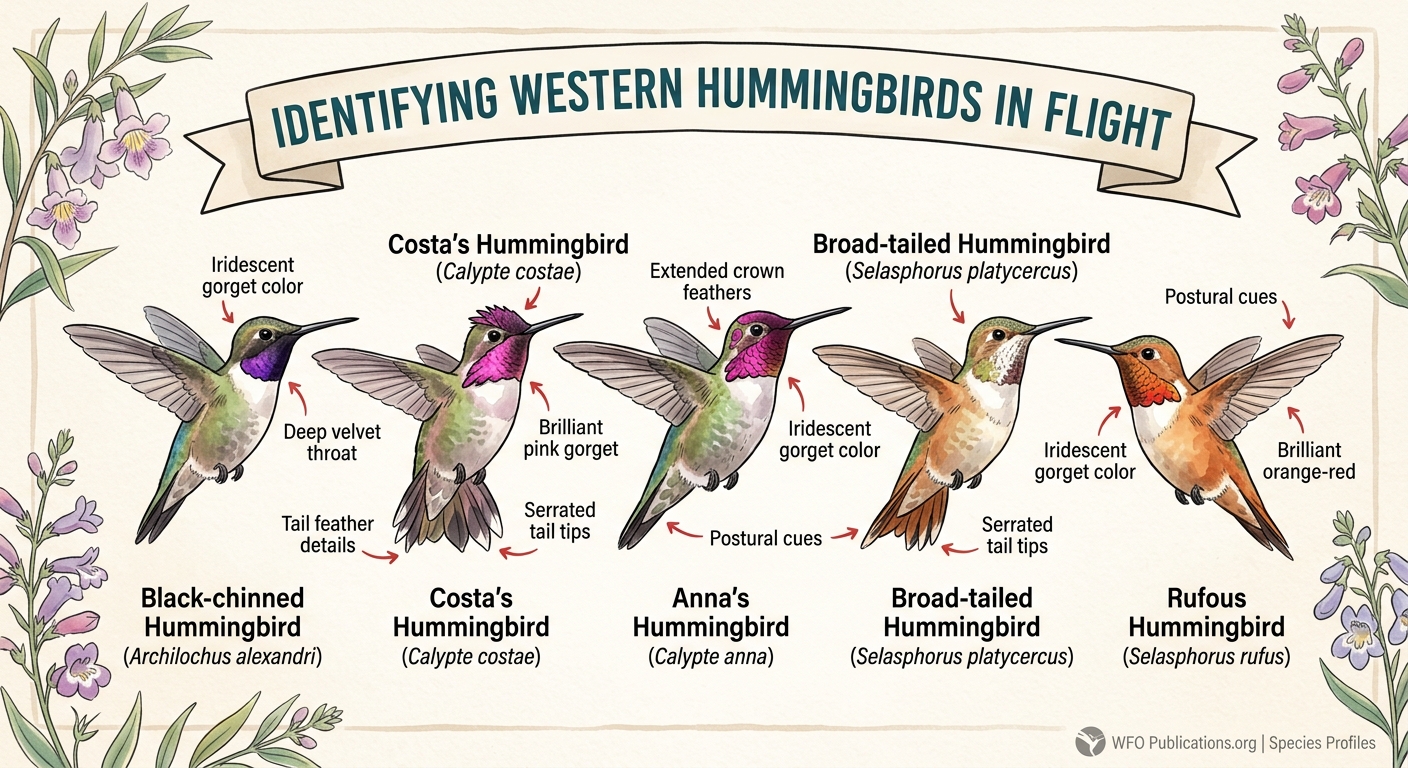
Call notes separate species faster than visual marks in many cases. Learn these sounds and you’ll identify birds even when they zip past too fast to see clearly.
Anna’s Hummingbirds are the noisiest. Males sing a scratchy, buzzy song from exposed perches. Both sexes give sharp “chit” notes constantly. You’ll hear Anna’s before you see them.
Black-chinned Hummingbirds stay relatively quiet. Their calls are soft, high-pitched “tew” notes, easily missed in noisy environments.
Rufous Hummingbirds sound aggressive. Males produce a loud, sputtering trill with their wings during display flights. The chase calls are sharp and metallic.
Allen’s Hummingbirds sound almost identical to Rufous. Experienced birders claim Allen’s calls are slightly higher-pitched, but this difference is unreliable for most observers.
Calliope Hummingbirds give high, thin “tsi” notes. The sound is softer than other species and easy to overlook.
Timing narrows your options
Knowing when each species occurs in your area eliminates impossible identifications.
- Check your location against range maps for each species.
- Note the current month and compare it to migration timing.
- Rule out species that don’t occur in your region during that season.
Anna’s Hummingbirds stay year-round along the Pacific Coast from British Columbia to Baja California. They’ve expanded their range northward and eastward over recent decades.
Black-chinned Hummingbirds arrive in April and depart by September across most of the interior West. They prefer lower elevations and riparian habitats.
Rufous Hummingbirds migrate north along the Pacific Coast in spring (March to May) and return through the Rocky Mountains in summer and fall (June to September). Males leave breeding grounds first, followed by females and immatures.
Allen’s Hummingbirds have two populations. The migratory population breeds in coastal California and Oregon from February to July. A resident population stays year-round in Southern California.
Calliope Hummingbirds breed in mountain meadows from May to August. They migrate through lower elevations in spring and fall.
Size comparison helps with tricky pairs
Hummingbirds rarely sit still long enough for precise measurements. Instead, learn to judge relative size when multiple birds visit the same feeder.
| Species | Relative Size | Comparison Notes |
|---|---|---|
| Anna’s | Medium-large | Bulkier than Black-chinned, larger than Calliope |
| Black-chinned | Medium | Slimmer than Anna’s, longer wings |
| Rufous | Medium | Same size as Allen’s, stockier than Black-chinned |
| Allen’s | Medium | Identical to Rufous in size and shape |
| Calliope | Tiny | Noticeably smaller than all other species |
Calliope Hummingbirds are obviously smaller when seen with any other species. The difference is dramatic and immediately noticeable.
Anna’s and Black-chinned appear similar in size, but Anna’s looks chunkier with a thicker neck. Black-chinned appears more delicate with proportionally longer wings.
Rufous and Allen’s are identical in size and shape. You cannot separate them by structure alone.
Behavior patterns support your identification
How a hummingbird acts provides supporting evidence for your identification. No single behavior confirms a species, but patterns add confidence.
Anna’s Hummingbirds defend territories aggressively. Males perform dramatic dive displays, climbing high and swooping down with a loud pop at the bottom. They sing from exposed perches for hours.
Black-chinned Hummingbirds are more tolerant of other species. They often feed peacefully alongside other birds. Males perform pendulum displays, swinging back and forth in front of females.
Rufous Hummingbirds are famously aggressive. They chase every other hummingbird away from feeders and flowers. Males are especially territorial and will attack birds twice their size.
Allen’s Hummingbirds behave similarly to Rufous, showing the same aggressive territorial defense. Behavior doesn’t help separate these two species.
Calliope Hummingbirds are timid despite their aggressive-sounding name. They often feed at lower flower levels and avoid confrontation with larger species.
Common mistakes to avoid
Even experienced birders make identification errors. Recognizing these pitfalls helps you avoid them.
Assuming all orange hummingbirds are Rufous is the most common mistake. Male Allen’s look nearly identical and require checking the back color. Female and immature birds of both species are often impossible to separate visually.
Confusing female Anna’s with female Black-chinned happens constantly. The species look remarkably similar. Location and season help, but many birds remain unidentified unless they call.
Expecting gorget colors to always be visible leads to misidentification. Iridescent feathers only show color at certain angles. A male Anna’s can look completely black in the wrong light.
Identifying birds in flight without seeing them perch is unreliable. Flight silhouettes and wing sounds help narrow options but rarely confirm species.
Trusting a single field mark causes errors. Always confirm with multiple independent features before finalizing your identification.
Building your identification skills
Improving at western hummingbird identification requires deliberate practice and patience.
- Spend time watching your feeders from different angles to see how gorget colors change with light
- Record call notes with your phone and compare them to reference recordings
- Take photos of every hummingbird you see, even common species, to study details later
- Keep a yard list noting which species appear during each month
- Visit different habitats during migration to see more species
Start by mastering the common species in your area. If Anna’s Hummingbirds dominate your yard, learn every detail about them first. This builds a reference point for comparing other species.
Study females and immatures more than males. The challenging identifications teach you more than the easy ones. When you can confidently separate female Anna’s from female Black-chinned, you’ve achieved real expertise.
Join local birding groups or online communities where experienced birders can review your photos and recordings. Feedback from experts accelerates your learning.
Putting your knowledge to work in the field
Western hummingbird identification becomes easier with every bird you observe. The five species have distinct combinations of field marks that become obvious once you know what to look for.
Start with the easy marks: male gorget colors and patterns. Add tail patterns for females. Listen for call notes. Check the calendar against migration timing. Consider behavior and size as supporting evidence.
Most importantly, accept that some birds will remain unidentified. Female and immature Rufous and Allen’s often can’t be separated in the field. That’s perfectly fine. Honest uncertainty is better than forced guesses.
Your skills will grow naturally as you spend more time watching hummingbirds. Each observation adds to your mental library of images and sounds. Before long, you’ll identify most birds instantly, saving your careful study for the truly tricky individuals that make western hummingbird identification endlessly rewarding.