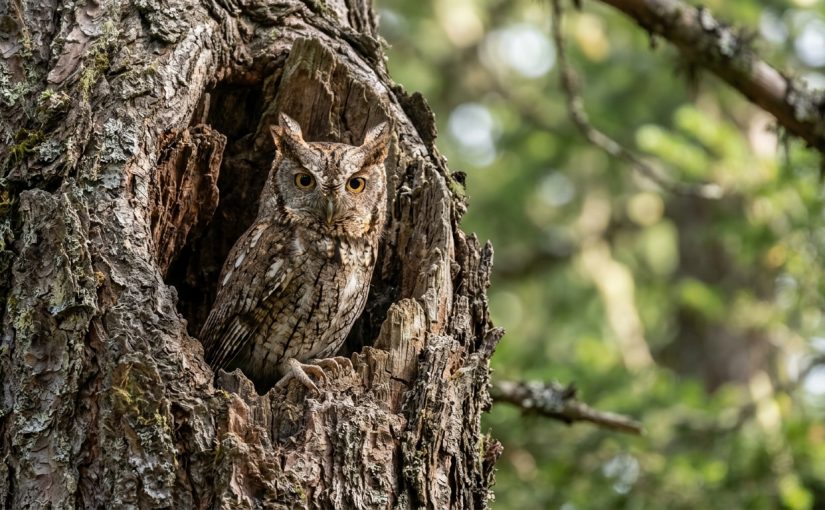
The Western Screech-Owl sits motionless on a branch just feet away, perfectly camouflaged against the bark. Most people walk right past. But once you know what to listen for and where to look, this small predator becomes one of the most rewarding birds to find in western North America.
The Western Screech-Owl is a compact, eared owl found across varied habitats from coastal forests to desert riparian zones. Identifying this species requires listening for its distinctive bouncing ball call, searching appropriate roosting sites during daylight, and understanding seasonal behavior patterns. Success depends on patience, proper timing, and respect for the bird’s sensitivity to disturbance during nesting season.
Identifying the Western Screech-Owl
This owl stands about 8.5 inches tall, roughly the size of a soda can. Two ear tufts rise from its rounded head, though the bird can flatten them completely when alarmed.
Plumage varies dramatically across its range. Coastal populations tend toward grayish brown. Interior birds often show more rufous tones. Desert dwellers are the palest, with sandy gray feathers that match the cottonwood bark they favor.
Yellow eyes peer from a facial disk marked with fine concentric rings. The bill is dark greenish or blackish gray. Heavy streaking and crosshatching cover the breast and belly, creating exceptional camouflage against tree bark.
Size comparison with similar species:
| Species | Length | Ear Tufts | Eye Color | Primary Range |
|---|---|---|---|---|
| Western Screech-Owl | 7.5-10 inches | Prominent | Yellow | Western North America |
| Eastern Screech-Owl | 6.3-9.8 inches | Prominent | Yellow | Eastern North America |
| Whiskered Screech-Owl | 6.5-8 inches | Prominent | Yellow | SE Arizona, SW New Mexico |
| Northern Saw-whet Owl | 7-8.5 inches | None | Yellow | Widespread |
The Western Screech-Owl overlaps with the Whiskered Screech-Owl in southeastern Arizona mountain canyons. Voice provides the most reliable distinction. Westerns give an accelerating series of hollow notes. Whiskereds produce an even-paced Morse code pattern.
Recognizing Calls and Vocalizations
Learning the voice matters more than memorizing field marks. You will hear ten Western Screech-Owls for every one you see.
The primary territorial call sounds like a small rubber ball bouncing to a stop. It starts with slow, evenly spaced hoots that accelerate into a rapid trill. The whole sequence lasts about four seconds.
Males also give a double trill, where two trills run together with barely a pause between them. Females respond with shorter, higher pitched versions of the same calls.
During courtship and nesting, both sexes produce soft barking notes and bill snapping. Nestlings make insistent hissing sounds that can be heard from outside the cavity.
The bouncing ball call is your best search tool. Play a recording softly from a phone or speaker, wait three minutes, then listen. If a territorial male is nearby, he will usually respond within five minutes. Use playback sparingly to avoid stressing birds, especially during nesting season from March through June.
The best listening hours run from full darkness until about midnight, then again in the hour before dawn. Activity peaks on calm nights. Wind masks their calls and reduces hunting success, so owls vocalize less.
Finding Prime Habitat
Western Screech-Owls occupy an impressive range of habitats. You can find them in:
- Mixed oak woodlands
- Riparian corridors with cottonwoods and willows
- Suburban parks with mature trees
- Desert washes with mesquite and ironwood
- Pine-oak forests up to 6,000 feet elevation
- Coastal coniferous forests
The common thread is cavities. These owls need tree holes for roosting and nesting. Woodpecker cavities work perfectly. So do natural decay pockets and nest boxes designed for small owls.
Look for areas with a mix of dense cover and open hunting grounds. The owl hunts along forest edges, in clearings, and around streetlights where insects gather. It roosts in thick foliage during the day.
Water attracts prey. Streams, ponds, and even bird baths increase your chances. The owl takes advantage of any concentration of insects, small mammals, or songbirds.
Locating Roosting Birds
Finding a roosting Western Screech-Owl during daylight takes detective work.
Step-by-step roosting search:
- Listen for alarm calls from songbirds, especially chickadees, titmice, and jays. They mob roosting owls relentlessly.
- Check tree cavities at eye level and higher. The owl often perches just inside the entrance hole, visible as a brown lump.
- Scan thick tangles of ivy, mistletoe clumps, and dense conifer branches. Some individuals roost in foliage rather than cavities.
- Look for whitewash (droppings) and pellets below potential roost sites. Fresh material indicates regular use.
- Return to productive spots repeatedly. Many owls use the same roost trees for weeks or months.
The owl’s camouflage is extraordinary. Your eyes will pass over it multiple times before the shape resolves. Look for the ear tufts, the yellow eye, or the outline of the facial disk.
Some birds become habituated to observers and allow close approach. Others flush immediately. Always keep distance if the bird shows stress by sleeking its feathers, raising its ear tufts, or shifting position.
Understanding Seasonal Behavior
Timing your search to the owl’s annual cycle improves success dramatically.
January through March: Courtship intensifies. Males call frequently to establish territories and attract mates. This is the easiest time to locate birds by voice.
April through June: Nesting season. Adults become quieter but remain tied to nest cavities. Look for adults bringing food to nestlings. Avoid excessive disturbance near active nests.
July through September: Fledglings leave the nest but stay near parents. Young birds give loud begging calls at dusk. Family groups hunt together in late evening.
October through December: Juveniles disperse. Adults reestablish territorial boundaries. Calling increases again as temperatures drop.
Winter offers excellent viewing opportunities. Deciduous trees lose leaves, making roosting owls easier to spot. Cold weather increases hunting activity, so owls move earlier in the evening.
Photography Tips and Ethics
Photographing Western Screech-Owls requires patience and respect.
Natural light works best. Position yourself so the owl is backlit by open sky or sidelit by low sun. Avoid flash, which can temporarily blind the bird and disrupt hunting.
A 400mm lens or longer gives frame-filling images without crowding the subject. Shorter lenses work for environmental portraits showing habitat context.
Common photography mistakes:
| Mistake | Why It Fails | Better Approach |
|---|---|---|
| Using playback to lure birds closer | Stresses territorial birds, especially during nesting | Find roosting birds visually or wait at known hunting perches |
| Approaching too closely | Causes the owl to flush, wasting energy | Use longer lenses and stay at least 15 feet away |
| Extended sessions at roost sites | Prevents the owl from resting properly | Limit visits to 10 minutes, avoid repeat visits on the same day |
| Trimming branches for clear shots | Destroys the owl’s protective cover | Work with the natural setting or choose a different angle |
The bird’s welfare always comes first. If the owl changes behavior because of your presence, you are too close.
Many Western Screech-Owls hunt around streetlights and porch lights. Setting up near these artificial light sources lets you photograph natural hunting behavior without baiting or disturbance.
Distinguishing Western from Eastern Screech-Owls
These two species were considered one until 1983. They look nearly identical but occupy separate ranges.
The Western Screech-Owl lives west of the Great Plains. The Eastern Screech-Owl occupies everything east of the Rockies. A narrow contact zone exists in eastern Colorado and western Texas, where hybrids occasionally occur.
Voice provides instant identification. The Eastern gives a descending whinny and a steady trill. The Western gives the bouncing ball call. If you hear both species’ calls a few times, you will never confuse them.
Plumage offers no reliable distinction in the field. Both species show gray and rufous morphs. Both have yellow eyes and prominent ear tufts.
Range is your best clue. If you are in California, Oregon, Washington, Arizona, or most of the interior West, you are looking at a Western. If you are in the eastern two-thirds of the continent, it is an Eastern.
Nest Box Programs and Citizen Science
Western Screech-Owls readily accept properly designed nest boxes. A box with an entrance hole 3 inches in diameter, placed 12 to 20 feet high in appropriate habitat, can attract nesting pairs.
Position boxes in areas with mature trees, away from heavy human traffic. Face the entrance away from prevailing weather. Add 3 inches of wood chips to the bottom.
Check boxes once in early spring to confirm occupancy, then leave them alone until after the breeding season. Adults may abandon nests if disturbed repeatedly.
Many regional bird observatories and wildlife organizations run nest box programs. Participating helps scientists track population trends and breeding success.
Contributing observations to platforms like eBird creates valuable data for researchers. Recording date, location, behavior, and habitat details helps ornithologists understand how Western Screech-Owl populations respond to habitat change and climate shifts.
Prey and Hunting Strategies
This owl is an opportunistic predator. Its diet includes:
- Insects (beetles, moths, crickets, grasshoppers)
- Small mammals (deer mice, voles, shrews)
- Small birds (sparrows, warblers, hummingbirds)
- Reptiles and amphibians in warmer months
- Earthworms and crayfish near water
Hunting style varies with prey type. The owl catches flying insects in aerial sallies, snatching moths around lights. It pounces on ground prey from low perches. It even wades into shallow water to grab crayfish.
Peak hunting occurs in the first two hours after dark and the hour before dawn. The owl perches motionless on a branch, scanning for movement below. When prey appears, it drops silently and strikes with extended talons.
Watching hunting behavior requires night vision equipment or luck. Position yourself near a productive hunting area at dusk and wait. The owl may use the same perches repeatedly, making it possible to anticipate its movements.
Range and Regional Variations
The Western Screech-Owl ranges from southeastern Alaska south through British Columbia, Washington, Oregon, California, and inland through Idaho, Montana, Wyoming, Colorado, Utah, Nevada, Arizona, New Mexico, and into Mexico.
Subspecies vary in size and color. Pacific Northwest birds are darker and more heavily marked. Desert populations are paler. Mountain populations tend toward gray tones.
These regional differences reflect adaptation to local conditions. Pale plumage matches light-colored bark in desert habitats. Dark plumage provides better camouflage in dense, shadowy forests.
Understanding these variations helps with identification in areas where subspecies overlap. A pale bird in coastal Washington would be unusual. The same pale bird in southern Arizona fits perfectly.
Observing Without Disturbing
Responsible observation protects both the bird and future viewing opportunities.
Never use playback near known nest sites during breeding season. The adults are already stressed by the demands of raising young. Adding territorial pressure can cause nest abandonment.
Keep visits short. Ten to fifteen minutes gives you time to observe behavior and take photos without causing chronic stress.
Share locations carefully. Posting exact coordinates on social media can lead to overcrowding and harassment. Share general areas instead, and emphasize ethical viewing practices.
Respect private property. Many productive owl habitats lie on private land. Always get permission before entering.
If you find a nest, observe from a distance that does not change the adults’ behavior. If they stop bringing food, start alarm calling, or flush from the cavity, you are too close.
What Makes This Owl Worth Finding
The Western Screech-Owl offers something rare in modern life: a genuine wild encounter close to home. These birds live in city parks, suburban neighborhoods, and wild forests alike.
Learning to find them sharpens your observation skills. You start noticing cavity trees, listening for subtle sounds, reading habitat differently. The skills transfer to finding other species.
Each encounter is different. One night you hear the bouncing ball call echoing through a canyon. Another evening you watch a family group hunting under streetlights. A winter morning reveals a bird roosting in plain sight, trusting its camouflage completely.
The challenge is real but achievable. You do not need exotic travel or expensive equipment. You need patience, attention, and respect for the bird’s needs. Start listening after dark. Check cavity trees. Learn the call. The owl is out there, closer than you think.