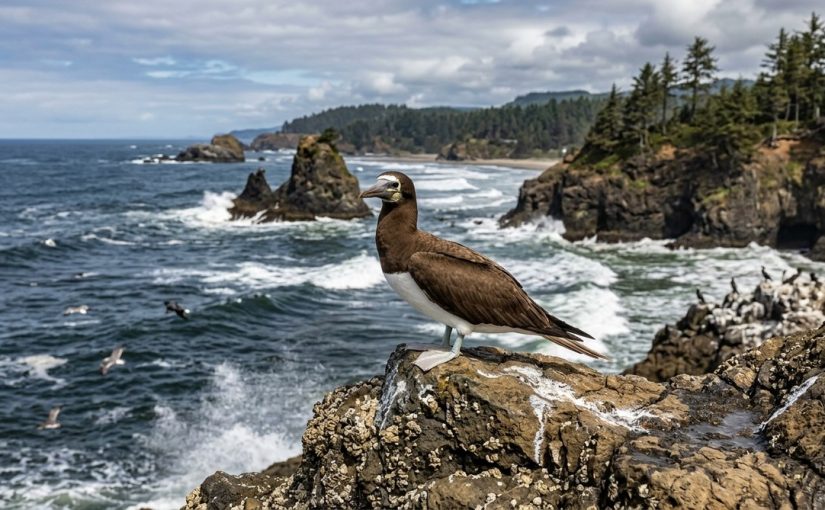
A seabird built for tropical islands, with a spear-like bill and plumage that looks painted by a minimalist, showed up on a rocky outcrop off the Oregon coast. For West Coast birders, the brown booby Oregon sighting was not just a rare tick on a life list. It was a signal that the old rules of where birds belong are shifting.
A brown booby sighting in Oregon in 2026 marks one of the northernmost records for this tropical seabird on the West Coast. The event signals warmer ocean temperatures and shifting prey availability, pushing species outside their normal ranges. For birders, it underscores the importance of documenting vagrants and staying alert for more tropical visitors in Pacific Northwest waters.
A Seabird That Belongs in the Tropics
The brown booby (Sula leucogaster) is a large, heavy-bodied seabird that spends most of its life over warm, open ocean. Its normal range stretches from the Gulf of California down to the coasts of Central and South America, and across to the Caribbean. These birds nest on rocky islands and remote atolls, rarely venturing far from the equatorial zone.
So when a brown booby turned up near Bandon, Oregon, in late summer 2026, the birding community took notice. Oregon has only a handful of accepted brown booby records. Most of them come from the past decade. Each sighting raises the same questions: Why now? And will we see more?
How to Identify a Brown Booby in the Field
If you are scanning the offshore rocks at places like Cape Blanco or Yaquina Head, you need to know what to look for. The brown booby has a distinctive shape that sets it apart from cormorants and gulls.
- Size and shape: Large for a booby, with a wingspan around 55 inches. The body is streamlined, the tail is long and pointed.
- Plumage: Adults have a stark white belly and chest, with a dark brown head, neck, and upper back. The contrast is sharp and obvious.
- Bill and face: The bill is pale yellow or grayish, long, and pointed. The facial skin around the bill is blue-gray in adults.
- Juveniles: Young birds are mostly brown with a pale belly and a mottled appearance. They lack the crisp white chest of adults.
- Flight style: Strong, direct wingbeats. They often fly low over the water, gliding between flaps.
Look for a bird that seems out of place among the local murres and cormorants. The brown booby stands out like a tropical guest at a coastal potluck.
Why Did a Brown Booby Appear in Oregon?
The brown booby Oregon sighting is not a random accident. It fits a pattern that ornithologists have been tracking for years. Several factors likely contributed to this bird’s appearance:
- Warm ocean temperatures: The Pacific Ocean off the West Coast has experienced repeated marine heatwaves. Warm water pushes tropical fish and squid northward. The brown booby follows its food.
- El Nino influence: Strong El Nino years can displace seabirds hundreds of miles from their normal range. The 2025-2026 El Nino cycle may have played a role in pushing this bird north.
- Changing prey distribution: Brown boobies feed on flying fish, mackerel, and squid. When these prey species shift north, the boobies follow.
- Juvenile dispersal: Young boobies often wander widely. A juvenile bird may overshoot its normal range during its first year of exploration.
“We are seeing a clear trend of tropical seabirds appearing farther north than ever before,” says Dr. Maria Lopez, a seabird ecologist at the University of Washington. “The brown booby Oregon sighting is not an anomaly. It is part of a larger shift driven by ocean warming.”
What This Sighting Means for West Coast Birders
The implications of this sighting go beyond a single lifer. For birders who track range shifts and vagrant patterns, the brown booby Oregon sighting offers several takeaways.
| What it signals | What birders should do |
|---|---|
| Tropical species are expanding northward | Watch for other tropical visitors like blue-footed boobies and red-billed tropicbirds |
| Marine heatwaves are impacting seabird distribution | Monitor sea surface temperature data to predict future sightings |
| Oregon is becoming a hotspot for rare seabirds | Focus on headlands and offshore rocks during late summer and fall |
| Citizen science records are essential | Report every sighting to eBird and state rare bird committees |
How to Document Your Own Rare Bird Sighting
If you are lucky enough to spot a brown booby or another rare seabird, follow these steps to make your sighting count. Proper documentation helps ornithologists track range shifts and confirm records.
- Take photos and video: Capture multiple angles. Focus on the bill, the underparts, and the flight pattern. Even poor photos are better than none.
- Write detailed field notes: Record the date, time, location, weather conditions, and the bird’s behavior. Note any identifying marks you see.
- Compare with similar species: Check against cormorants, gannets, and other booby species. Make sure you rule out look-alikes.
- Submit to eBird: Enter your sighting with photos and notes. This creates a permanent, verifiable record.
- Notify your state rare bird committee: Each state has a committee that reviews unusual sightings. Follow their submission guidelines.
- Share with the community: Post on local birding listservs or social media groups. Other birders can help confirm the ID.
For a deeper guide on this process, check out our article on how to document and report your rare bird sighting like a pro.
Other Tropical Seabirds to Watch For
The brown booby is not the only tropical visitor making headlines on the West Coast. In 2026, birders have reported several other species that suggest a broader pattern of range expansion.
- Blue-footed booby: These charismatic birds have been spotted as far north as Puget Sound. Their bright blue feet make them easy to identify.
- Red-billed tropicbird: A stunning white seabird with a long red tail streamer. Sightings have increased off California and Oregon.
- Magnificent frigatebird: This large, fork-tailed seabird has appeared at inland lakes and coastal areas across the West.
- Brown pelican: While more common than boobies, brown pelicans have been pushing northward into Oregon and Washington in greater numbers.
If you want to stay ahead of the next big rarity, read our guide on 5 unexpected vagrant species that showed up in California this year.
Understanding Vagrancy in Seabirds
Vagrancy is the term ornithologists use when a bird shows up far outside its normal range. For seabirds, vagrancy is often driven by weather and ocean conditions. But not all vagrants are the same.
- Storm-driven vagrants: Birds blown off course by hurricanes or strong storms. These are often single events.
- Food-driven vagrants: Birds that follow prey into new areas. These can last for weeks or months.
- Dispersal vagrants: Young birds exploring new territory. These are most common in late summer and fall.
- Climate-driven vagrants: Birds that shift their range in response to long-term warming. These are the most significant for understanding future patterns.
The brown booby Oregon sighting likely falls into the food-driven and climate-driven categories. That makes it more than a one-off event. It could be a preview of what West Coast birders can expect in the coming years.
Key Locations for Rare Seabird Watching in Oregon
If you want to increase your chances of spotting a brown booby or other rare seabird, focus on these prime locations. Each offers good vantage points and consistent seabird activity.
- Cape Blanco: The westernmost point in Oregon. Strong upwelling brings nutrients and fish close to shore.
- Yaquina Head Outstanding Natural Area: A rocky headland with excellent views of offshore rocks. Seabirds often rest on the rocks.
- Bandon State Natural Area: Where the 2026 brown booby was seen. The offshore islands attract loafing seabirds.
- Cascade Head: A lesser-known spot with great views of the ocean. Fewer crowds mean more time scanning.
- Tillamook Head: High cliffs offer a wide view of the ocean. Good for spotting pelagic species from land.
For more location tips, see our roundup of 7 underrated mountain birding spots in the Pacific Northwest.
How to Prepare for Future Vagrant Seasons
The brown booby Oregon sighting should serve as a wake-up call. Rare birds are appearing more often, and birders need to be ready. Here is a practical checklist to prepare for the next big rarity.
- Keep your camera charged and in your car.
- Learn the field marks of tropical seabirds before you go out.
- Follow rare bird alerts on apps like eBird and rare bird WhatsApp groups.
- Join your local birding listserv to hear about sightings in real time.
- Practice identifying boobies, tropicbirds, and frigatebirds using online photo quizzes.
For a full rundown of the best tools, read our guide on rare bird alerts: which apps and resources actually work best.
What This Means for the Future of West Coast Birding
The brown booby Oregon sighting is a small piece of a much larger puzzle. As ocean temperatures continue to warm, the birds that define the West Coast will change. Species that were once rare will become regular. Species that were common may fade.
For birders, this is both exciting and sobering. Every vagrant sighting is a chance to learn something new about how birds respond to a changing world. The brown booby that perched on a rock near Bandon was not lost. It was following its food, its instincts, and a planet that is shifting beneath its wings.
So keep your binoculars handy. Keep your camera ready. And keep watching the water. The next tropical visitor might be just over the horizon.
If you want to understand more about what makes a bird rare in the first place, take a look at our article on what makes a bird rare in western North America. It will give you the context you need to appreciate every unexpected sighting even more.