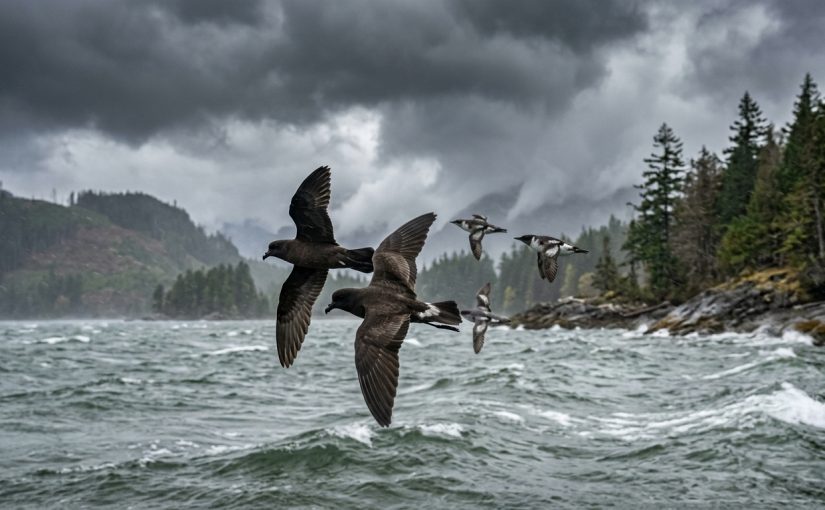
A storm rolls through overnight, and by morning your local reservoir hosts visitors that belong hundreds of miles out at sea. Ancient Murrelets bob on freshwater ponds. Storm-Petrels flutter over cornfields. Fork-tailed Storm-Petrels rest on suburban lawns, exhausted and disoriented.
These aren’t lost stragglers. They’re storm-driven seabirds, forced inland by powerful weather systems that override their navigation and stamina.
Seabirds blown inland by storms arrive during or immediately after severe weather events, particularly hurricanes, nor’easters, and Pacific storm systems. These pelagic species appear at inland lakes, reservoirs, and agricultural fields, often exhausted and vulnerable. Birders can predict sightings by monitoring low-pressure systems, offshore wind patterns, and post-storm conditions. Most birds recover and return to the ocean within days if they survive the initial displacement.
Why storms push seabirds hundreds of miles from the ocean
Pelagic seabirds spend most of their lives over open water. They feed, sleep, and migrate entirely at sea, only coming to land for breeding.
Their bodies are built for ocean conditions. Long wings carry them efficiently over waves. Specialized salt glands filter seawater. Their entire physiology assumes constant access to marine food sources.
Severe storms disrupt this system completely.
Low-pressure systems generate powerful winds that can exceed 100 mph in extreme cases. Seabirds caught in these conditions face an impossible choice: fight the wind and exhaust themselves, or ride the current and end up far from their natural habitat.
Most choose survival over location. They conserve energy by allowing the wind to carry them, even when that means traveling inland.
The strongest displacement events occur when storm tracks move perpendicular to the coastline. A hurricane moving west to east across the Gulf Coast, for example, can deposit thousands of seabirds across inland states within 24 hours.
Timing matters too. Fall migration periods coincide with peak hurricane season in the Atlantic and Pacific storm activity along the West Coast. Young, inexperienced birds are especially vulnerable during their first migration.
Species most commonly found after major weather events
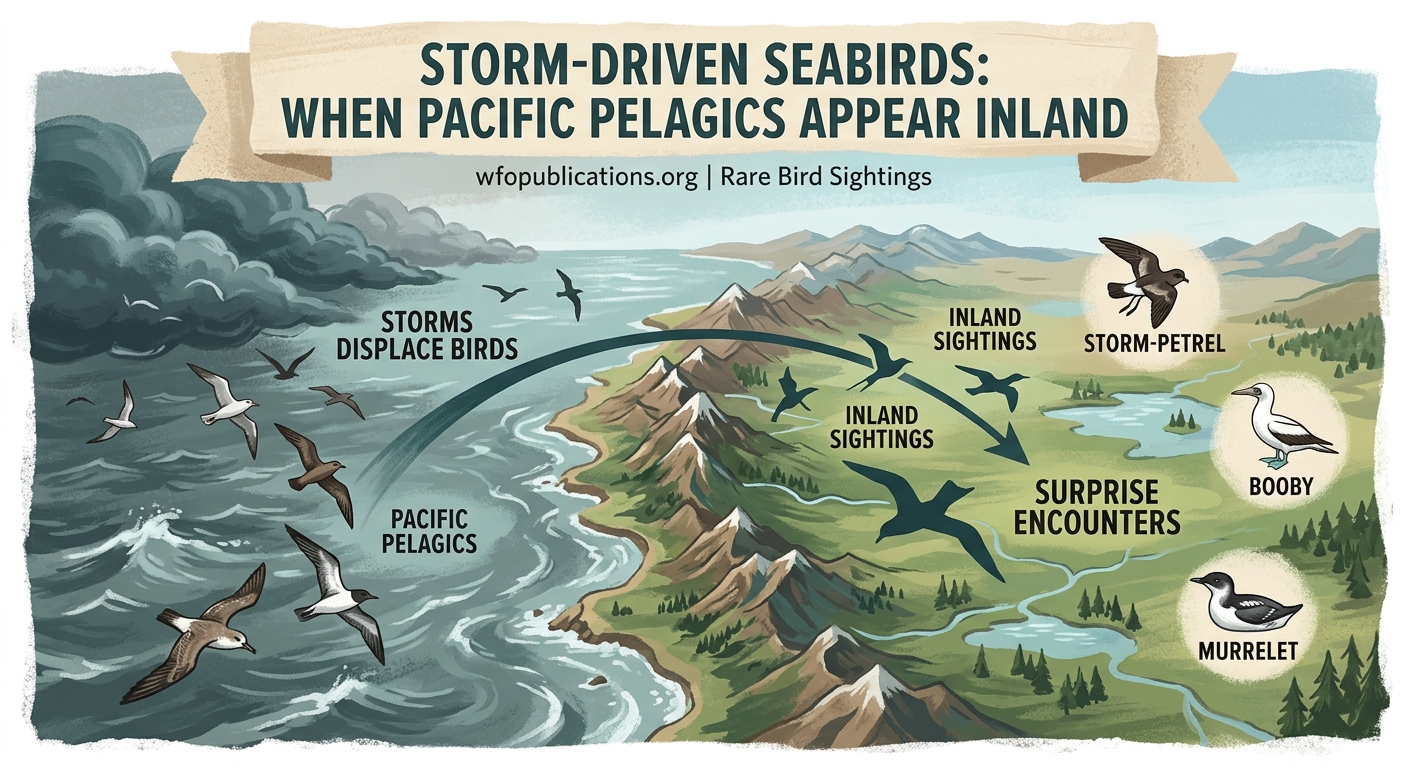
Not all seabirds appear inland with equal frequency. Certain species show up repeatedly in displacement records.
Atlantic and Gulf Coast species:
- Sooty Terns
- Bridled Terns
- Black Terns
- Leach’s Storm-Petrels
- Band-rumped Storm-Petrels
- Pomarine Jaegers
- Long-tailed Jaegers
- Red Phalaropes
- Red-necked Phalaropes
Pacific Coast species:
- Fork-tailed Storm-Petrels
- Ashy Storm-Petrels
- Ancient Murrelets
- Cassin’s Auklets
- Rhinoceros Auklets
- Black-legged Kittiwakes
- Sabine’s Gulls
These species share common traits. Most are small-bodied with limited fat reserves. They depend on constant feeding to maintain energy. When displaced to freshwater environments without their usual prey, they deteriorate fast.
Larger seabirds like albatrosses and shearwaters also get displaced, but their size and stamina often allow them to navigate back to the coast more successfully.
Reading weather patterns to predict inland appearances
Experienced birders monitor specific meteorological conditions to anticipate seabird arrivals.
1. Track low-pressure systems moving onshore
Check marine forecasts and satellite imagery for storms approaching the coast. Systems with sustained winds above 40 mph have the highest displacement potential.
Pay attention to the storm’s forward speed. Slower-moving systems give seabirds more time to escape. Fast-moving storms trap birds in their wind fields.
2. Note wind direction during peak intensity
Onshore winds (blowing from sea to land) are essential for inland displacement. The longer these conditions persist, the farther inland birds will travel.
Winds shifting to offshore directions after the storm passes can help grounded seabirds return to the coast.
3. Plan field visits for 24 to 72 hours post-storm
The window for finding storm-driven seabirds is narrow. Most birds either perish, recover and leave, or get picked off by predators within three days.
Dawn visits are most productive. Exhausted birds often rest overnight and become active at first light as they search for food or attempt to orient themselves.
Where to look for displaced pelagic visitors
Storm-driven seabirds don’t distribute randomly across the landscape. They concentrate in specific habitat types.
Large reservoirs and lakes attract the highest numbers. These bodies of water provide visual cues similar to the ocean. Birds often land thinking they’ve reached a safe resting area.
Agricultural fields, especially those recently irrigated or flooded, also draw seabirds. The reflective water surface mimics ocean conditions from altitude.
Sewage treatment ponds concentrate displaced birds because they attract insects and small fish, offering at least some food options.
Urban areas see occasional visitors too. Storm-Petrels sometimes crash into lit buildings during nocturnal displacement events. Check parking lots and rooftops the morning after severe weather.
| Habitat Type | Target Species | Best Timing |
|---|---|---|
| Large reservoirs | Auklets, murrelets, kittiwakes | Dawn, first 48 hours |
| Agricultural ponds | Phalaropes, terns, jaegers | Midday when birds are active |
| Sewage lagoons | Storm-petrels, small alcids | Any time, check multiple days |
| Coastal plains | All species, especially exhausted birds | Immediately after storm passes |
| Urban areas | Nocturnal species (petrels) | Early morning building checks |
How to identify exhausted seabirds safely
Grounded seabirds often appear disoriented and lethargic. This creates identification challenges and ethical considerations.
Approach slowly and quietly. Stressed birds waste precious energy fleeing. If a bird allows close approach, it’s likely in poor condition.
Take photographs from a respectful distance rather than handling the bird. Most species have specialized care requirements beyond general wildlife rehabilitation.
Look for diagnostic field marks:
Storm-petrels show distinctive flight patterns even when grounded. They have tube-nosed bills and dark plumage with white rumps in most species.
Auklets and murrelets have chunky bodies, short wings, and often retain breeding plumage features into fall.
Jaegers display pointed central tail feathers (in adults) and aggressive behavior even when weakened.
Phalaropes spin in tight circles on water surfaces, a feeding behavior that persists even in freshwater.
“The most important thing birders can do when finding storm-displaced seabirds is document the sighting with photos and location data, then contact local wildlife authorities. These birds need specialized care, not well-meaning but uninformed intervention.” — Dr. Sarah Chen, Seabird Biologist
Supporting recovery and reporting your observations
Finding a grounded seabird creates a responsibility to help if possible.
Contact licensed wildlife rehabilitators immediately. Most seabirds require tube-feeding with specialized formulas. They need marine-based diets that general rehabbers may not stock.
Don’t attempt to feed the bird yourself. Freshwater fish, bread, and other common offerings can cause more harm than good.
If the bird appears strong enough to fly but seems disoriented, simply giving it space may be the best option. Many displaced seabirds recover naturally once winds calm.
Report all sightings to regional rare bird alert systems and eBird. These records contribute to scientific understanding of displacement patterns and help other birders locate unusual species.
Include detailed information:
- Exact location with GPS coordinates
- Date and time of observation
- Weather conditions during and preceding the sighting
- Bird behavior and apparent condition
- Habitat type where found
- Number of individuals if more than one
This data helps ornithologists track displacement events, identify particularly vulnerable migration routes, and understand how climate change may be affecting storm frequency and intensity.
Understanding survival rates and long-term impacts
Most seabirds blown inland by storms don’t survive.
Small species with high metabolic rates can only survive 24 to 48 hours without food. Freshwater environments offer few suitable prey items for birds adapted to catching fish, squid, and marine invertebrates.
Predation takes a heavy toll. Grounded seabirds become easy targets for cats, dogs, hawks, and owls. Their ocean-adapted camouflage offers no protection in terrestrial environments.
Collisions with vehicles, buildings, and power lines kill additional birds as they attempt to navigate unfamiliar landscapes.
Those that do survive long enough to return to the coast face another challenge: finding their way back. Pelagic species navigate using ocean cues that don’t exist inland. They may wander for days before locating the coast.
Younger birds show lower survival rates than adults. First-year migrants lack the experience to recognize dangerous conditions or find alternative routes around storms.
Climate change appears to be increasing displacement frequency. Stronger hurricanes, more intense Pacific storms, and shifting migration timing all contribute to higher numbers of storm-driven seabirds appearing inland.
Distinguishing true displacement from vagrant patterns
Not every unusual seabird sighting represents storm displacement.
Some pelagic species naturally wander during post-breeding dispersal. Young birds especially may appear far from typical range without any storm involvement.
True displacement events share specific characteristics:
The timing coincides directly with severe weather. Birds appear during or within 48 hours of storm passage.
Multiple individuals of the same species show up simultaneously. A single lost bird might be a vagrant. Dozens appearing overnight indicates displacement.
The species involved are strictly pelagic. Birds that regularly visit coastal bays and estuaries are less likely to represent true displacement.
Body condition appears poor. Storm-driven birds often show signs of exhaustion, weight loss, and stress.
Geographic patterns make sense. Atlantic species appear after Gulf or East Coast storms. Pacific species follow West Coast weather events.
Vagrant birds, by contrast, may appear during calm weather, show good body condition, and represent species with known wandering tendencies.
Preparing for the next major displacement event
Smart birders prepare before storms arrive.
Identify potential hotspots in your area now. Scout large bodies of water, agricultural regions with irrigation ponds, and sewage treatment facilities.
Build relationships with property managers. Getting permission to access private ponds during the narrow post-storm window is much easier when you’ve made contact beforehand.
Assemble a storm-birding kit:
- Spotting scope for distant identification
- Camera with telephoto capability
- GPS device or smartphone for precise location data
- Field guides covering pelagic species
- Contact information for local wildlife rehabilitators
- Waterproof notebook for field notes
- Waders if you plan to check shallow ponds
Monitor weather forecasts during migration seasons. Set up alerts for severe weather in your region.
Join local birding groups and rare bird alert networks. Coordination helps cover more ground during the brief window when displaced birds are present.
When rare becomes regular
Storm-driven seabirds offer birders a chance to observe species that would otherwise require expensive pelagic trips to see.
But these sightings come at a cost. Each grounded bird represents an individual fighting for survival far from its natural habitat.
The thrill of finding a rare species should be balanced with concern for its welfare. Document thoroughly, report accurately, and intervene appropriately when birds need help.
As storm patterns shift and intensify, inland seabird sightings may become more frequent. Understanding the mechanisms behind these events helps us appreciate both the remarkable adaptability of seabirds and the serious challenges they face in a changing climate.
Next time severe weather approaches your area, consider checking local water bodies once conditions calm. You might find yourself face to face with a bird that belongs to the open ocean, temporarily grounded but still carrying the wildness of the pelagic realm.