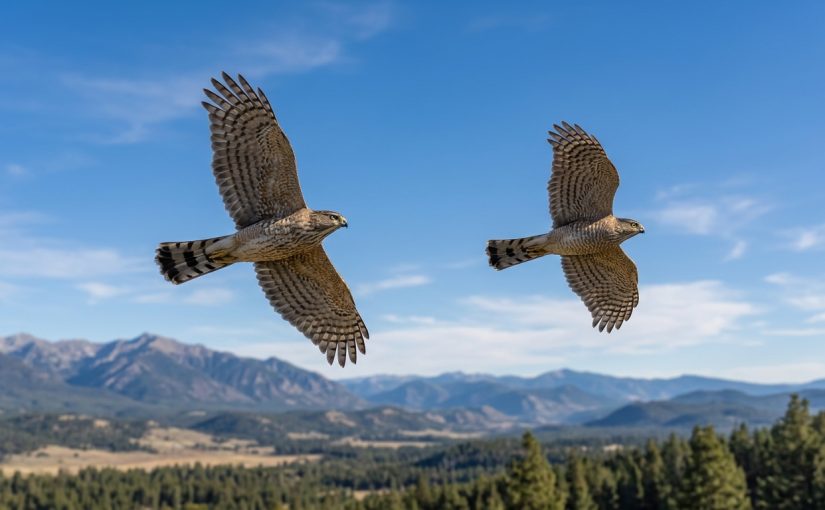
Two streaks of gray and rust blur past your backyard feeder. A panicked scatter of songbirds. Then silence. You just witnessed an accipiter hunt, but which species? Cooper’s hawks and sharp-shinned hawks look remarkably similar, and even experienced birders pause before making the call. These forest raptors share the same body plan, hunting strategy, and habitat preferences. Yet with practice and the right field marks, you can tell them apart.
Cooper’s hawks and sharp-shinned hawks are woodland raptors that hunt songbirds near feeders. Size is the most reliable field mark: Cooper’s hawks match crow size while sharp-shinned hawks are jay-sized. Head shape, tail shape, and flight style provide additional clues. Females of both species are significantly larger than males, creating overlap that complicates identification. Practice with multiple field marks together improves accuracy.
Understanding the Accipiter Family
Both species belong to the accipiter genus, a group of bird-hunting hawks built for speed and maneuverability in dense cover. Short, rounded wings and long tails let them navigate forest understory at high speed. They share similar plumage: blue-gray backs, rusty barring on the chest, and dark vertical streaking in juveniles.
This body plan evolved for ambush hunting. Accipiters perch quietly, then explode into short, intense chases through branches and around corners. They rely on surprise rather than sustained pursuit. Both species patrol suburban neighborhoods during migration and winter, targeting backyard feeders where prey concentrates.
The challenge for birders is that these hawks exist on a size continuum. Male sharp-shinned hawks are the smallest, barely larger than a robin. Female Cooper’s hawks are the largest, approaching the size of a red-tailed hawk. The middle ground creates confusion, especially when you see a lone bird without size context.
Size Differences That Actually Help
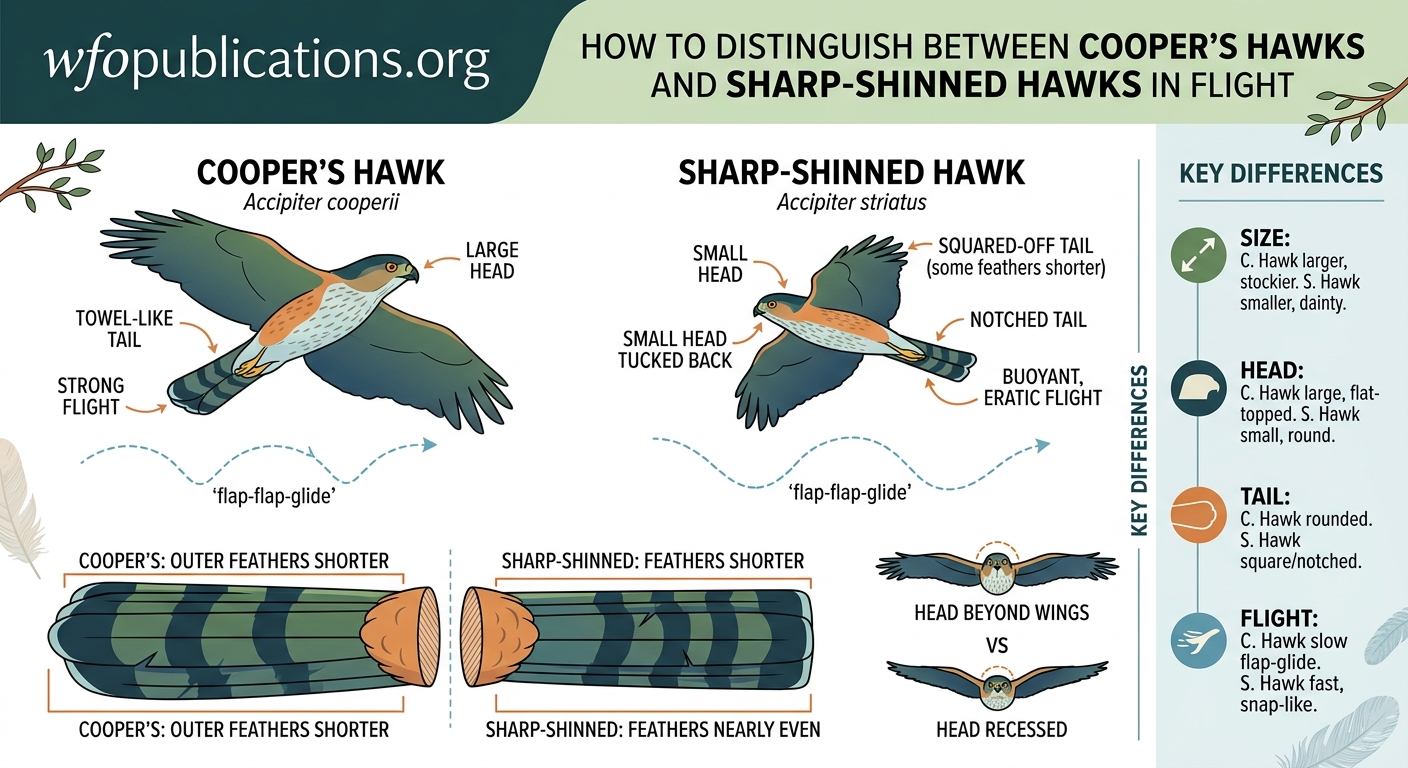
Size is your most reliable field mark, but only when you have reference points. A Cooper’s hawk stands roughly crow-sized. A sharp-shinned hawk matches a blue jay. That sounds simple until you see a bird alone in a tree 100 feet away.
Look for these size-based clues:
- Head projection: Cooper’s hawks have noticeably larger heads that project well beyond the wings when perched. Sharp-shinned hawks show smaller heads that barely extend past the leading edge of the wing.
- Body bulk: Cooper’s hawks appear barrel-chested with substantial body mass. Sharp-shinned hawks look compact and lightweight, almost delicate.
- Leg thickness: Cooper’s hawks have visibly thicker legs, like pencils. Sharp-shinned hawks have matchstick-thin legs that look almost too fragile for a raptor.
Female accipiters are roughly one-third larger than males, a size difference called reverse sexual dimorphism. This means a large female sharp-shinned hawk overlaps with a small male Cooper’s hawk. When you encounter a mid-sized accipiter, you need additional field marks beyond size alone.
Tail Shape and Pattern
The tail provides one of the most cited field marks, though it requires good views and proper lighting. Both species have banded tails, but the shape differs.
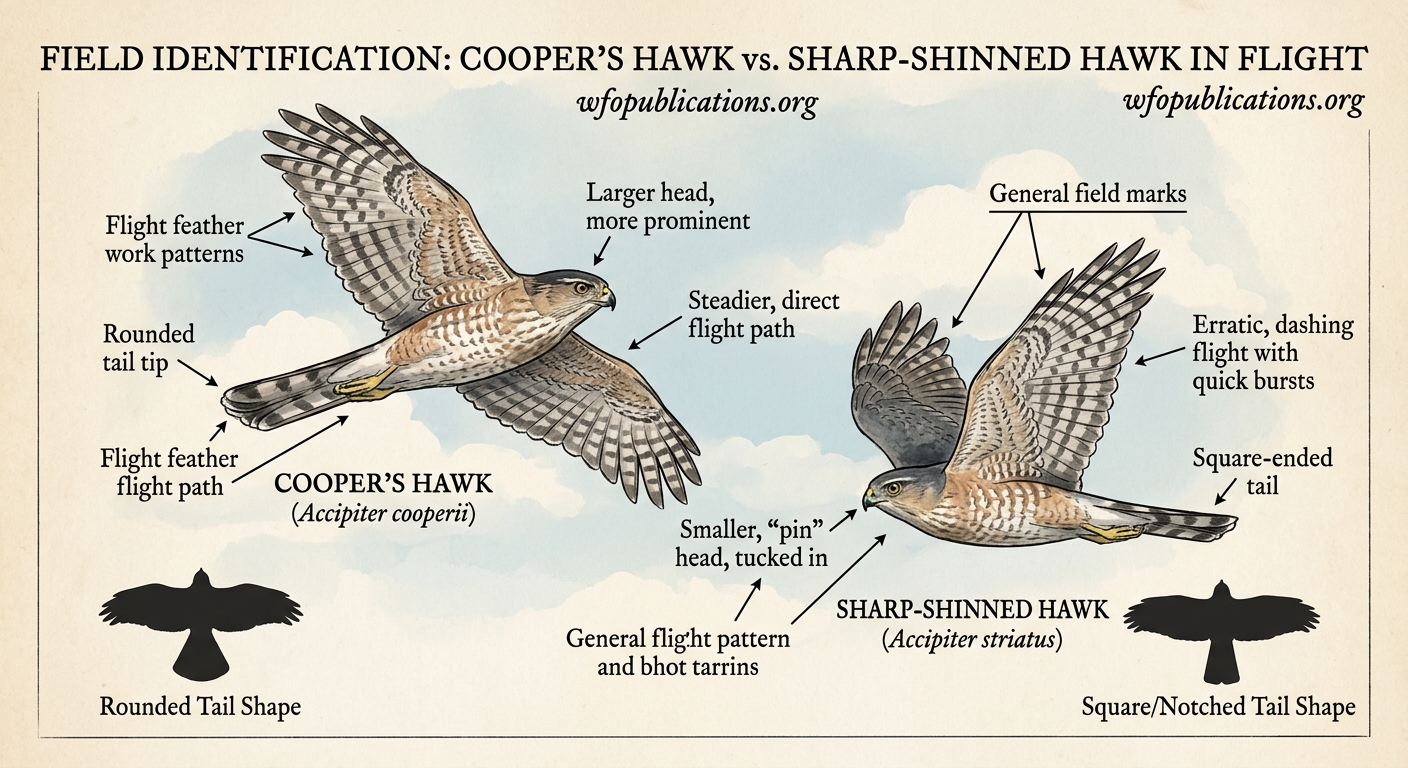
A Cooper’s hawk tail is rounded with a broad white terminal band. The outer tail feathers are noticeably shorter than the central feathers, creating a fan shape when the tail is spread. When the tail is folded, it appears rounded at the tip.
A sharp-shinned hawk tail looks square or slightly notched when spread. The outer tail feathers are roughly the same length as the central feathers. The white terminal band is narrower than on Cooper’s hawks. When folded, the tail appears straight across or slightly indented at the tip.
These differences are most visible when the bird is soaring or gliding with the tail fanned. Perched birds often hold their tails folded, making shape assessment difficult. Molting can also complicate tail shape, as missing feathers temporarily alter the silhouette.
Head and Neck Proportions
Head shape separates these species more reliably than tail shape, especially on perched birds with good views.
Cooper’s hawks have large, blocky heads with a flat crown. The head appears angular, almost helmet-like. The nape often shows a darker cap that contrasts with the back. The neck is thick and well-defined, giving the bird a powerful appearance.
Sharp-shinned hawks have small, rounded heads with a steep forehead. The head appears domed or bullet-shaped. The nape color blends smoothly with the back without strong contrast. The neck is short and thin, making the head appear to sit directly on the shoulders.
“When I’m teaching new birders, I tell them to look at the head first. A Cooper’s hawk looks like it could break your finger. A sharp-shinned hawk looks like it would bounce off your windshield.” — Field ornithologist with 30 years of raptor banding experience
This head proportion difference holds true across age and sex classes. Even juvenile birds show the same relative head size, making it one of the most consistent field marks.
Flight Style and Behavior
Watching these hawks fly reveals behavioral differences that complement physical field marks. Both species use a flap-flap-glide pattern typical of accipiters, but the execution differs.
Cooper’s hawks fly with steady, powerful wingbeats. The glides are longer and the flight path appears more direct. When soaring, they hold their wings in a slight dihedral (upward angle) and often flare the tail. They appear confident and purposeful in flight.
Sharp-shinned hawks fly with snappier, more frantic wingbeats. The glides are shorter and the flight path appears more erratic, with frequent direction changes. When soaring, they hold their wings flat or pushed slightly forward. They appear nervous and twitchy in flight.
These behavioral differences become more apparent when you watch multiple individuals. Cooper’s hawks often soar higher and migrate in more open conditions. Sharp-shinned hawks stay lower and hug the treeline, especially during migration.
Plumage Details Across Age Classes
Adult plumage is similar between species, but subtle differences exist. Adult Cooper’s hawks show a darker cap that contrasts strongly with the nape. The rusty barring on the chest is thicker and extends farther down the belly. The eye is deep red or orange-red.
Adult sharp-shinned hawks show less cap contrast, with the crown color blending into the nape. The rusty barring is finer and often fades on the lower belly. The eye is red but often appears lighter or more yellowish than Cooper’s hawk eyes.
Juvenile birds of both species show brown backs and heavy brown streaking on white underparts. Juvenile Cooper’s hawks show neater, more defined streaking that ends in small spots. The head pattern shows more contrast. Juvenile sharp-shinned hawks show messier, more diffuse streaking that blurs together. The head pattern shows less contrast.
Practical Identification Steps
When you encounter an accipiter in the field, work through these steps systematically:
-
Assess size context: Compare the bird to nearby objects, other birds, or vegetation. Crow-sized suggests Cooper’s hawk. Jay-sized suggests sharp-shinned hawk.
-
Examine the head: Look at head size relative to body, head shape (blocky vs. rounded), and neck thickness. Large blocky head with thick neck suggests Cooper’s hawk.
-
Check the tail: If the bird spreads its tail, note the shape (rounded vs. square) and the width of the white terminal band. Rounded tail with broad white band suggests Cooper’s hawk.
-
Watch the flight: Note wingbeat cadence, glide length, and overall flight impression. Steady powerful flight suggests Cooper’s hawk. Snappy erratic flight suggests sharp-shinned hawk.
-
Consider the context: Time of year, habitat, and behavior provide supporting evidence. Cooper’s hawks are more common in suburban areas year-round. Sharp-shinned hawks are more common during migration and winter.
Common Identification Mistakes
Even experienced birders make errors with these species. Understanding common mistakes helps you avoid them.
| Mistake | Why It Happens | How to Avoid It |
|---|---|---|
| Relying on tail shape alone | Molting, lighting, and posture affect tail appearance | Use multiple field marks together |
| Ignoring size overlap | Female sharp-shinned hawks overlap with male Cooper’s hawks | Focus on proportions rather than absolute size |
| Making snap judgments | Brief views don’t provide enough information | Accept uncertain identifications and keep practicing |
| Trusting single photos | Angles and compression distort proportions | Use video or multiple photos from different angles |
| Overlooking juveniles | Young birds show less obvious field marks | Study juvenile plumage patterns separately |
The biggest mistake is forcing an identification when the bird doesn’t provide enough information. Some individuals, especially mid-sized birds in poor light or at great distance, cannot be identified with certainty. Accepting uncertainty is part of responsible field identification.
Seasonal Patterns and Range
Both species breed across North America, but their ranges and seasonal movements differ slightly. Cooper’s hawks breed throughout the United States and southern Canada. Many populations are non-migratory or short-distance migrants. They commonly winter in suburban areas, especially where bird feeders concentrate prey.
Sharp-shinned hawks breed primarily in Canada and the northern United States, with some populations in western mountains and Appalachia. They are strongly migratory, with most individuals moving south for winter. They pass through in large numbers during fall migration, especially along mountain ridges and coastlines.
During migration season, especially September through November, sharp-shinned hawks outnumber Cooper’s hawks at most hawk watch sites. During winter in southern states, Cooper’s hawks are more common at feeders and in neighborhoods. During breeding season in northern forests, both species occur but often in different microhabitats.
Vocalizations and Calls
Both species vocalize, especially during breeding season and when alarmed. The calls sound similar but differ in pitch and cadence.
Cooper’s hawks give a loud, harsh “cak-cak-cak-cak” call. The notes are evenly spaced and relatively slow, about two notes per second. The call sounds forceful and carries well through the forest.
Sharp-shinned hawks give a higher-pitched “kik-kik-kik-kik” call. The notes are faster and more compressed, about three notes per second. The call sounds thinner and less forceful than Cooper’s hawk calls.
These vocal differences are most useful during breeding season when birds are territorial and vocal. During migration and winter, both species are largely silent except when alarmed or competing for food.
Building Your Identification Skills
Improving at accipiter identification requires deliberate practice. These hawks are challenging, and progress comes gradually.
Start by studying photos and videos of known individuals. Focus on one field mark at a time until you can visualize it clearly. Then combine multiple field marks into an overall impression.
Visit hawk watch sites during fall migration. Experienced counters can help you learn field marks on flying birds. The high volume of birds during migration provides repeated practice opportunities.
Photograph or video accipiters when possible. Review the footage at home, comparing your field identification to what the images reveal. This feedback loop accelerates learning.
Keep notes on uncertain birds. Sketch what you saw, note which field marks you checked, and record what prevented a confident identification. This process reveals patterns in your identification challenges.
Join online birding communities where experts review photos and provide feedback. Seeing how experienced birders analyze difficult individuals teaches you what to look for.
When to Call for Help
Some accipiters defy confident identification even for experts. Distant birds, brief views, poor lighting, molting individuals, and mid-sized birds without context all create legitimate identification challenges.
Photography helps when you’re uncertain. A clear photo lets multiple observers review the bird and discuss field marks. Even if the photo doesn’t resolve the identification, it provides a learning opportunity.
Regional bird identification groups on social media welcome identification requests. Provide context about location, date, habitat, and behavior along with your photos. Explain which field marks you noted and why you’re uncertain.
Accept that some birds will remain unidentified. “Accipiter species” is a legitimate field note when you can’t determine which species you saw. This honesty is more valuable than forced identifications based on inadequate views.
Watching Accipiters Hunt
Understanding hunting behavior helps with identification and provides context for field marks. Both species hunt similarly but show subtle differences.
Cooper’s hawks often hunt from perches, watching for prey before launching surprise attacks. They pursue prey through dense cover, using their long tails as rudders for tight turns. They commonly hunt medium-sized birds like doves, jays, and robins.
Sharp-shinned hawks hunt more actively, moving frequently between perches and making speculative attacks. They pursue smaller prey like sparrows, warblers, and finches. They seem more willing to chase prey into extremely dense cover.
Both species visit bird feeders regularly, not for seed but for the birds the seed attracts. A sudden explosion of songbirds from a feeder often signals an accipiter attack. The hawk may perch nearby, waiting for the birds to resume feeding before attacking again.
Aging Birds Beyond Juvenile and Adult
Most field guides discuss juvenile and adult plumage, but accipiters actually progress through several plumage stages. Understanding these intermediate plumages helps explain birds that don’t fit standard descriptions.
First-year birds (juveniles) show brown backs and streaked underparts. They molt into adult plumage during their second year, but the molt is gradual. Second-year birds often show mixed plumage with some adult feathers and some juvenile feathers. The eyes begin changing from yellow to orange.
By the third year, most birds appear fully adult, though some traces of immaturity may remain. The eyes complete their color change to red or orange-red. The plumage becomes more uniform and the barring more regular.
These intermediate plumages can confuse identification, especially when combined with size overlap. A second-year bird with mixed plumage and unusual proportions may not fit standard field marks cleanly.
Your Next Steps at the Feeder
The accipiter that just scattered your feeder birds will return. These hawks are creatures of habit, patrolling productive hunting areas on regular schedules. Now you have the tools to identify which species is visiting.
Start with head shape and body proportions. These field marks work on perched birds and don’t require the bird to spread its tail or fly. Add size context when possible, comparing the hawk to nearby objects or birds. If the bird flies, note the wingbeat pattern and flight style. Combine multiple field marks rather than relying on any single feature.
Keep your binoculars ready and your field guide handy. Each encounter builds your mental image of these species. With practice, the differences that seemed subtle at first become obvious. You’ll start making confident identifications even on distant or briefly seen birds. The Cooper’s hawk vs sharp-shinned hawk challenge becomes less frustrating and more rewarding with every observation.