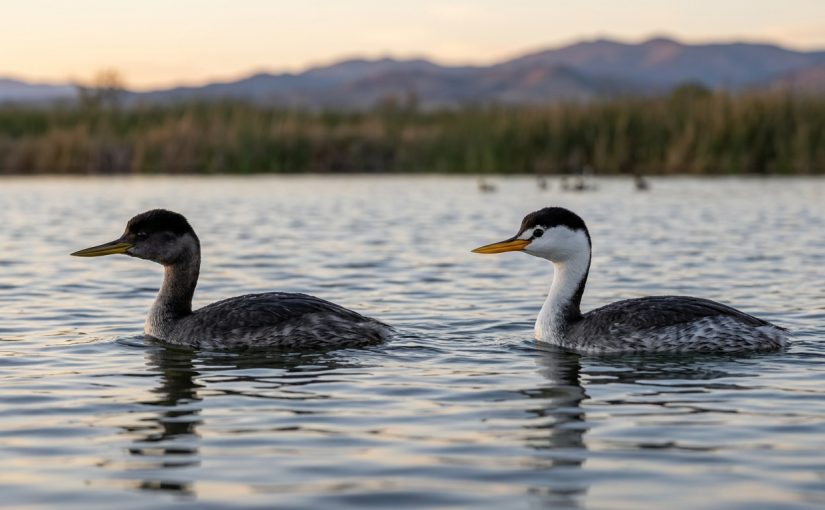
You’re watching a pair of elegant grebes glide across a lake, necks stretched skyward, bodies low in the water. They look nearly identical. One might be a Western Grebe. The other could be a Clark’s Grebe. Or maybe they’re both the same species? Until 1985, ornithologists considered them a single species. Now we know they’re distinct, but telling them apart still challenges even experienced birders.
Western and Clark’s Grebes share habitats and behaviors but differ in bill color, facial pattern, and vocalizations. Western Grebes show greenish-yellow bills and more black around the eye, while Clark’s Grebes display bright orange-yellow bills with white surrounding the red eye. Learning these subtle field marks transforms confusing waterbird encounters into confident identifications that enhance any birdwatching outing.
Bill Color Tells the Story
The most reliable field mark sits right on the bird’s face. Bill color separates these species faster than any other feature.
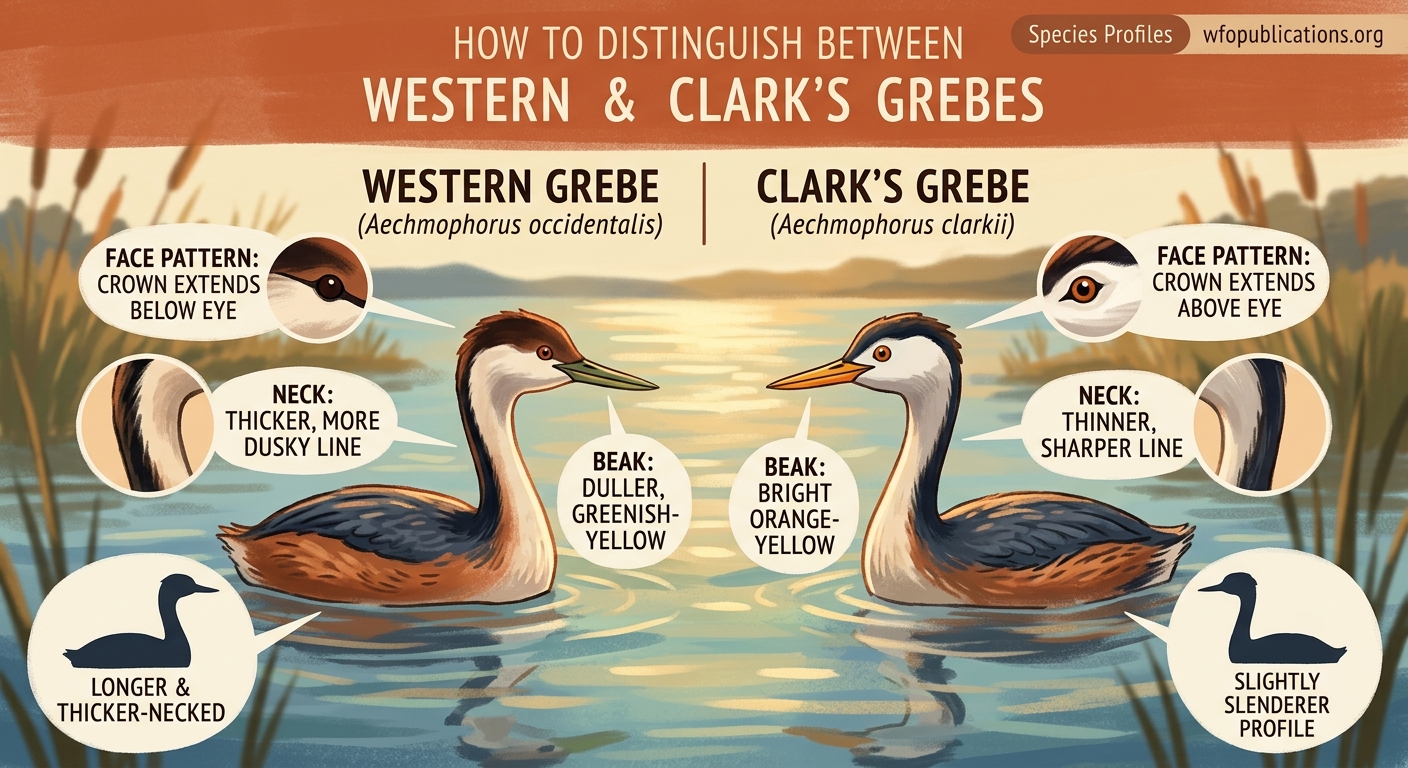
Western Grebes carry a greenish-yellow or olive-yellow bill. The color looks muted, almost dull in certain light conditions. Think of it as a subdued yellow with a greenish tint running through it.
Clark’s Grebes sport a bright orange-yellow bill. The difference becomes obvious when you see both species side by side. The Clark’s bill practically glows, especially in good sunlight. It’s a warmer, more saturated yellow that leans toward orange.
Here’s the catch. Juvenile birds of both species show duller bills. Young Clark’s Grebes don’t always show that signature bright orange-yellow right away. Lighting conditions also play tricks on your eyes. A Western Grebe’s bill might look brighter in harsh midday sun. A Clark’s Grebe’s bill can appear duller in shadow or overcast conditions.
Always check multiple field marks before making your final call.
Facial Patterns Require a Closer Look
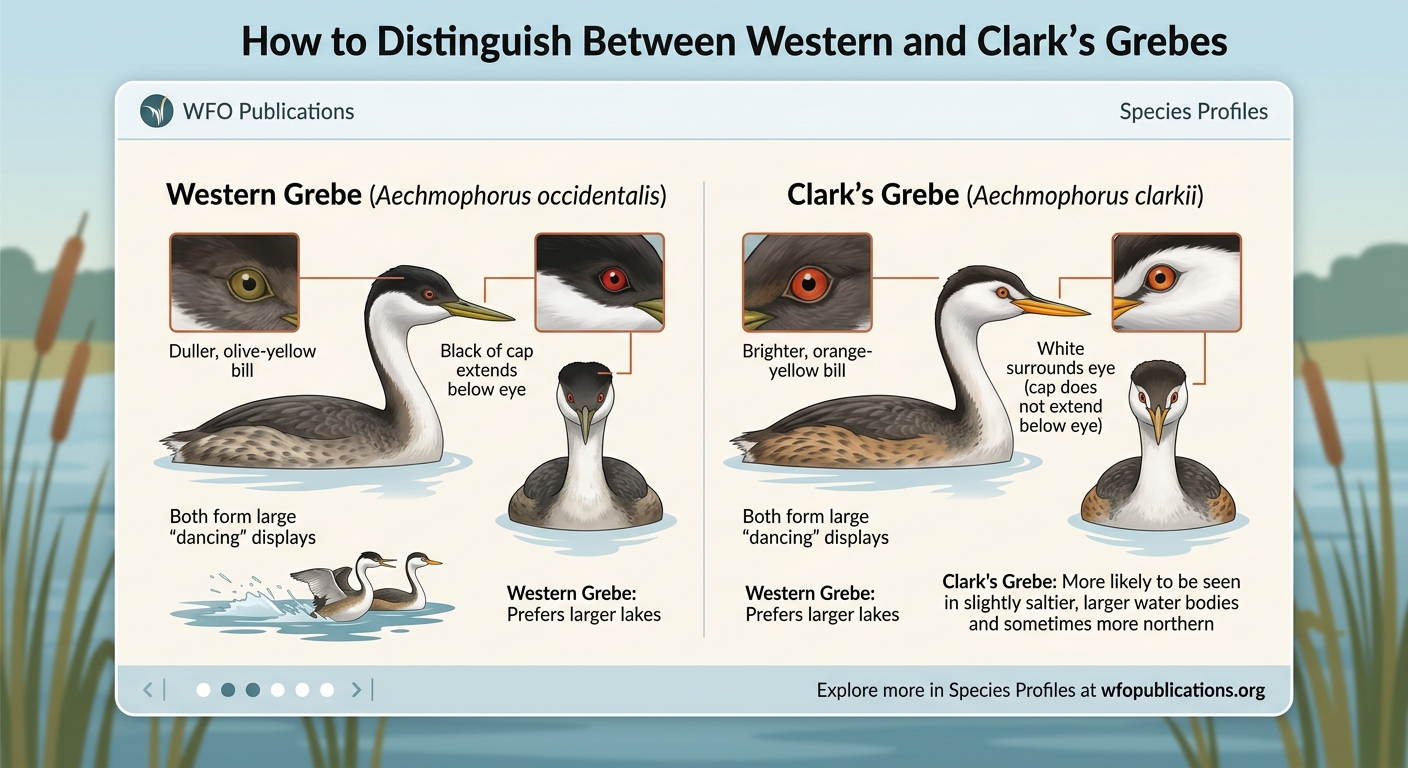
The amount of black on the face creates the second major identification point. This feature works well when birds are close enough for detailed observation.
Western Grebes wear more black on the face. The black cap extends down to include the area around the eye. When you look at a Western Grebe head-on, you’ll see black surrounding the red eye, creating a dark mask effect. The black reaches below the eye in most individuals.
Clark’s Grebes show white around the red eye. The black cap sits higher on the head, and white facial feathers come up to meet the eye. This creates a cleaner, brighter facial appearance. The eye seems to pop against the white background rather than sinking into dark feathers.
The lores provide another clue. These are the small areas between the eye and the bill base. Western Grebes typically show dark lores. Clark’s Grebes usually display lighter, sometimes white lores. This small detail reinforces your identification when combined with other features.
Variation exists within each species. Some Western Grebes show slightly less black around the eye. Some Clark’s Grebes have more extensive dark markings. Intermediate birds appear occasionally, though true hybrids remain rare in most populations.
Comparing Key Field Marks
| Feature | Western Grebe | Clark’s Grebe |
|---|---|---|
| Bill color | Greenish-yellow, olive tone | Bright orange-yellow |
| Eye surround | Black extends around eye | White surrounds red eye |
| Lores | Usually dark | Usually white or pale |
| Facial contrast | Less contrast, darker overall | High contrast, brighter face |
| Voice | Two-note “cree-creet” | Single “creeet” |
| Flank color | Slightly darker gray | Slightly paler gray |
Vocalizations Confirm Your Identification
Sound provides excellent confirmation when visual marks prove difficult to assess. These grebes vocalize frequently during breeding season and occasionally throughout the year.
Western Grebes produce a distinctive two-note call. Listen for “cree-creet” with the second note slightly higher. The call has a harsh, somewhat grating quality. During courtship displays, pairs create elaborate duets with synchronized calling.
Clark’s Grebes give a single-note call. It sounds like “creeet,” one syllable that rises slightly. The tone seems slightly less harsh than the Western Grebe’s call, though this difference takes practice to recognize consistently.
Recording apps help you learn these calls. Play reference recordings before your field trip. Then listen carefully when you encounter grebes on the water. The vocal difference becomes one of your most reliable tools, especially when birds are too distant for detailed visual study.
“I always tell new birders to learn grebe calls first. You can hear them from much farther away than you can see facial details. Once you know the voices, identification becomes much easier, even in large mixed flocks.” — Field ornithologist with 30 years of waterbird survey experience
Where and When to Find Both Species
These grebes share much of their range across western North America. They breed on large freshwater lakes with emergent vegetation. They winter along the Pacific coast and on ice-free inland waters.
Both species prefer similar habitats. You’ll find them on:
- Large alkaline lakes during breeding season
- Coastal bays and estuaries in winter
- Reservoirs and large rivers during migration
- Open water areas where they can dive for fish
Geographic overlap is extensive. From British Columbia south through California, and inland to the Great Plains, both species occur together. This makes identification skills essential rather than optional.
Seasonal timing matches closely too. Both species arrive on breeding grounds in spring, nest through summer, and migrate to wintering areas in fall. You might encounter pure flocks of one species, mixed flocks, or even mixed pairs on rare occasions.
Population centers differ slightly. Western Grebes generally outnumber Clark’s Grebes across most of the range. Some lakes host predominantly Western Grebes with just a few Clark’s mixed in. Other locations show more balanced numbers. Local birding groups often know which species dominates specific water bodies.
Behavior and Courtship Displays
Both species perform the famous “rushing” ceremony. Pairs run across the water surface together, bodies nearly vertical, feet pattering rapidly. This spectacular display happens during courtship and pair bonding.
The displays look identical between species. Both perform the weed ceremony, where birds dive for vegetation and present it to potential mates. Both execute synchronized swimming patterns. Both engage in elaborate head movements and posturing.
These behavioral similarities make sense given their recent separation as distinct species. They share most aspects of their biology. The differences that do exist are subtle and require careful observation.
Feeding behavior matches closely. Both species:
- Dive for small fish and aquatic invertebrates
- Hunt in open water away from shore
- Pursue prey underwater with powerful foot propulsion
- Swallow fish headfirst while surfacing
Watching behavior alone won’t help you separate these species. You need those key visual and vocal field marks.
Step-by-Step Identification Process
Follow this sequence when you encounter these grebes in the field:
-
Note the bill color first. Is it greenish-yellow or bright orange-yellow? This single feature often provides your answer. Use binoculars or a spotting scope to see the true color clearly.
-
Check the facial pattern next. Does black surround the eye, or does white come up to meet it? Look at the lores between the eye and bill. Dark lores support Western Grebe. White or pale lores support Clark’s Grebe.
-
Listen for vocalizations. If the bird calls, count the notes. Two notes suggest Western. One note suggests Clark’s. This works especially well during breeding season when birds vocalize frequently.
-
Consider the overall impression. Does the face look dark and masked, or bright and clean? Western Grebes appear darker overall. Clark’s Grebes look brighter and show more contrast.
-
Document uncertain birds. Take photos or detailed notes. Some individuals show intermediate features. Consult field guides and experienced birders when you’re unsure.
-
Watch for mixed pairs. Occasionally, Western and Clark’s Grebes pair together. If you see two grebes with different field marks performing courtship together, you’ve found a mixed pair. These occur but remain uncommon.
Common Identification Mistakes
New birders make predictable errors when learning these species. Awareness helps you avoid them.
Relying on a single field mark causes problems. Bill color varies with age and light. Always check multiple features before deciding.
Assuming all grebes in a group are the same species leads to missed Clark’s Grebes. Mixed flocks happen regularly. Check each individual bird rather than assuming uniformity.
Ignoring seasonal plumage changes creates confusion. Juvenile and winter-plumage birds show duller colors. The bright field marks of breeding adults become muted. Focus on pattern rather than color intensity during fall and winter.
Mistaking other grebe species for these two happens less often but still occurs. Eared Grebes and Horned Grebes share some habitats but look quite different with proper views. Western and Clark’s Grebes are much larger, with longer necks and different body shapes.
Photography Tips for Documentation
Good photos help you confirm identifications later and share observations with other birders. These grebes present specific photographic challenges.
Shoot in good light when possible. Early morning and late afternoon provide warm, directional light that shows bill color accurately. Midday overhead sun creates harsh shadows that obscure facial patterns.
Get close enough for detail. Bill color and facial patterns require reasonably close views. Use a telephoto lens of at least 400mm for frame-filling shots. Digiscoping through a spotting scope works well too.
Focus on the head. The diagnostic features all occur on the face and bill. A sharp head shot tells you more than a full-body image where the bird is small in the frame.
Capture calling birds when you can. Photos of birds with open bills often show them mid-vocalization. Combined with your field notes about the call type, these images provide excellent documentation.
Take multiple shots. Birds move, light changes, and focus misses happen. Shoot several frames of each individual to ensure you get at least one sharp, well-lit image showing the key field marks.
Building Your Identification Skills
Proficiency comes with practice and exposure. Each encounter teaches you something new about these subtle species.
Study museum specimens if you have access. Seeing bills side by side in controlled lighting eliminates uncertainty about color differences. Many natural history museums welcome birders who want to study their collections.
Join local bird walks focused on waterbirds. Experienced leaders point out field marks in real time. Learning from someone who knows these species well accelerates your progress significantly.
Review your photos after each outing. Compare what you saw in the field with what your camera captured. Sometimes photos reveal details you missed while observing. Other times, field observations clarify what photos make ambiguous.
Keep a list of locations where you find each species. Over time, you’ll notice patterns. Some lakes consistently host more Clark’s Grebes. Others lean heavily toward Western Grebes. This local knowledge helps you know what to expect.
Practice with online photo quizzes. Several birding websites offer identification challenges using real field photos. These test your skills without the pressure of making a call in the moment.
Making Sense of These Look-Alikes
The western vs clark’s grebe identification challenge rewards patient observation. These birds split from a common ancestor relatively recently in evolutionary terms. They maintain similar appearances because they fill nearly identical ecological roles.
Your growing ability to separate them opens up new dimensions in your birding. You’ll notice distribution patterns. You’ll track which species dominates different habitats. You’ll appreciate the subtle variations that make each individual unique.
Start with bill color. Add facial pattern. Listen for calls. Check multiple birds in each group. With these tools, you’ll confidently identify both species and enjoy every encounter with these stunning waterbirds.