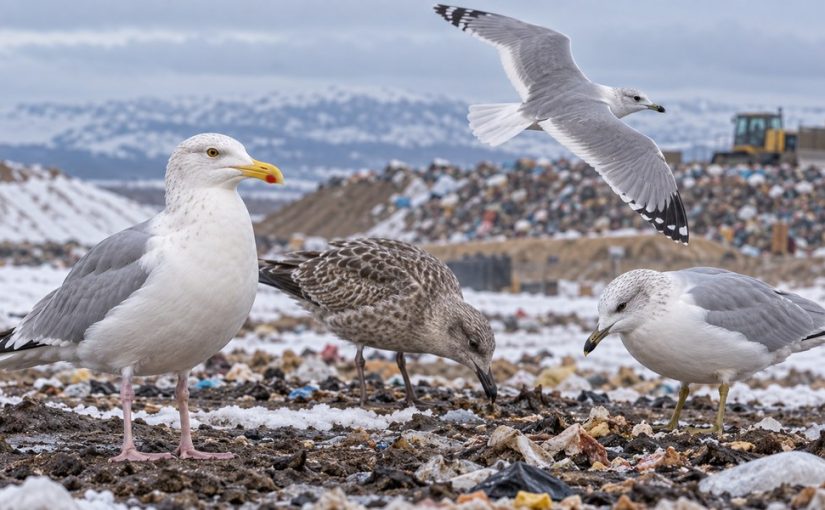
The smell hits you first. Then the noise. A landfill in the interior West during January is not a place most people choose to stand around. But for an experienced birder, that pile of steaming trash is one of the most promising habitats on the continent. Gulls that spend summers on Siberian coasts or along the Bering Sea sometimes decide to spend their winters picking through garbage in Colorado, New Mexico, or Utah. The trick is knowing which birds to look for and how to separate them from the thousands of Ring-billed and California Gulls that dominate the scene.
This winter, four gull species stand out as the most elusive targets for western landfill birders: Slaty-backed Gull, Thayer’s Gull, Glaucous Gull, and Iceland Gull. Each requires careful attention to mantle shade, wingtip pattern, and bill structure. Learn where they hide, how to confirm them, and which field marks separate them from common look alikes.
Why Landfills Attract the Rarest Gulls
Landfills are basically all-you-can-eat buffets. In the winter, natural food sources freeze over or disappear. Gulls that normally scavenge along coastlines or on inland lakes must find reliable calories. A municipal landfill offers warmth, shelter from wind, and a steady supply of organic waste. This draws in not just the common species but also vagrants that have drifted far from their normal ranges.
Most of the rare gulls that show up in the interior West come from Arctic or subarctic breeding grounds. They follow weather patterns and food availability. A deep freeze in Alaska or a series of Pacific storms can push them east and south. By the time they reach a landfill in Denver or Albuquerque, they are tired and hungry. That makes them slightly more approachable than they would be on a windswept beach, but it also means you have to work through hundreds of similar looking birds to find the one odd individual.
The Four Most Elusive Gulls to Target
1. Slaty-backed Gull
This is the holy grail for many western birders. Slaty-backed Gulls breed in northeastern Asia and winter primarily in Japan and Korea. Only a handful make it to North America each year, and most of those are found on the West Coast. When one turns up at an inland landfill, it is a major event.
The key field marks are straightforward if you get a good look. The mantle is a dark slate gray, noticeably darker than a Western Gull and much darker than a Herring Gull. The legs are a bright pinkish color. The eye is pale, almost white in adults. The head is relatively flat and the bill is heavy.
The biggest challenge is that first-winter and second-winter birds look completely different. Young Slaty-backed Gulls are brownish and heavily patterned, making them easy to confuse with other large gulls. Look for the combination of a dark mantle (even in juveniles the back is darker than similar species) and that distinctive leg color.
2. Thayer’s Gull
Thayer’s Gull has caused more arguments among gull enthusiasts than almost any other species. It was only recently split from Iceland Gull, and the two look extremely similar. Thayer’s Gulls breed in the high Arctic of Canada and winter mostly along the Pacific coast. A few push inland to landfills in the western states.
Adult Thayer’s Gulls have a medium gray mantle, paler than a Herring Gull but darker than a Glaucous Gull. The wingtips are black with white mirrors, or “windows,” near the tips. The bill is relatively slim and the head is rounded. In winter, the head is heavily streaked with brown.
The real test comes with first-winter birds. Young Thayer’s Gulls are a uniform pale brown with a dark bill and dark eye. They lack the strong pattern of a first-winter Herring Gull. Many birders pass them off as “just another brown gull,” but the structure is different. The wing projection past the tail is longer, and the chest is deeper.
3. Glaucous Gull
Glaucous Gulls are the polar bears of the gull world. They breed in the high Arctic and are mostly white. An adult Glaucous Gull is almost entirely white with a very pale gray mantle. The wingtips are white, not black. This is the easiest way to separate one from a Glaucous-winged Gull, which has gray wingtips.
These birds are large, bulky, and aggressive. They often dominate feeding areas. At a landfill, a Glaucous Gull stands out like a ghost among darker birds. The bill is heavy and the head is large. The legs are pink.
The confusion species is the Iceland Gull, which is similar in overall paleness but has a smaller bill and a more delicate structure. Glaucous Gulls also tend to have a more pronounced “fierce” expression due to the heavy brow.
4. Iceland Gull
Iceland Gulls are the palest of the “white-winged” gulls after the Glaucous. They breed in Greenland and the eastern Canadian Arctic. In winter, they move south along both coasts, and a reliable number show up at inland landfills in the West.
An adult Iceland Gull has a very pale gray mantle, almost white. The wingtips are white or very pale gray. The bill is slim and the head is small relative to the body. The eye is dark. The legs are a pale pink.
The trick is telling an Iceland Gull from a Thayer’s Gull. The safest method is to look at the wingtips. On an Iceland Gull, the wingtips are white. On a Thayer’s Gull, the wingtips are black. In the hand or with good photos, you can also measure the bill depth, but in the field, wingtip color is the most reliable.
How to Find Them: A Step-by-Step Process
You cannot just show up at a landfill and expect to find a Slaty-backed Gull. You need a plan.
-
Check eBird alerts daily. Set up a filter for your state or region. Look for reports of “Slaty-backed Gull,” “Thayer’s Gull,” “Glaucous Gull,” and “Iceland Gull.” Many rare gulls stick around for days or weeks. If someone reports one, go as soon as possible.
-
Scout the landfill perimeter. Most landfills have public roads or viewing areas. Do not trespass. Find a spot where you can see the active dumping area or the roosting piles. Morning is often best, before the birds disperse to other feeding sites.
-
Scan slowly and systematically. Start with the largest gulls. Look for birds that are noticeably larger or smaller than the surrounding flock. Check for unusual leg colors. Scan for white wingtips or dark mantles.
-
Photograph everything. You cannot confirm a rare gull without photos. Take shots from multiple angles. Focus on the wingtip pattern, the mantle shade, and the bill shape. If the bird is far away, use a scope and a phone adapter.
-
Share your photos for review. Post them to a local birding group or a gull identification forum. Experienced gullers can often confirm or rule out a species based on details you might have missed.
Common Mistakes and How to Avoid Them
| Mistake | Why It Happens | How to Fix It |
|---|---|---|
| Calling a large Herring Gull a Slaty-backed | Herring Gulls can look dark in poor light | Check the leg color; Herring Gulls have pink legs too, but Slaty-backed has a darker mantle |
| Confusing a first-winter Glaucous with a first-winter Iceland | Both are pale and brownish | Glaucous has a heavier bill and a larger body; Iceland is slimmer |
| Misidentifying a Thayer’s as a Herring Gull | First-winter Thayer’s are brown with a dark bill | Look for longer wing projection and a more rounded head |
| Assuming a white gull is a Glaucous | Iceland Gulls are also mostly white | Check the wingtips: white on Iceland, white on Glaucous, but Glaucous has a heavier bill |
“Gulls are like puzzles. You have to look at the whole bird, not just one field mark. The leg color, the wingtip pattern, the bill shape, the head shape. Put them all together and the picture becomes clear.” — Alvaro Jaramillo, author of Gulls of the Americas
Essential Gear for Landfill Birding
A landfill is not a comfortable place to stand. The ground is uneven, the wind is constant, and the smell can be overwhelming. Here is what you need to make the trip productive.
- A quality spotting scope with at least 60x magnification. You will be looking at birds that are often 100 yards away or more.
- A camera with a long lens or a phone adapter for your scope.
- A field guide focused on gulls. The classic is Gulls of the Americas by Howell and Dunn, but the newer Gulls of the World by Olsen and Larsson is excellent.
- Warm, layered clothing. Landfills are exposed. The wind chill can be brutal.
- A notebook and pen for recording details.
- A face mask or bandana for the smell.
For a full list of recommended equipment, check out our guide on chasing rarities: essential gear every serious birder needs.
Where to Focus Your Efforts This Winter
Some western landfills are better than others. The best sites tend to be large regional landfills near major population centers. Here are a few that consistently produce rare gulls.
-
Denver Arapahoe County Landfill (Colorado). This site has hosted Slaty-backed, Thayer’s, Glaucous, and Iceland Gulls in recent winters. The birding community here is active, and reports go out quickly.
-
Salt Lake City Landfill (Utah). The Great Salt Lake attracts huge numbers of gulls, and the landfill picks up the overflow. Thayer’s and Glaucous Gulls are annual visitors.
-
Albuquerque Area Landfill (New Mexico). A reliable spot for Iceland Gulls. The warmer climate means the landfill stays active all winter.
-
Boise Landfill (Idaho). Less famous but productive. Glaucous Gulls show up most years, and Thayer’s Gulls are regular.
If you are new to this type of birding, start with the landfill nearest to you. Even if you do not find a rarity, you will gain experience sorting through large flocks. That skill is transferable to any site.
How to Document Your Sighting
When you find a rare gull, document it carefully. Take photos of the bird in flight and at rest. Record the date, time, weather conditions, and the exact location. Note what other species were present. This information is valuable for researchers tracking gull movements.
Submit your sighting to eBird as soon as possible. Include a note about the identification details. If you are unsure, submit it as a “possible” or “candidate” and ask for review. For a step-by-step guide on submitting records, read our article on how to document and report your rare bird sighting like a pro.
Understanding the Rarity Pattern
Why do some winters produce multiple rare gulls while others produce none? The answer is usually weather. A strong Arctic front can push birds south. A series of Pacific storms can blow birds inland. If you pay attention to weather patterns, you can predict when the best opportunities will come.
In 2026, the pattern has been unusual. A persistent ridge of high pressure over the Gulf of Alaska has pushed storms further south than normal. This has brought more Thayer’s Gulls to the interior West than in the previous three years combined. The Slaty-backed Gull that spent two weeks at the Denver landfill in January was likely carried east by the same system.
For more on how weather drives vagrancy, see our piece on storm-driven seabirds: when Pacific pelagics appear inland.
Your Next Steps for a Successful Winter
The winter is not over yet. February and March can be excellent months for rare gulls. Birds that have been pushed south by Arctic weather often linger until the spring thaw. If you have not visited your local landfill yet, there is still time.
Start by checking eBird for recent reports near you. If nothing is showing up, go anyway. Many rare gulls are found by birders who simply put in the time. Bring your scope, dress warmly, and settle in for a long scan.
And remember: every gull you see is a chance to learn. The more time you spend with common species, the easier it becomes to spot the odd one out. That odd bird might just be a Thayer’s Gull that has traveled 2,000 miles to spend the winter in your neighborhood.
Happy hunting.