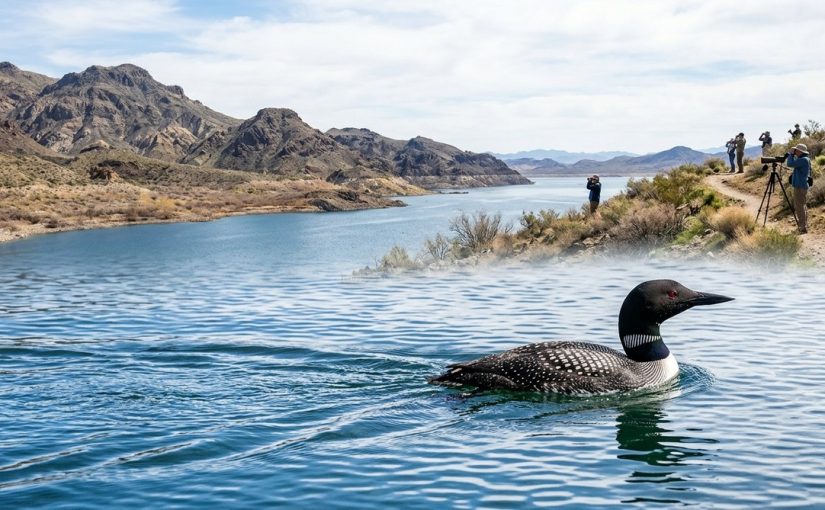
The winter of 2025-2026 will go down in birding history. Pacific loons, those sleek, black-and-white divers typically found bobbing on saltwater, started showing up on reservoirs, lakes, and even farm ponds across the interior West. Birders in Idaho, Montana, Nevada, and Arizona had to double-check their field guides. It was not a single lost bird. It was a full-blown invasion. This event did more than create a spike in rare bird alerts. It rewrote the map for inland birding hotspots and gave us a new lens for understanding how seabirds navigate extreme weather.
The 2026 Pacific loon invasion shows that inland reservoirs and large lakes are becoming critical refuges for seabirds displaced by Pacific storms. Birders who learn to read weather radar, monitor reservoir levels, and target deep, fish-rich waters will find rare loons far from the coast. This is not a fluke. It is a new pattern worth tracking.
Why Pacific Loons Left the Coast
Pacific loons spend most of their lives on the open ocean. They come to land only to breed on Arctic tundra lakes. During migration, they hug the Pacific coastline. That is the expected route. In late 2025, a series of intense atmospheric rivers slammed into the West Coast. These storms were stronger and more persistent than average. They pushed loons inland as birds sought calmer waters and reliable food sources.
The same thing happened with Ancient Murrelets in past years, but the scale of the 2026 loon event was different. eBird records show Pacific loons appearing at more than 40 inland sites across seven states. Some birds stayed for weeks. A few remained through the winter. That gave birders a rare chance to study them up close.
What triggered the movement? Marine biologists point to a combination of factors:
- Sustained gale-force winds that made coastal foraging impossible
- A collapse in local baitfish populations nearshore
- Unseasonably warm ocean surface temperatures that pushed prey deeper
Loons need to eat. When the coast stopped providing, they went looking. Inland lakes offered still water and schools of stocked trout and kokanee salmon. For a hungry loon, a reservoir in eastern Oregon looks a lot like a safe harbor.
How to Identify a Pacific Loon Inland
Most birders know the Pacific loon by its gray hood, dark throat patch, and the way it sits low in the water. But identification gets tricky when you are staring at a bird on a murky prairie reservoir. Here is what to look for:
Key field marks for inland Pacific loon sightings:
- Size and shape. Slightly smaller and more slender than a Common Loon.
- Head color. Pale gray crown with a dark, iridescent throat that can look black or purple.
- Bill. Straight and dagger-like, held level with the water.
- Neck posture. Often cranes its neck upward, giving a “snake-like” profile.
- Call. A haunting, wailing yodel that carries across open water.
Confusion species include Red-throated Loons and Arctic Loons. Red-throated Loons have a more upturned bill and a steeper forehead. Arctic Loons show a white flank patch in breeding plumage. Pacific loons in non-breeding plumage are drabber, but the gray nape is a reliable clue.
Top Inland Hotspots from the 2026 Event
The invasion revealed which inland waters are most attractive to displaced seabirds. Here are the sites that produced consistent sightings during the peak months of November 2025 through February 2026:
| Location | State | Water Body Type | Number of Loons | Best Viewing Access |
|---|---|---|---|---|
| Lake Pueblo | Colorado | Large reservoir | 4-6 | State Park boat ramp |
| American Falls Reservoir | Idaho | Irrigation reservoir | 8-12 | Highway overlook pullouts |
| Walker Lake | Nevada | Terminal lake | 3-5 | Public access points on east shore |
| Lake Roosevelt | Washington | Columbia River impoundment | 10-15 | Multiple marinas |
| Strawberry Reservoir | Utah | High-elevation reservoir | 2-3 | Dam area and inlet coves |
| Elephant Butte Lake | New Mexico | Desert reservoir | 1-2 | Main lake campground |
These hotspots share common traits. They are large, deep water bodies with healthy fish populations. They offer protected coves away from wind. And they are far enough from major cities that the birds are not constantly disturbed.
The Role of Weather Radar in Predicting Inland Loons
You do not need a boat to find Pacific loons inland. You need a weather radar app. Ornithologists have known for years that radar can detect migrating birds. But the 2026 event proved that radar is also useful for tracking seabird movements during storms.
When a strong Pacific front pushes inland, watch the radar for “blooms” of biological targets moving eastward. These are not raindrops. They are birds. Loons show up as fast-moving, high-altitude targets because they fly at speeds over 50 miles per hour. If you see a radar plume moving from the coast into the interior, you can predict where loons will land within 24 hours.
Here is a simple process to use radar for finding inland loons:
- Open a free weather radar site like College of DuPage’s radar viewer. Set it to show base reflectivity.
- Look for large, diffuse echoes moving inland from the Pacific. These are not storms. They are bird movements.
- Note the wind direction. Loons fly with tailwinds. A strong west wind is a good sign.
- Identify large water bodies in the path of the radar plume. Target those lakes the next morning.
- Check eBird rare bird alerts for that area. If other birders are reporting loons, you have a pattern.
This technique works best between October and March, when loon migration overlaps with storm season. It also works for other seabirds like grebes and scoters.
What the Invasion Means for Future Birding
The 2026 Pacific loon invasion is not an isolated event. Climate models predict more intense winter storms along the West Coast. That means more seabirds will be pushed inland in coming years. Birders who adapt to this new reality will have opportunities to see species that were once considered strictly coastal.
But there is a catch. Inland loons are stressed birds. They have burned energy flying over land. They may be underweight. They are often in unfamiliar habitat. Approaching them too closely can cause them to flush, wasting precious energy they need to survive.
“When you find a Pacific loon on a farm pond, give it space. Watch from a distance. Do not chase it with a kayak. These birds are already fighting for their lives. Your best photo is not worth their survival.” — Dr. Sarah Chen, Seabird Ecologist, University of Washington
That advice matters. Some of the 2026 sightings involved loons that stayed for weeks. Others involved birds that disappeared after a single day. We do not know how many survived the winter. But we do know that respectful birding gives them a better chance.
Gear and Preparation for Inland Loon Chasing
If you plan to target Pacific loons inland this winter, you need the right setup. These birds are not like mallards. They are wary and they have excellent eyesight.
Essential gear for inland loon birding:
- Spotting scope with at least 60x magnification. Loons can sit a half mile out on a big reservoir.
- Polarized sunglasses. They cut glare and let you see birds underwater.
- Field guide with seabird plates. Standard North American guides often skip loons in non-breeding plumage.
- Waterproof notebook. You will want to record behavior, location, and time for citizen science databases.
- Warm layers. Inland lakes are windy. You will be standing still for long periods.
For more on what to carry, check out our guide on chasing rarities essential gear every serious birder needs. It covers everything from tripod heads to field bags.
Common Mistakes Birders Make with Inland Loons
Even experienced birders slip up when seabirds show up in unexpected places. Here are the most frequent errors from the 2026 invasion:
- Mistaking a Western Grebe for a loon. Grebes have white cheeks and a thinner neck. Loons have a thicker neck and a dark throat.
- Assuming a loon is sick or injured. Loons often sit still for long periods. That is normal. Only call a rehabber if the bird cannot hold its head up.
- Reporting a sighting without photos. eBird reviewers need visual proof for rare inland records. A blurry photo is better than none.
- Using playback calls. Loons are sensitive to audio disturbance. Playing calls can keep them from feeding. Do not do it.
If you want to learn how to submit your sightings the right way, read our guide on how to document and report your rare bird sighting like a pro. It walks you through the process step by step.
The Bigger Picture: Vagrancy Patterns
Pacific loons are not the only seabirds showing up inland. The 2026 event fits a broader pattern of vagrancy driven by weather. We have seen Ancient Murrelets in Montana. Brown Boobies in Oregon. Cave Swallows at California hot springs. Each case follows a similar script: a storm, a displaced bird, and a lucky birder.
The difference with loons is the scale. This was not a single vagrant. It was a population-level movement. That tells us something about how resilient, or fragile, these birds are. Loons are strong fliers. They can cover hundreds of miles in a single night. But they need specific conditions to survive. If inland waters freeze over or lack fish, the invasion becomes a die-off.
For a deeper look at how storm events shape bird movements, see our article on storm driven seabirds when pacific pelagics appear inland. It covers the science behind these events and what they mean for conservation.
How to Turn This Knowledge Into Action
You do not need to wait for the next major invasion. You can start preparing now. Here is a checklist for the upcoming winter season:
- Subscribe to rare bird alert apps. We tested the best ones in rare bird alerts which apps and resources actually work best. Get the ones that let you filter by species and distance.
- Learn to read radar. Practice during fall migration when songbirds are moving. The same skills apply to loons.
- Identify your local hotspots. Look at a map of large reservoirs within 200 miles of your home. Visit them at least once before winter.
- Join a local birding listserv. Inland loon sightings often get reported first on state-level groups, not national databases.
- Keep your scope in the car. You never know when a storm will push birds your way.
The New Normal for Inland Birders
The 2026 Pacific loon invasion was a wake-up call. It showed us that the line between coastal and inland birding is blurring. Seabirds are going to show up in places we never expected. That is not a bad thing. It is an opportunity to see familiar birds in a new light.
Next time a big storm rolls in from the Pacific, do not stay home. Grab your scope, check the radar, and head to the nearest deep lake. You might find a Pacific loon waiting for you. And when you do, you will know exactly what you are looking at, why it is there, and how to enjoy it without causing harm.
That is the kind of knowledge that turns a good birder into a great one.