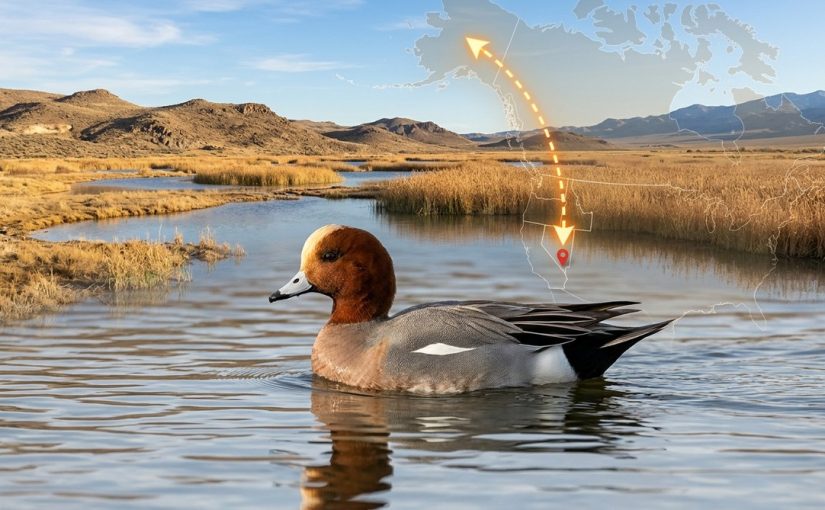
A male Eurasian Wigeon showed up in Nevada during the winter of 2025, and it did not just cause a local stir. It made birders across the American West stop and reconsider what we think we know about migration. This duck, with its rusty red head and cream-colored crown, normally breeds across Iceland, Scandinavia, and northern Russia. It winters in Europe, Asia, and along the Pacific coast of North America, but mostly in Alaska and British Columbia. Seeing one in the high desert of the Great Basin is not just a surprise. It is a clue that the old maps of bird movement might need redrawing.
The 2025 Eurasian Wigeon sighting in Nevada is more than a rare bird alert. It challenges long held assumptions about waterfowl migration in the interior West. This vagrant duck suggests that shifting weather patterns, habitat changes, and increased observer coverage are revealing new routes. Birders should treat every rare sighting as a data point that can reshape ornithology.
What Made This Nevada Sighting So Unusual
The Eurasian Wigeon is a regular vagrant to the West Coast. Every winter, a handful turn up in California, Oregon, and Washington. But Nevada is a different story. The state sits far from the typical Pacific Flyway path that these ducks follow. Most Eurasian Wigeons that reach the lower 48 do so by traveling south along the coast, rarely straying more than a hundred miles inland.
This bird was found at a small pond in Churchill County, east of the Sierra Nevada. It was associating with a flock of American Wigeons, which is typical behavior for a lost vagrant. What made it notable was the location. Nevada is not a state where birders expect to find Palearctic waterfowl. The state has fewer than ten accepted records of this species.
The sighting forced a simple question. If a duck that breeds in Siberia can end up in the Nevada desert, what else are we missing?
Why Vagrant Birds Matter More Than You Think
Vagrant birds are not just fun additions to a life list. They are biological probes. When a bird shows up far outside its normal range, it tells us something about the conditions that allowed it to get there.
The Eurasian Wigeon Nevada sighting in 2025 fits into a larger pattern of transcontinental vagrancy. In recent years, birders have recorded Siberian species like the Red-flanked Bluetail and the Dusky Warbler in the Pacific Northwest. These birds are not lost in the traditional sense. They are likely responding to environmental cues that we are only beginning to understand.
Here is what a single vagrant can teach us:
- It reveals the limits of a species’ navigational ability.
- It highlights weather events that can push birds off course.
- It shows which habitats are suitable for species we did not expect to find there.
- It provides data on how climate change might be altering traditional flyways.
Every rare bird sighting is a piece of a larger puzzle. When we connect them, we start to see the real shape of bird movement across the continent.
How to Identify a Eurasian Wigeon in the Field
If you are birding the West and spot a wigeon that looks a little off, here is what to look for. Telling a Eurasian Wigeon apart from our common American Wigeon takes practice, especially in winter plumage.
| Field Mark | Eurasian Wigeon | American Wigeon |
|---|---|---|
| Head color (male) | Rich chestnut red with a cream or buff crown stripe | Grayish brown with a green patch behind the eye and a white crown |
| Flank color | Gray with fine vermiculation | Pinkish brown |
| Wing patch | White leading edge, visible in flight | White patch on the inner wing, less extensive |
| Bill color | Blue gray with a black tip | Blue gray with a black tip (similar) |
| Female plumage | Warmer brown overall, more uniform | Colder gray brown, more contrast |
| Call | A high pitched whistled “whee” | A lower, three note whistle |
The crown stripe is the easiest field mark for males. American Wigeons have a white crown that extends from the forehead to the nape. Eurasian Wigeons have a cream or buff stripe that is narrower and stops short of the nape. In flight, the white leading edge of the wing on a Eurasian Wigeon is brighter and more extensive.
Three Possible Explanations for This Sighting
Birders have proposed several theories for why this Eurasian Wigeon ended up in Nevada. None of them are mutually exclusive.
-
Weather displacement. A series of strong Pacific storms in late 2025 pushed birds further inland than usual. The same storm systems that brought rain to the Sierra Nevada could have carried this duck eastward. When the weather cleared, it found itself in unfamiliar habitat and joined the nearest flock of American Wigeons.
-
Population pressure. The Eurasian Wigeon population has been stable or increasing in recent decades. As more birds are on the landscape, the statistical chance of vagrancy goes up. More birds means more individuals that can be pushed off course by weather or navigational error.
-
Changing migration patterns. Some researchers believe that climate change is altering the timing and routes of waterfowl migration. Warmer winters in the interior West may make Nevada more hospitable to birds that previously would have stayed on the coast. If this trend continues, we may see more Palearctic vagrants in the Great Basin.
None of these explanations are proven. But they give us a framework for understanding what we are seeing.
What This Means for Birders in the American West
The Eurasian Wigeon sighting in Nevada is not an isolated event. It is part of a broader shift in how we think about bird distribution in the West. If you are a birder who tracks rare species, you need to adjust your expectations.
Here are a few practical takeaways for the 2026 season:
- Check every wigeon flock carefully. Eurasian Wigeons often hide in plain sight among American Wigeons. Do not assume that a duck in Nevada is a common species.
- Pay attention to weather patterns. Major storm events in the Pacific can push birds into the interior. The days following a strong atmospheric river event are prime time for finding vagrants.
- Report your sightings promptly. The faster a sighting gets into eBird or your local rare bird alert network, the more birders can confirm it and gather data.
If you want to get more involved in tracking these movements, consider reading our guide on how to document and report your rare bird sighting like a pro. Good documentation turns a casual observation into a scientific record.
The Bigger Picture: Rethinking the Pacific Flyway
For decades, the Pacific Flyway was described as a narrow corridor along the coast. Birds that wintered in California were assumed to follow the coast south. The Eurasian Wigeon Nevada sighting challenges that model.
The reality is more fluid. Birds use a network of habitats that stretches from the coast to the interior valleys. When conditions are right, they can appear almost anywhere. The Great Basin, with its scattered wetlands and playa lakes, may act as a safety net for displaced birds.
This is not just true for waterfowl. Songbirds, shorebirds, and even seabirds are showing up in unexpected places. Check out our list of 5 unexpected vagrant species that showed up in California this year for more examples of this trend.
How to Prepare for Future Vagrant Events
You cannot predict exactly when the next mega rarity will appear. But you can put yourself in a position to find it. Here is a practical list of steps to take.
- Monitor eBird alerts for your region. Set up notifications for rare species so you know the moment a sighting is reported.
- Learn the calls of common species. If you know what a normal flock sounds like, you will notice when something is different.
- Carry a camera or phone with a good zoom lens. Documentation is critical for rare birds. A blurry photo is better than no photo, but a clear shot can confirm an identification.
- Join local birding listservs and social media groups. Many rare birds are found by one person and then shared through informal networks.
For a deeper look at which tools actually work, read our comparison of rare bird alerts: which apps and resources actually work best.
What the Experts Are Saying
“The Eurasian Wigeon in Nevada is a reminder that our maps are always provisional. Birds do not read field guides. They respond to wind, food, and instinct. Every time we think we understand migration, a duck shows up in the desert and proves us wrong.” — Dr. Sarah Lindquist, waterfowl ecologist at the University of Nevada, Reno
This sentiment echoes what many field ornithologists are saying. The old model of rigid flyways is giving way to a more dynamic understanding. Birds are flexible. They adapt. And sometimes, they end up in places that make no sense on paper.
A Call to Stay Curious
The Eurasian Wigeon Nevada sighting in 2025 is a gift to the birding community. It reminds us that there is still mystery in the natural world. We do not have all the answers. We are still learning.
If you live in the West, keep your eyes open. Check the ponds. Scan the reservoirs. Look at every wigeon. The next rare bird could be the one that changes how we think about migration. And when you find it, take a photo, write down the coordinates, and share it. You are not just adding a tick to a list. You are helping rewrite the story of bird movement in North America.
For more on the species that define rarity in our region, read our article on what makes a bird ‘rare’ in western North America. And if you are ready to chase the next one, check out our gear guide for chasing rarities: essential gear every serious birder needs.
Happy birding. The desert has more secrets to share.