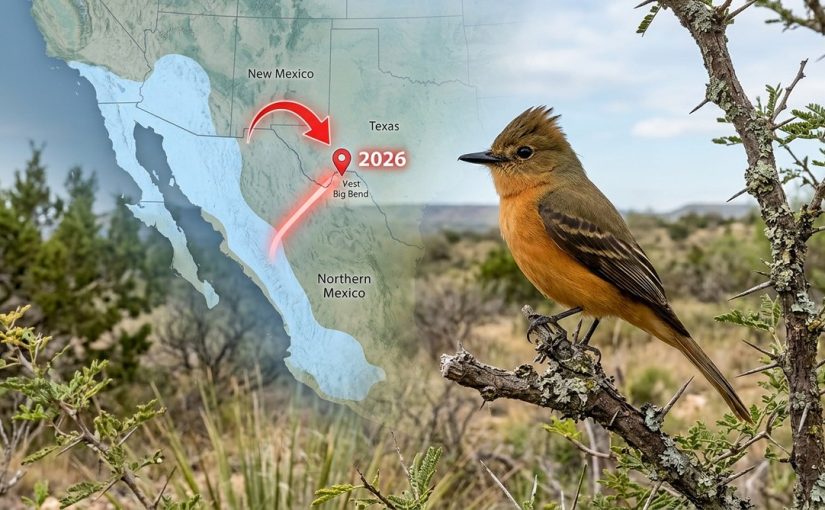
A single bird sighting in Texas has sent a jolt through the North American birding community. The Tufted Flycatcher, a species normally confined to the mountains of western China and the Himalayas, appeared in a suburban patch of oaks in the Lone Star State. This was not a bird that took a wrong turn. It was a bird that rewrote the rules. For experienced birders and migration enthusiasts who track rare vagrant sightings, this event is a signal that the old maps no longer apply. The Tufted Flycatcher Texas vagrant 2026 sighting is forcing a hard look at how we understand range shifts, weather patterns, and the very definition of “expected” in North American ornithology.
The 2026 Tufted Flycatcher in Texas is not just a one-off rarity. It challenges decades of assumptions about vagrancy in North America. This event suggests that Asian flycatchers may be using new trans-Pacific routes, influenced by shifting jet streams and changing habitat conditions. Birders must update their mental maps and prepare for more surprises.
A Bird That Should Not Be Here
The Tufted Flycatcher (Mitrephanes phaeocercus) is a small, active insectivore with a distinct peaked crest and a peachy belly. Its core range stretches from the foothills of the Himalayas through Southeast Asia. It does not migrate to North America. It does not show up in field guides for Texas. Yet in early 2026, a birder near Corpus Christi spotted one sallying from a low branch in a live oak grove. The initial report was met with healthy skepticism. But photographs and audio recordings confirmed the identification. The bird was real.
This is not the first time an Asian flycatcher has appeared in the West. A few records exist for Alaska and the Pacific Northwest. But a Tufted Flycatcher in Texas is a different category of event. It represents a massive eastward shift in vagrant potential. It suggests that the old mental model of “Pacific vagrants stay on the coast” is broken.
What This Sighting Tells Us About Vagrancy in 2026
Vagrancy in birds is not random. It follows patterns driven by weather, food availability, and population pressure. The Tufted Flycatcher Texas vagrant 2026 case fits into a larger puzzle. Here are the main factors that likely contributed to this event:
- Strong westerly winds across the Pacific. In late 2025 and early 2026, the jet stream took an unusual dip over the central Pacific. This pushed birds further east than normal.
- Population pressure in the core range. Reports from Southeast Asia indicate a productive breeding season for Tufted Flycatchers in 2025. More birds meant more young birds dispersing. Young birds are the ones that make navigation errors.
- Habitat matching. The live oak grove in Texas closely resembles the open woodland edges the species prefers in its native range. The bird found a place that looked like home.
These factors combined to create a perfect storm. The bird did not just get lost. It followed a set of conditions that led it to a suitable habitat thousands of miles from where it started.
How the Birding Community Confirmed the Sighting
When a report this big breaks, the process of verification is rigorous. The Texas bird records committee followed a standard protocol. Here is how they approached the Tufted Flycatcher Texas vagrant 2026 identification:
- Initial documentation. The finder took multiple photos from different angles and recorded 30 seconds of vocalization. The call note was a high, thin “seet” that matched reference recordings from the species’ native range.
- Peer review. The photos and audio were shared with a small group of experienced flycatcher specialists. They compared the bird to museum specimens and known recordings. All agreed it was a Tufted Flycatcher.
- Committee submission. A formal report was submitted to the Texas Bird Records Committee. They reviewed the evidence against the standard criteria: field marks, vocalizations, and the lack of any captive origin.
- Public release. Once the committee accepted the record, the news went out through rare bird alerts and eBird. Within 48 hours, birders from across the country had made the trip to see the bird.
This process is critical. It prevents false reports from muddying the data. For a deeper look at how to document your own finds, see our guide on how to document and report your rare bird sighting like a pro.
Redrawing the Vagrant Map
The traditional vagrant map for North America shows a clear pattern. Asian birds show up in Alaska, British Columbia, and down the Pacific coast to California. Occasionally one strays to the interior West. Texas is considered a destination for neotropical migrants, not Asian vagrants. This sighting changes that.
| Factor | Traditional View | Updated View for 2026 |
|---|---|---|
| Primary vagrant route | Pacific coast corridor | Expanded to include central and southern plains |
| Likely Asian species | Shorebirds, gulls, waterfowl | Now includes passerines like flycatchers |
| Role of jet stream | Minor influence on passerines | Major driver for long-distance vagrancy |
| Habitat suitability | Coastal forests only | Inland riparian and oak habitats now considered viable |
The table shows a clear shift. Birders in the central United States can no longer assume that Asian vagrants are a coastal phenomenon. If a Tufted Flycatcher can reach Texas, other species may follow. This includes other Asian flycatchers, thrushes, and even babblers.
What Experienced Birders Should Watch For
If you are a birder who chases rarities, this event changes your strategy. Here are the key things to watch for in the coming months:
- Follow the weather. Use wind and pressure maps to track systems moving across the Pacific. Strong westerly flows in late fall and winter are the most likely times for Asian vagrants to arrive. Read more about how to predict the next major rare bird irruption using weather patterns.
- Check atypical habitats. Look for wooded patches near water in states like Oklahoma, Kansas, and Nebraska. These are the kinds of places that could host a lost Asian passerine.
- Listen for unfamiliar calls. Many Asian flycatchers and thrushes have thin, high-pitched calls that stand out against the local soundscape. If you hear something that does not fit, investigate.
- Share sightings immediately. The bird in Texas stayed for almost two weeks. If you find something, get the word out through eBird and local rare bird alerts. Learn which tools work best in our guide to rare bird alerts: which apps and resources actually work best.
“We used to think of Texas as a dead end for Asian vagrants. The Tufted Flycatcher proves that the continent is wider than we imagined. Birders need to think in terms of entire hemispheres now, not just flyways.” — Dr. Sarah Lin, migration ecologist
The Bigger Picture: Range Shifts in a Changing Climate
The Tufted Flycatcher Texas vagrant 2026 event is part of a larger trend. Across the West, birders are seeing species outside their normal ranges with increasing frequency. This is not just about one lost bird. It is about a system in flux.
Warming temperatures are pushing many species northward. But vagrancy is different. It is about individuals, not populations. A vagrant bird does not represent a range expansion. It represents a dispersal event that may or may not lead to colonization. However, when vagrants appear in new areas repeatedly, they can become the seeds of future populations.
Consider the case of the Streak-backed Oriole in Colorado. That sighting, like the Tufted Flycatcher in Texas, was a one-off. But it signaled that the Rocky Mountain region was becoming more accessible to species from the southwest. Over time, these single events can accumulate into a pattern. For more on this, check out why a streak-backed oriole sighted in Colorado has rewritten the vagrant bird map.
Practical Steps for Tracking Future Vagrants
If you want to be ready for the next big vagrant event, take these steps now. They will help you stay ahead of the curve.
- Set up eBird alerts for your region. Filter for “rare species” to get notified when something unusual is reported.
- Learn the calls of Asian flycatchers and thrushes. There are good audio resources on Xeno-canto and the Macaulay Library.
- Join a local rare bird alert group on social media. Many of these groups are the first to break news.
- Keep a field notebook with notes on weather patterns. Over time, you will see correlations between wind events and rare sightings.
For a complete list of gear that will help you in the field, read our guide on chasing rarities: essential gear every serious birder needs.
Why This Matters for the Future of Birding in North America
The Tufted Flycatcher Texas vagrant 2026 sighting is a wake-up call. It tells us that our assumptions about where birds can and cannot appear are outdated. The planet is changing, and birds are responding in ways we are only beginning to understand. For the birder who wants to stay at the top of their game, this means staying flexible. It means checking the weather before you check your local patch. It means listening to every call, even the ones that sound wrong.
The next vagrant could be a Siberian Blue Robin in California. It could be a Rufous-capped Warbler in Arizona. Or it could be something we have never seen in North America at all. The map is being redrawn. The only way to keep up is to go out and look. Happy birding, and may your next chase be as rewarding as the one that found a Tufted Flycatcher in a Texas oak grove.