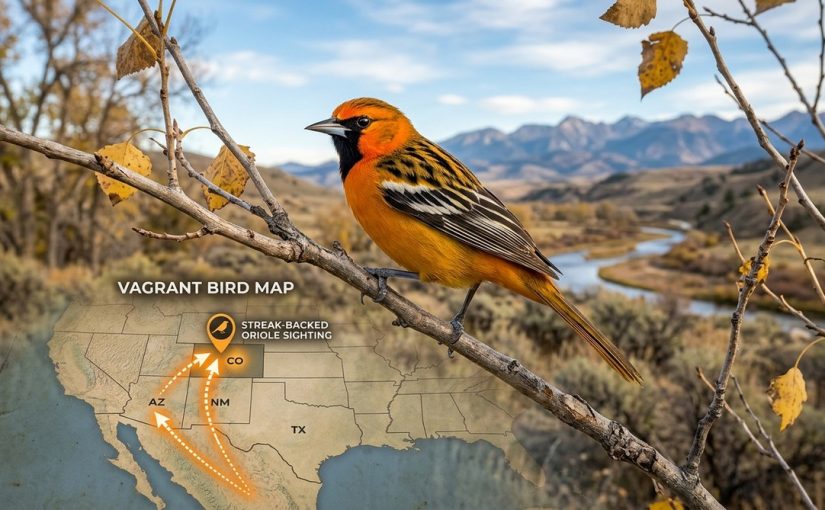
The first Streak-backed Oriole ever documented in Colorado did more than add a new checkmark to a state list. It forced ornithologists to rethink how we map vagrancy in North America. When that black-and-orange bird turned up in a suburban Denver yard in the spring of 2026, it wasn’t just a surprise. It was a signal. A signal that the old rules about where tropical birds belong no longer apply. For birders across the West, this sighting is a wake-up call to pay closer attention to the changing patterns of avian movement.
The Streak-backed Oriole sighting in Colorado in 2026 is not just a rare bird alert. It marks a turning point in how we understand vagrant bird behavior. This event shows that traditional migration maps are becoming outdated as climate shifts and weather patterns push tropical species farther north than ever before. For birders, it means staying ready for the unexpected.
Why This Vagrant Bird Shocked the Ornithology World
The Streak-backed Oriole (Icterus pustulatus) normally sticks to the dry forests of western Mexico and Central America. It is a bird of arid lowlands, thorn scrub, and tropical deciduous forests. Seeing one in Colorado is like finding a cactus wren in a Maine pine forest. It simply should not happen.
Yet there it was. Photographed, documented, and confirmed by the Colorado Bird Records Committee. The bird showed classic field marks: a bright orange body, black streaks down the back, a solid black hood, and a sharp, pointed bill. It was feeding on grape jelly at a backyard feeder, a behavior that made it easy to observe for several days.
What makes this sighting so significant is not just the rarity. It is the location. Colorado sits far outside the species’ known range. The closest breeding populations are in northern Mexico, hundreds of miles away. This bird did not just wander off course. It crossed major geographic barriers, including the high deserts of New Mexico and the southern Rocky Mountains. For a species that rarely ventures north of the U.S.-Mexico border, this was a monumental leap.
What Makes a Bird a Vagrant?
Before we get into the implications, let’s clarify what we mean by “vagrant bird.” A vagrant is an individual found outside its normal range, often far from where it should be. These are not migrants following a regular route. They are lost birds, storm-driven birds, or birds that overshoot their targets during migration.
Vagrancy happens for many reasons. Some birds get caught in strong tailwinds and are pushed into unfamiliar territory. Others follow food sources that lead them astray. And some birds, especially young ones, simply have poor navigation instincts. The Streak-backed Oriole in Colorado likely fell into the storm-driven category. Weather data from the weeks before the sighting showed a series of strong southerly winds pushing up from the Gulf of California into the interior West.
This is not a new phenomenon. Birders have documented vagrants for decades. What is new is the frequency and distance of these events. Species that once appeared as one-in-a-lifetime rarities are now showing up with surprising regularity. The Streak-backed Oriole is just the latest example.
How the Streak-backed Oriole Rewrote the Vagrant Bird Map
The traditional vagrant bird map for North America shows a predictable pattern. Eastern vagrants drift west. Western vagrants drift east. Tropical species stick to the Gulf Coast and the Southeast. The Streak-backed Oriole broke that pattern.
This bird came from the southwest, not the southeast. It traveled inland, not along the coast. And it ended up in a state that has no history of hosting this species. The Colorado sighting forces us to redraw the expected pathways for tropical vagrants in the West. It suggests that the Rocky Mountain region may become a new corridor for birds pushed north by changing climate conditions.
Here is what this means for birders:
- Expect the unexpected. Species that were once considered impossible in your area may now appear.
- Pay attention to weather patterns. Strong southerly winds in spring and fall are prime conditions for tropical vagrants.
- Check backyard feeders regularly. Many vagrant birds, like this oriole, are drawn to food sources in residential areas.
Identifying a Streak-backed Oriole in the Field
If you are lucky enough to spot a candidate Streak-backed Oriole, you need to know what to look for. Confusion with other oriole species is common, especially with the similar-looking Bullock’s Oriole and Hooded Oriole. Here is a breakdown of the key differences.
| Feature | Streak-backed Oriole | Bullock’s Oriole | Hooded Oriole |
|---|---|---|---|
| Back pattern | Heavy black streaks on orange | Solid black or dark | Olive-green or yellow |
| Hood color | Solid black covering head and throat | Black cap and throat, orange face | Black throat, yellow face |
| Tail length | Medium, with some white edging | Long, with extensive white | Medium, less white |
| Bill shape | Pointed, slightly curved | Stout, straight | Thin, slightly curved |
| Range (normal) | Western Mexico, Central America | Western U.S., Canada | Southwestern U.S., Mexico |
The easiest way to tell them apart is the back. If you see a bird with distinct black streaks on an orange back, you are looking at a Streak-backed Oriole. No other North American oriole has that pattern.
Steps to Confirm a Rare Sighting
When you think you have found a vagrant bird like the Streak-backed Oriole, follow these steps to document it properly. Good documentation is the difference between a credible record and a dismissed report.
- Take multiple photos from different angles. Focus on the back, head, and tail. Try to get both perched and in-flight shots if possible.
- Record the location and time. Note the exact GPS coordinates or a detailed description of the spot. Include the date and time of day.
- Describe the behavior. Was it feeding? Calling? Interacting with other birds? Behavior can help confirm identification.
- Note the habitat. Is it a backyard, a park, a riparian area? Habitat context matters for vagrant records.
- Report to eBird and your state records committee. Use the appropriate channels. For more on this process, check out our guide on how to document and report your rare bird sighting like a pro.
What This Sighting Tells Us About Climate and Migration
The Streak-backed Oriole in Colorado is not an isolated event. It fits a larger trend of tropical birds appearing farther north. In the past five years, species like the Rufous-capped Warbler, the Fan-tailed Warbler, and the Blue Bunting have all been documented in the U.S. Southwest with increasing frequency. Each sighting adds a piece to the puzzle.
Climate change is the most likely driver. Warmer temperatures allow tropical species to survive in areas that were once too cold. Shifts in precipitation patterns alter food availability. And extreme weather events, like the storms that pushed this oriole north, are becoming more common.
“We are seeing a fundamental shift in the distribution of many bird species. The Streak-backed Oriole in Colorado is a textbook example of how climate change is rewriting the rules of migration.” – Dr. Maria Santos, ornithologist at the University of New Mexico
This does not mean every vagrant sighting is climate-related. Some are just lost birds. But the pattern is hard to ignore. When a species that has never been recorded in a state suddenly appears, and then appears again in another state a year later, something bigger is happening.
Tools and Resources for Tracking Vagrant Birds
Staying on top of rare bird alerts is easier than ever. Use these resources to increase your chances of catching the next big vagrant.
- eBird alerts. Set up email or text alerts for rare species in your area. This is the most reliable tool for real-time updates.
- Rare Bird Alerts apps. There are several apps that aggregate sightings from eBird and other databases. For a full comparison, read our post on rare bird alerts which apps and resources actually work best.
- State bird listservs. Many states have email groups where birders share sightings. Join the one for your state.
- Weather radar. Use radar to track bird movements during migration. Large flocks show up as blips on the screen.
Common Mistakes When Identifying Vagrant Orioles
Even experienced birders can get tripped up by vagrant orioles. Here are the most common errors and how to avoid them.
- Mistaking a female Bullock’s Oriole for a Streak-backed. Female Bullock’s can have faint streaking on the back, but it is much less defined. Look for heavy, bold streaks.
- Ignoring the bill shape. A Streak-backed Oriole has a slightly curved, pointed bill. A Hooded Oriole has a thinner, more delicate bill.
- Assuming range determines identity. Do not rule out a bird just because it is far from home. That is the whole point of vagrancy.
How to Prepare for Future Vagrant Events
You cannot predict exactly when or where the next vagrant will appear, but you can be ready. Here is a checklist of gear and habits that will help.
- Keep a camera with a telephoto lens in your car.
- Set up a feeding station with grape jelly and orange halves. Orioles love these.
- Learn the calls of rare species. Vocalizations are often the first clue.
- Join local birding groups. Word of mouth is still one of the fastest ways to hear about a rarity.
For a full list of essential gear, see our guide on chasing rarities essential gear every serious birder needs.
The Bigger Picture for Western Birders
The Streak-backed Oriole sighting in Colorado is a moment to celebrate, but it is also a moment to reflect. The birding landscape of the American West is changing. Species that were once confined to Mexico or the desert Southwest are pushing north. Vagrant birds are becoming less rare and more expected.
This does not diminish the thrill of seeing one. If anything, it makes it more exciting. Every sighting now carries the weight of a scientific data point. When you report a vagrant bird, you are contributing to a growing body of evidence that helps researchers understand how our world is changing.
So keep your eyes open. Keep your camera ready. And never assume that a bird cannot be in your backyard just because the field guide says it belongs somewhere else. The map is being rewritten, one sighting at a time.
What This Sighting Means for the Future of Vagrancy Studies
The Colorado Streak-backed Oriole is a landmark event, but it is probably not the last. Ornithologists are already predicting more tropical vagrants in the Intermountain West in the coming years. The key will be to track these movements systematically. Citizen science platforms like eBird are essential for this. Every report, no matter how small, adds to the dataset.
If you want to get more involved, consider participating in local bird surveys or contributing to what makes a bird rare in western north america discussions. The more we know, the better we can predict where the next vagrant will show up.
Your Next Steps as a Birder
You do not need to be a professional ornithologist to make a difference. The next time you see a bird that does not look right, take a second look. Take a photo. Ask questions. Report what you find. You might be the one who discovers the next Streak-backed Oriole.
And if you are lucky enough to find one, remember the lessons of the Colorado sighting. Document everything. Share your findings. And enjoy the moment. Because in the world of birding, the unexpected is the best part.