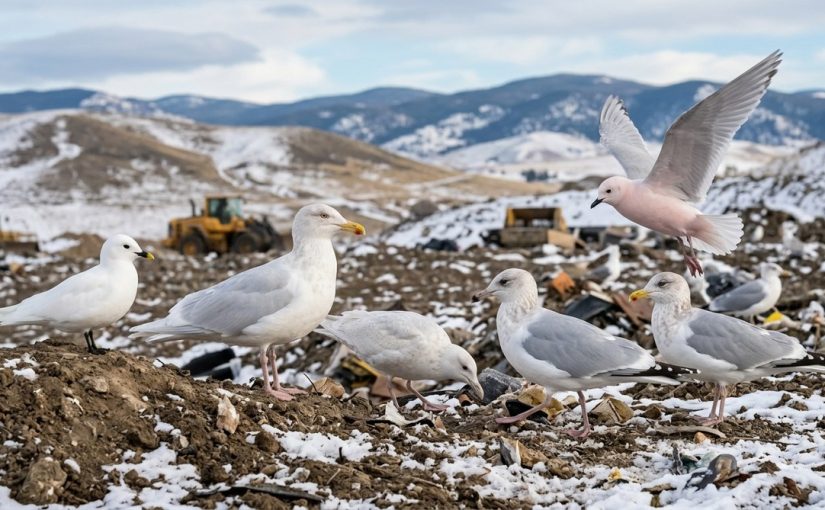
A thin layer of frost covers the gravel as the sun struggles over the ridge. The air smells of diesel and organic decay. For most people, a landfill in January is a place to avoid. For a birder, it is a goldmine. Western landfills in winter offer a reliable buffet of food waste and open water, attracting gulls from thousands of miles away. Among the hundreds of Ring-billed Gulls and California Gulls, Arctic visitors sometimes drop in. These rare species ride cold air south, following food and open water. If you know what to look for, your local dump could become your next lifer.
Each winter, Arctic gulls like Iceland, Glaucous, and Thayer’s gulls leave the frozen north for western landfills. You can spot them by focusing on size, wingtip color, and bill pattern. Arrive early, bring a scope, and check the edges of the flock. A patient birder can turn a routine landfill visit into a memorable rarity.
Why Landfills Draw Arctic Gulls
Gulls are opportunists. When the Arctic Ocean freezes and snow covers the tundra, their usual food sources vanish. They need calories to survive. Western landfills provide exactly that. Open piles of organic waste, discarded meat, and grain byproducts create a consistent food supply. The heat generated by decomposing trash also keeps small patches of water ice free. This combination of warmth and food makes landfills irresistible.
In states like California, Oregon, Washington, Nevada, and Arizona, landfills become temporary refuges. The same sites that host Common Ravens and American Crows in summer transform into gull hubs in winter. Arctic species mix in with resident birds. They are often shyer and hang at the edges of the flock. That is your first clue.
The Six Arctic Gulls You Might Encounter
Not every large white gull is a Glaucous Gull. Here are the species that can turn up at a landfill near you.
1. Glaucous Gull
This is the largest Arctic gull. It is almost pure white with no dark wingtips. In flight, it looks like a ghost. Glaucous Gulls breed in the high Arctic and winter along the Pacific coast and interior landfills. They are bulky, with a thick bill and a fierce expression. Look for them standing apart from smaller gulls, often on top of a pile of refuse.
2. Iceland Gull
Slightly smaller than a Glaucous, the Iceland Gull has a more delicate build. Its wingtips are pale gray or white, not black. The bill is slender and often shows a dark tip. Iceland Gulls originate from Greenland and Canada. They are more common in the East but appear regularly in western landfills, especially in the Pacific Northwest. Check flocks of Thayer’s Gulls for a paler bird that stands out.
3. Thayer’s Gull
For years, Thayer’s Gull was considered a subspecies of Iceland Gull. Today it is recognized as a full species. It has a rounded head, dark eye, and gray wingtips with white spots. The legs are pink. Thayer’s Gulls breed in the Canadian high Arctic and winter on the West Coast. They are the most likely Arctic gull to appear in California landfills. Learn to separate Thayer’s from Herring Gulls by the smaller bill and more gentle face.
4. Slaty-backed Gull
This is the largest gull in the world. It breeds in northeastern Asia and wanders to Alaska and the West Coast. The back is dark slate gray, almost black. The legs are pink, and the eye is pale. Slaty-backed Gulls are rare but increasing in the Pacific Northwest. Check any gull that looks too dark and too big. If you see one at a landfill, you have found a genuine prize.
5. Glaucous-winged Gull
This species is common along the coast, but interior landfills see fewer of them. It has gray wingtips and a heavy bill. The back is medium gray. Glaucous-winged Gulls interbreed with Western Gulls, creating identification puzzles. Look for a gull with a flat forehead and a thick neck. In winter, some move inland to landfills in California’s Central Valley.
6. Vega Gull
Vega Gulls breed in Siberia and Alaska. They look like a pale Herring Gull with a dark back and yellow legs. The wingtips have extensive black with small white mirrors. Vega Gulls are rare in the lower 48, but sightings have increased in recent years. They favor landfills and large reservoirs. If you see a gull with yellow legs and a dark back that does not match a California Gull, take a closer look.
How to Identify an Arctic Gull in a Crowd
You will likely be surrounded by hundreds of gulls. Sorting through them takes a system. Use this step by step approach.
- Scan the flock from a distance. Look for gulls that are noticeably larger or smaller than the majority. Arctic gulls often stand out by size.
- Focus on wingtip color. Most common gulls have black wingtips. If you see a gull with pale gray or white wingtips, it is likely an Arctic species.
- Check the legs. Pink legs point toward Glaucous, Iceland, or Thayer’s. Yellow legs suggest Vega or a hybrid.
- Study the bill. Arctic gulls tend to have smaller, more delicate bills than similar sized Herring Gulls. A thick bill is a mark of a Glaucous or a large hybrid.
- Watch behavior. Arctic gulls are often less aggressive. They wait at the edges and move in after local birds have fed.
“The best way to find a rare gull is to look at every white gull you see. Not just the ones that look different. Every single one. That is how the gems are found.” — veteran birder and gull enthusiast from the Pacific Northwest.
Common Mistakes When Identifying Gulls in Winter Landfills
Even experienced birders misidentify gulls. The table below shows the most common errors and how to avoid them.
| Mistake | Why It Happens | How to Avoid It |
|---|---|---|
| Calling a pale Herring Gull a Glaucous | Herring Gulls can look very pale in winter. | Check wingtips. Herring Gulls have black tips. |
| Mistaking a Thayer’s for an Iceland | They look similar at a distance. | Look at head shape. Thayer’s is rounder. |
| Assuming all large gulls are Western Gulls | Western Gulls are coastal. Inland birds are often hybrids. | Check the back color. Western Gulls are dark gray. |
| Ignoring juvenile birds | Young gulls have brown plumage and are often skipped. | Juvenile Arctic gulls are pale brown with pale wingtips. |
| Relying on one field mark | Gulls vary by age, season, and individual. | Use at least three field marks before ID. |
Essential Gear for Landfill Birding
A landfill is not a nature reserve. You need the right tools to make the trip productive and safe.
- A spotting scope. This is non negotiable. Gulls at landfills often stay at a distance. A scope lets you see wingtip color and bill shape.
- Binoculars with good low light performance. Winter days are short. A 8×42 or 10×42 works well.
- A field guide or gull specific app. Apps like Merlin or iBird can help, but a printed guide is more reliable in cold weather.
- Warm clothing and waterproof boots. Landfills can be muddy and windy. Dress for the worst conditions.
- A notebook or phone for recording details. If you find a rare gull, write down the date, location, and field marks.
For a full list of recommended gear, check out our guide on chasing rarities essential gear every serious birder needs.
Best Practices for Documenting Your Sighting
If you spot a rare gull, you will want to share it. Proper documentation helps confirm the ID and contributes to science.
- Take photos. Even poor photos help. Try to capture the bird in flight and standing.
- Note the time and weather. Gulls move with wind and temperature changes.
- Record the exact location. Use a GPS coordinate or a landmark description.
- Submit your sighting to eBird or a local rare bird alert system. This helps other birders find the bird.
For a deeper look at reporting, read our article on how to document and report your rare bird sighting like a pro.
Where to Find Landfills That Attract Arctic Gulls
Not every landfill is equally good. Look for sites that meet these criteria.
- Large regional landfills that accept municipal waste. These attract the biggest flocks.
- Landfills near water. A nearby river or lake provides drinking water and bathing spots.
- Sites with open piles. Covered landfills are less attractive.
- Landfills in agricultural areas. The mix of waste and grain fields draws more gulls.
In the West, some famous gull hotspots include the Altamont Landfill in California, the Roosevelt Landfill in Washington, and the Butterfield Landfill in Oregon. Smaller county landfills can also be productive.
When to Go for the Best Results
Timing matters. Here is a seasonal breakdown.
- November to December. The first Arctic gulls arrive as northern waters freeze.
- January to February. This is peak season. The largest numbers of rare gulls appear.
- March. Numbers drop as birds begin moving north. Some linger into early April.
Go early in the morning. Gulls feed heavily after sunrise. By midday, many have scattered. Late afternoon can also be good as they return to roost.
A Final Word on Ethics and Safety
Landfills are active industrial sites. You must respect the rules. Always stay in public areas or locations where birding is permitted. Do not block trucks or interfere with operations. Wear a high visibility vest if possible. Keep a safe distance from machinery.
The birds depend on these sites for survival. Do not chase or flush them. A stressed gull wastes energy it needs for migration. Watch quietly and enjoy the spectacle.
Your Next Steps for Finding Arctic Gulls in Winter Landfills
You have the knowledge. Now put it into practice. Pick a landfill near you that matches the criteria above. Plan a visit on a calm, cold morning. Bring your scope and dress warmly. Scan every white gull with patience. The Arctic visitors are out there, waiting to be found. Each winter brings new chances. Each flock holds a potential surprise.
If you want to stay updated on the latest rarities, check out our post on tracking western north america’s most recent rare bird sightings in 2026. It will help you know what is being seen and where.
The next time someone asks why you are standing in a cold, smelly parking lot staring at trash, you can smile. You know the truth. You are not looking at garbage. You are looking for a ghost from the Arctic, and this winter, it just might show up.