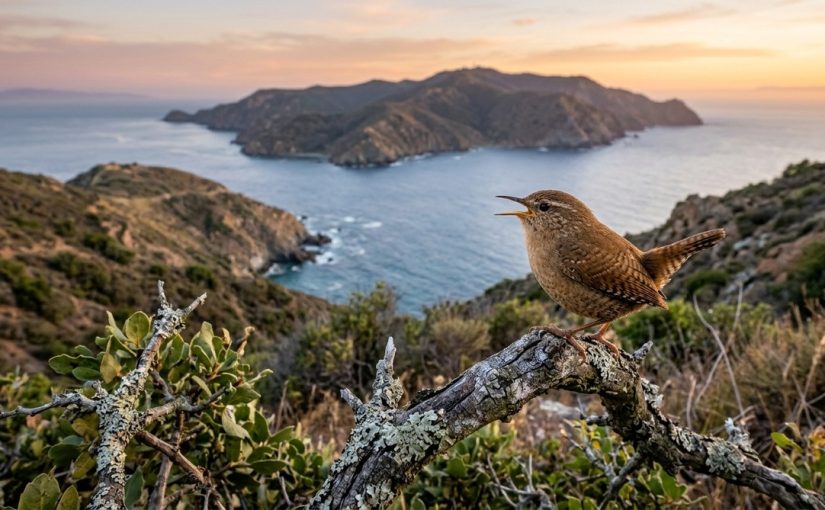
A small, russet-brown bird with a cocked tail appeared on Santa Catalina Island in early 2026, and it has the ornithology world buzzing. This was not a House Wren or a Bewick’s Wren. It was a Pacific Wren, a species that typically sticks to the damp, mossy forests of the Pacific Northwest and coastal British Columbia. Its presence on a dry, Mediterranean-climate island twenty-two miles off the coast of Southern California is a head-scratcher. For birders and scientists alike, this sighting is more than just a rare tick on a life list. It is a data point that challenges our understanding of how and why birds show up where they do.
The 2026 Pacific Wren sighting on Santa Catalina Island is forcing a re-evaluation of avian vagrancy. Instead of being random errors, such movements may reveal how birds respond to climate pressure, food scarcity, and genetic dispersal. This case study shows how a single rare bird can reshape our understanding of species distribution in Western North America.
Why a Pacific Wren on Santa Catalina Island Breaks the Mold
The Pacific Wren (Troglodytes pacificus) was only recently split from the Winter Wren complex. It is a bird of the coastal rainforest. Think Olympic Peninsula, Vancouver Island, and the redwood groves of Northern California. It lives in dense, wet understory. It does not migrate. It does not fly across large bodies of open water. So how did one end up on an island known for its bald eagles, island foxes, and scrub jays?
Scientists have a term for this: vagrancy. A vagrant bird is one found far outside its normal range. Most vagrants are young birds that get lost during migration. But the Pacific Wren is not a migrant. This suggests the causes for its appearance are different from a wayward warbler or a storm-blown petrel.
Let’s look at the leading theories for this specific event.
- Juvenile dispersal gone wrong. Young wrens leave their natal territory to find their own patch. Most move a few miles. A few, driven by instinct or competition, might push much farther. A strong tailwind could have carried one south.
- Weather event transport. A series of atmospheric rivers hit the West Coast in the winter of 2025-2026. These storms could have picked up a small bird and pushed it offshore.
- Ship-assisted vagrancy. A wren could have hopped onto a boat in a port like Coos Bay or Eureka and ridden it south. This is rare for wrens but not impossible.
- Habitat overshoot. If the bird’s home forest was degraded by drought or fire, it may have moved south looking for moisture. It kept going until it hit the ocean, then crossed to the island.
Each theory has its own implications. If it was weather, we might see more of these events. If it was ship-assisted, it is a one-off. If it was habitat-driven, that is a warning sign.
What the Sighting Tells Us About Avian Vagrancy
For decades, vagrancy was treated as a biological accident. A bird got lost. End of story. But the Pacific Wren on Santa Catalina Island is part of a growing body of evidence that says vagrancy is a real, functional behavior.
Birds do not just wander randomly. They follow environmental cues. A young wren that moves south is not lost. It is exploring. It is checking if there is suitable habitat that its parents never used. This is how species shift their ranges.
Consider these points:
- Vagrancy is a mechanism for range expansion. If the wren finds a mate and suitable habitat, a new population could establish.
- Vagrancy is a response to climate change. As the Pacific Northwest warms, species that evolved for cool, wet forests may need to move. The Santa Catalina Island sighting could be a test run.
- Vagrancy reveals genetic connectivity. Even rare movements keep populations linked. A wren that makes it to the island carries genes that might otherwise stay isolated.
This sighting is not just a curiosity. It is a clue about the future of our avifauna.
How to Document a Rare Bird Sighting the Right Way
If you are lucky enough to find a Pacific Wren or another rare bird on an island or coast, your report matters. Bad data is worse than no data. Here is a numbered process for making your sighting useful to science.
- Take diagnostic photos. Get shots of the tail, the flanks, and the face. A Pacific Wren has a pale eyebrow and dark barring on the flanks that is finer than a House Wren. If you cannot get a photo, sketch the key field marks.
- Record the exact location and time. Use GPS coordinates if possible. Note the habitat: was it in a riparian thicket, a eucalyptus grove, or a rocky shoreline?
- Note the behavior. Was it foraging alone? Was it calling? A calling bird is easier to track. A silent bird might be stressed.
- Submit to eBird or a local rare bird committee. Include all details. Do not assume someone else will report it.
- Share with local researchers. The ornithology department at a nearby university may want to follow up.
For a deeper look at the reporting process, read our guide on how to document and report your rare bird sighting like a pro.
Field Marks: Pacific Wren vs. Look-Alikes
A Pacific Wren can be tough to separate from the similar Bewick’s Wren and House Wren. Here is a table to help you tell them apart in the field.
| Feature | Pacific Wren | Bewick’s Wren | House Wren |
|---|---|---|---|
| Eyebrow | Bold, pale, extends far back | Bold, white, very prominent | Duller, less distinct |
| Belly color | Warm buffy brown | Clean white to grayish | Buffy, often with fine barring |
| Tail length | Short, often cocked up | Long, often cocked up | Short, often held flat |
| Barring on flanks | Fine, dark, distinct | None, flanks are plain | Fine barring, but less crisp |
| Song | Rapid, musical trill | Harsh, scolding “cheek” notes | Bubbling, gurgling song |
| Habitat | Dense, wet forest | Scrub, chaparral, suburbs | Open woods, gardens |
If you see a small wren in a dry, open area on the island, it is almost certainly a House Wren or a Bewick’s. The Pacific Wren was found in a narrow, shaded canyon with running water. Habitat is a key clue.
What This Means for Birders and Conservation Biologists
The Pacific Wren on Santa Catalina Island is not just a flash in the pan. It is a signal. For the birder, it is a reminder to keep your eyes open. Rare birds can show up anywhere, even on a well-birded island. For the conservation biologist, it is a prompt to think about connectivity.
Islands are natural laboratories. They are isolated. A bird that arrives there has to overcome real barriers. If a sedentary species like the Pacific Wren can do it, then maybe our assumptions about dispersal are wrong.
This sighting also raises questions about the future. Will this wren stay? Will it find food through the dry summer? Will it attract a mate? The answers could tell us whether vagrancy is just a dead end or a genuine path to colonization.
“We tend to think of vagrants as mistakes. But the data suggests many of these birds are pioneers. They are the scouts. The Pacific Wren on Santa Catalina Island might be the first of many.” — Dr. Meghan Harris, field ornithologist, Western Bird Research Collective.
Common Mistakes When Interpreting Vagrant Bird Sightings
It is easy to get excited about a rare bird. But excitement can lead to errors. Here are common mistakes to avoid.
- Assuming the bird is a breeder. Just because one wren shows up does not mean the species is establishing a population. One bird is a data point. A breeding pair is a trend.
- Ignoring the role of weather. Every vagrant is not a climate refugee. Some are just caught in a storm. Look at the weather data for the week before the sighting.
- Misidentifying the species. A Pacific Wren is subtle. Get confirmation from multiple sources before announcing a county first.
- Forgetting to check for banded birds. If the bird has a leg band, it might be a known individual. Report the band number.
For more on this topic, see our article on what makes a bird ‘rare’ in western North America.
Tools to Track Future Vagrants
If you want to stay on top of rare bird movements like the Pacific Wren, you need the right tools. Here are some essential resources.
- eBird Alerts: Set up email or app alerts for your county. You will get notified the moment someone reports a rare species.
- Rare Bird Alert Listservs: Many Western states have dedicated listservs. California has CALBIRDS. Oregon has OBOL. These are often faster than eBird.
- Weather Radar: You can sometimes see bird movements on radar. This is especially useful for nocturnal migrants.
- Local Facebook Groups: Many regions have active birding groups where sightings are shared in real time.
For a full breakdown of the best apps and resources, check out our guide on rare bird alerts: which apps and resources actually work best.
The Bigger Picture: Vagrancy in a Changing West
The Pacific Wren is not the only oddball showing up in the West. In 2026, we have seen Siberian vagrants in the Pacific Northwest, tropical flycatchers in the desert, and seabirds turning up inland. The wren on Santa Catalina Island fits a pattern.
Climate change is shuffling the deck. Birds are moving. Some are moving north. Some are moving up in elevation. But some, like this wren, are moving in unexpected directions. They are testing the edges of their range. They are looking for refugia.
For the science-interested birder, this is a golden age. Every vagrant is a piece of a puzzle. The Pacific Wren on Santa Catalina Island is a piece that says: “Do not assume you know where a bird belongs.”
How to Prepare for the Next Vagrant Wave
You can get ready for the next rare bird event. It does not require a lot of gear. It requires awareness.
- Keep your camera charged and in your car.
- Learn the calls of the birds in your area. You will hear a vagrant before you see it.
- Check eBird before you go birding. See what has been reported in the last 24 hours.
- Bird the edges. Vagrants often show up in unusual habitats: a city park, a golf course, a landfill. Do not just stick to the hotspots.
For gear recommendations, see our guide on chasing rarities: essential gear every serious birder needs.
A New Lens on Bird Movement
The Pacific Wren on Santa Catalina Island is a small bird with a big story. It is a reminder that nature is not static. Birds move. They make mistakes. They take chances. And sometimes, those chances pay off.
For the birder, it is a thrill. For the scientist, it is a dataset. For the conservationist, it is a warning. The wren is telling us that the map is changing. The places we think of as safe for a species might not be safe forever. The places we think of as out of reach might be closer than we think.
So keep your binoculars handy. Keep your field guide open. And if you see a small brown wren with a cocked tail on a Southern California island, take a photo. You might be looking at the future.