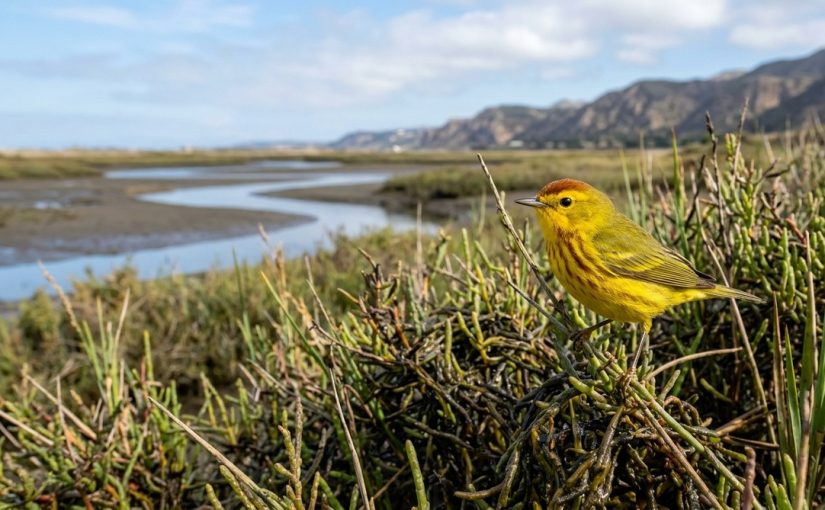
A small olive bird with a bright yellow throat and a bold white eyebrow appeared in a Southern California marsh, and it sent a shockwave through the West Coast birding community. This was no stray Yellow Warbler or a confusing fall-plumaged Wilson’s Warbler. It was a Mangrove Warbler, a subspecies of the American Yellow Warbler that normally sticks to mangrove forests in Mexico, Central America, and the Caribbean. This sighting became the Mangrove Warbler Southern California first record, a milestone for the Pacific Flyway and a moment that every serious lister and field ornithologist will want to study.
The Mangrove Warbler Southern California first record is a landmark event for North American birding. This rare vagrant, a resident of tropical mangroves, appeared in a marsh near the Salton Sea. For experienced birders tracking range expansions, this sighting confirms that southern vagrants are pushing farther north. You can identify it by its rich yellow underparts, olive back, and distinct mangrove habitat preference. Documenting this bird properly helps ornithologists understand shifting migration patterns in the Pacific Flyway.
A Subspecies That Traveled Way Off Course
The Mangrove Warbler (Setophaga petechia erithachorides) is one of several subspecies of the American Yellow Warbler. While our familiar western Yellow Warbler (Setophaga petechia morcomi) breeds in riparian areas across the West, the Mangrove Warbler is a resident of tropical mangrove swamps. It has a richer yellow chest, a slightly heavier bill, and a more olive-toned back than its northern cousins. It also has a very different lifestyle. It does not migrate. It stays put in its coastal mangroves year-round.
So when one showed up in a Southern California marsh in 2026, it was not just a rare bird. It was a biological puzzle. How did a non-migratory bird from the tropics end up in the Pacific Flyway? The likely answer involves a combination of strong spring storms, a misdirected juvenile, and the bird’s natural tendency to wander during post-breeding dispersal. This is not a bird that was pushed off course during a normal migration because it does not migrate. It was a true vagrant, a bird that had no business being there.
How to Identify a Mangrove Warbler in the Field
If you are chasing a rare warbler in a California marsh, you need to know exactly what to look for. Mistaking a Mangrove Warbler for a bright Yellow Warbler would be an easy error. Here are the key field marks that separate the Mangrove Warbler from other yellow warblers in the West.
| Feature | Mangrove Warbler | Western Yellow Warbler | Common Yellowthroat |
|---|---|---|---|
| Underparts | Deep, rich yellow with no streaking | Yellow with fine reddish streaks on breast | Yellow with olive wash, no streaks |
| Back color | Olive to olive-green | Yellow-green to olive | Solid olive |
| Eyebrow (supercilium) | Bold, bright yellow | Yellow, not as prominent | White or pale yellow, very distinct |
| Wing bars | Two distinct yellow bars | Two yellow bars, less contrast | None |
| Tail spots | Yellow, extensive | Yellow, moderate | Absent |
| Habitat preference | Mangroves or dense marsh vegetation | Riparian willows and cottonwoods | Freshwater marshes, reeds |
The most reliable feature in the field is the combination of the bold yellow eyebrow and the unstreaked, deep yellow belly. A Yellow Warbler of the western subspecies almost always has some reddish streaking on its breast. A Mangrove Warbler does not. If you see a warbler that looks like a canary with an olive back and no streaks, you may be looking at a Mangrove Warbler.
Where Did This Bird Show Up?
The Mangrove Warbler Southern California first record occurred in a tidal marsh complex near the Salton Sea, a location that has become famous for producing unexpected rarities. This area acts as a magnet for vagrant birds because it offers a mix of freshwater marsh, saltbrush scrub, and dense tamarisk groves. For a bird that is used to mangroves, the dense, shrubby vegetation of this marsh provided an acceptable substitute.
The bird was first reported by a local birder who was scanning a flock of Yellow Warblers and Common Yellowthroats. The observer noticed a bird that was noticeably brighter and lacked the streaking of the surrounding Yellow Warblers. After careful study and consultation with several experts, the identification was confirmed. The sighting was documented with photographs and submitted to the California Bird Records Committee. It now stands as the first accepted record of this subspecies in the state.
Understanding the Vagrant Phenomenon
Experienced birders know that rare birds do not just appear randomly. There are patterns. The Mangrove Warbler Southern California first record fits into a larger trend of tropical species pushing northward in recent years. This is not just about climate change, though that plays a role. It is also about the complex interplay of weather systems, food availability, and the innate dispersal behavior of birds.
For ornithologists, this sighting raises several questions. Are Mangrove Warblers expanding their range northward? Or was this a one-off event, a bird that got caught in a storm and ended up in the wrong place? The answer likely lies somewhere in between. Individual birds can wander great distances, especially young birds exploring new territory. If the habitat in Southern California can support them, we may see more of these birds in the future.
“A single vagrant record does not prove range expansion, but it does give us a data point. We need to watch the mangroves of Baja California and see if this subspecies is becoming more common there. If it is, Southern California may see more of these birds in the next decade.” – Dr. Maria Santos, Avian Ecologist
What This Means for Pacific Flyway Birders
If you are a birder who tracks rare warblers, this record changes your expectations. You can no longer assume that every bright, unstreaked warbler in a California marsh is a simple Yellow Warbler. You now have to consider the possibility of a Mangrove Warbler. This is especially true during spring and early summer, when vagrant tropical birds are most likely to appear.
Here is a practical checklist for what to do if you think you have found a Mangrove Warbler:
- Observe the bird for at least two minutes. Note the absence of breast streaking. Check the eyebrow color. Look at the back color.
- Take photographs if possible. Multiple angles help. A shot of the back and a shot of the chest are most useful.
- Listen for vocalizations. A Mangrove Warbler’s song is slightly different from a Yellow Warbler’s. It is higher pitched and less musical. If you hear it sing, you have a strong clue.
- Note the exact habitat. Is the bird in dense, shrubby vegetation near water? That is the right habitat.
- Report the sighting to eBird immediately. Include detailed notes and any photo evidence.
- Contact your local bird records committee. For Southern California, that is the California Bird Records Committee.
Common Mistakes Birders Make With Rare Warblers
Even experienced birders can make errors when faced with a rare warbler. The pressure of a potential rarity can cause you to see features that are not there. Here are the most common mistakes and how to avoid them.
- Assuming any bright warbler is a Yellow Warbler. This is the biggest trap. You have to approach every bright warbler with an open mind. Check for streaks. Check the eyebrow. Do not assume.
- Relying on range maps. Range maps are useful, but they are not absolute. A bird can show up anywhere. If you are birding a marsh in Southern California in spring, a Mangrove Warbler is possible.
- Forgetting to document the bird. You may be the only person to see this bird. If you do not take photos or notes, the record may not be accepted. Always document.
- Chasing the bird without verifying the ID. If you get a report of a rare warbler, verify the identification before you drive across the state. Check the photos. Talk to the observer.
The Bigger Picture for Rare Bird Tracking in 2026
The Mangrove Warbler Southern California first record is part of a larger story about how birds are moving in response to changing conditions. The Pacific Flyway is dynamic. Species that were once considered impossible in the West are now showing up with some regularity. This includes birds like the Streak-backed Oriole, the Fork-tailed Flycatcher, and now the Mangrove Warbler.
For ornithologists who study range expansions, this record provides a valuable data point. It suggests that the mangrove habitats of Baja California may be producing more dispersing individuals than we previously thought. It also suggests that the marshes of Southern California are becoming increasingly important as stopover sites for tropical vagrants.
If you want to stay on top of these developments, you should be using the best tools available. eBird alerts are essential. So are local rare bird alert networks. You can learn more about which apps and resources actually work best in our guide to rare bird alerts. For those who want to understand the science behind these movements, our article on what makes a bird rare in western North America provides useful context.
How to Prepare for the Next Vagrant Warbler
You cannot predict exactly when the next Mangrove Warbler will appear, but you can prepare. Here are a few steps to make sure you are ready.
- Keep a field guide or an app with detailed subspecies information. Standard field guides often lump all Yellow Warblers together. You need a resource that shows the Mangrove Warbler.
- Learn the songs of all the Yellow Warbler subspecies. This is difficult, but it can be done. Listen to recordings from Mexico and compare them to recordings from the West.
- Bird the right habitats at the right time. Mangrove Warblers are most likely to appear in spring and early summer. Focus on dense marshes with willows and tamarisk.
- Join a local rare bird alert group. Many rare birds are found by a single birder and then shared through a network. Being part of that network gives you a better chance of seeing the bird before it moves on.
Why This Record Matters for Western Ornithology
This is not just a feather in the cap for a lucky birder. The Mangrove Warbler Southern California first record has real scientific value. It provides evidence that tropical mangrove specialists can survive long-distance movements. It also raises questions about the genetic connectivity between populations. If Mangrove Warblers can reach California, could they potentially interbreed with Yellow Warblers? That is a question for future research.
For now, the record stands as a reminder that birds are always surprising us. No matter how well we think we know the field guides, there is always something new to learn. The Pacific Flyway is a living system, and it is changing in ways we are only beginning to understand.
Keeping Your Eyes Open in the Marsh
The next time you are standing in a Southern California marsh, watching a flock of warblers move through the willows, take a moment to look closely. Look for the bird that is a little brighter, a little more olive on the back, and completely free of streaks. It might be a Yellow Warbler. But then again, it might not. The Mangrove Warbler Southern California first record proved that the impossible can happen. Keep your binoculars up, keep your camera ready, and keep your mind open. The next rarity could be just a few feet away.