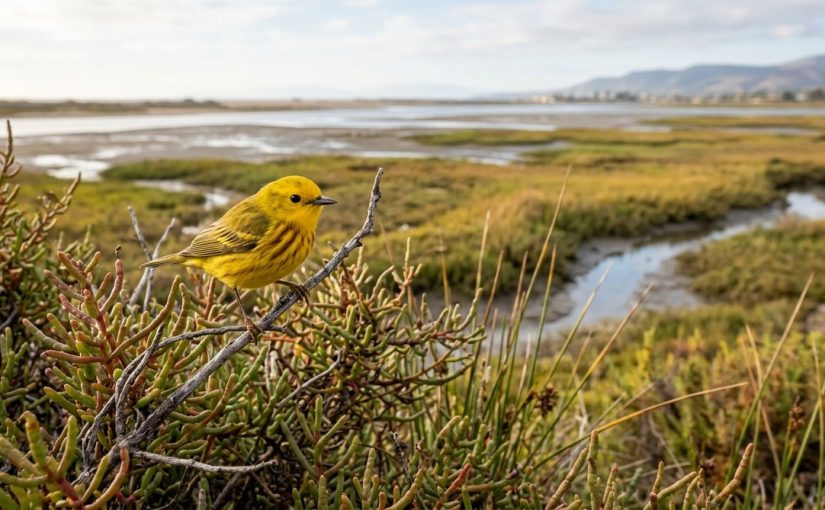
A small, brightly colored warbler showed up in a pickleweed marsh south of Los Angeles and instantly rewrote the birding record books for the entire West Coast. The bird was a Mangrove Warbler, a subspecies of the Yellow Warbler that normally sticks to mangrove forests from Mexico down through Central America. Its appearance in a Southern California marsh in 2026 marks the first documented record for the western United States. For serious birders and ornithologists, this sighting is the kind of event that only comes along once in a career. It raises big questions about vagrancy, climate shifts, and how we track rare birds in a rapidly changing world.
The Mangrove Warbler (Setophaga petechia erithachorides) was confirmed in a Southern California tidal marsh in 2026, representing the first accepted record for the western United States. This sighting challenges existing assumptions about the species’ range and highlights the growing trend of tropical vagrants appearing along the Pacific Coast. Birders should focus on habitat, vocalizations, and plumage differences to separate this bird from the familiar Yellow Warbler.
What Is a Mangrove Warbler and Why Does It Matter?
The Mangrove Warbler is not a separate species but a well defined subspecies of the Yellow Warbler (Setophaga petechia). It is formally known as Setophaga petechia erithachorides. While the familiar Yellow Warbler breeds across North America and winters in the tropics, the Mangrove Warbler is a resident bird of coastal mangrove forests. Its range stretches from Baja California and the Gulf of Mexico coast all the way down to northern South America.
What sets the Mangrove Warbler apart from its northern cousin is a combination of subtle but consistent physical traits. Adult males show a deeper, richer chestnut streaking on the breast and a more extensive rufous cap. The overall yellow tone can appear warmer and more saturated. But the most reliable field mark is the habitat. Mangrove Warblers seldom wander far from dense mangrove thickets. That is what made the Southern California sighting so shocking. The bird was found in a salt marsh dominated by pickleweed and cordgrass, not exactly prime mangrove habitat.
For the California Bird Records Committee, this sighting required careful review. The bird had to be documented with detailed notes, photographs, and audio recordings of its song. The song was a major clue. Mangrove Warblers sing a slightly different dialect than their northern relatives, with a slower, more deliberate delivery. The audio evidence helped seal the identification.
How Did a Mangrove Warbler End Up in Southern California?
This is the question on every birder’s mind. The most likely explanation involves a combination of weather patterns and natural vagrancy. Here is a breakdown of the factors that probably came together to push this bird far north of its normal range.
- Strong southerly winds during spring migration. In late April and early May, powerful low pressure systems moving across the Pacific can generate sustained winds from the south. These winds can carry small songbirds hundreds of miles off course. The Mangrove Warbler likely got caught in one of these wind events somewhere along the Baja California coast.
- A lack of suitable stopover habitat. Once displaced, a bird needs to find food and shelter. The coastal marshes of Southern California, while not ideal, offer enough insects and cover for a tired warbler to rest and refuel. The bird may have simply followed the coastline northward, searching for familiar looking vegetation.
- An existing pattern of tropical vagrancy. This is not an isolated event. In recent years, birders have documented an increase in tropical species appearing along the West Coast. Species like the Nutting’s Flycatcher, the Rose-throated Becard, and the Gray-collared Becard have all shown up in California. The Mangrove Warbler fits this broader pattern of northward movement by tropical birds.
The bird stayed in the same marsh for about a week, giving dozens of birders a chance to see it. It was last reported on the morning of May 12, 2026. After that, it vanished as suddenly as it had appeared.
Key Identification Features for the Mangrove Warbler
If you are lucky enough to encounter a potential Mangrove Warbler on the West Coast, you need to know exactly what to look for. The differences from a standard Yellow Warbler are real but subtle. Here are the key points to check.
- Crown color. Look for a deep rufous cap that extends further down the forehead than on a typical Yellow Warbler. The color is richer and less orange.
- Breast streaking. The chestnut streaks on the breast are heavier, wider, and darker. They often extend further down the belly.
- Overall tone. The yellow body color can appear more golden or saturated, especially on the underparts.
- Song. The song is slower and more measured. It lacks the buzzy, hurried quality of the northern Yellow Warbler. Listen for a series of clear, sweet notes with longer pauses between phrases.
- Habitat. This is a major clue. Mangrove Warblers are almost never found far from mangroves. If you see a bird that looks like a bright Yellow Warbler in a coastal salt marsh or scrubby wetland far from any mangroves, pay close attention.
Mangrove Warbler vs. Yellow Warbler: Key Differences
| Feature | Mangrove Warbler | Yellow Warbler (Northern) |
|---|---|---|
| Crown color | Deep, rich rufous cap | Lighter orange rufous cap |
| Breast streaking | Heavy, dark chestnut streaks | Finer, lighter chestnut streaks |
| Overall yellow tone | Warmer, more golden | Brighter, more lemon yellow |
| Song pace | Slower, more deliberate | Buzzy, hurried, faster |
| Habitat preference | Strictly mangrove forests | Wide variety of riparian and wetland habitats |
| Range | Resident from Baja to South America | Breeds across North America, winters in tropics |
What This Sighting Means for the Future of West Coast Birding
A single vagrant bird does not mean the Mangrove Warbler is colonizing California. But it does signal something important. The boundaries that once defined bird ranges are becoming more fluid. As climate patterns shift and extreme weather events become more common, we can expect more tropical birds to show up in unexpected places.
This sighting also highlights the value of citizen science and prompt reporting. The birder who first spotted the Mangrove Warbler took careful notes, captured clear photos, and uploaded everything to eBird within hours. That allowed the broader birding community to verify the record and document the event properly. If you want to be ready for the next big rarity, you should follow the same approach. Learn more about the process in our guide on how to document and report your rare bird sighting like a pro.
For serious birders, the Mangrove Warbler record is a reminder to stay alert. Every marsh, every patch of coastal scrub, and every city park could hold a surprise. The birds are moving. The question is whether we are paying enough attention to catch them.
“The Mangrove Warbler record is a textbook example of how a single well documented vagrant can reshape our understanding of avian movement patterns. It is not just a tick on a list. It is a data point that ornithologists will reference for years.” – Dr. Sarah Ortega, field ornithologist and California Bird Records Committee member
Steps to Take If You Find a Potential First Record
Finding a bird that could be a first state record or a first for the West is an incredible experience. But it also comes with responsibility. A poorly documented claim can be rejected by records committees. Here is a step by step process to follow if you think you have found something rare.
- Take photos and record audio immediately. Do not wait. Use your phone or camera to capture as many angles as possible. Record at least 30 seconds of song or call notes. These are your primary pieces of evidence.
- Write down field notes on the spot. Note the bird’s size, shape, behavior, and habitat. Describe the exact location, the time of day, and the weather conditions. Do not rely on memory.
- Share the news responsibly. Post your sighting to eBird and your local rare bird alert network. But avoid overselling the identification. Let other birders come to their own conclusions based on the evidence you provide.
- Let the experts review it. Submit your documentation to the relevant state bird records committee. They will evaluate the record using established criteria. Do not take it personally if they ask for more information.
- Respect the bird and other birders. Do not harass the bird for better views. Keep a respectful distance. If a crowd gathers, help maintain order so everyone gets a fair look.
For more tips on verification, check out our article on 5 steps to confirm a rare bird sighting without leaving your spot.
The Bigger Picture: Vagrancy in a Changing Climate
The Mangrove Warbler is not an isolated curiosity. It is part of a larger phenomenon. Across the West, birders are documenting species that have no business being where they are found. A Fork-tailed Flycatcher in Oregon. A Streak-backed Oriole in Colorado. A Brown Booby in Washington. These events used to be once in a lifetime sightings. Now they seem to happen every year.
Climate change is likely a driving factor. Warmer ocean temperatures, altered wind patterns, and shifts in prey availability are all pushing birds outside their traditional ranges. For tropical species, the margin for error is shrinking. A storm that used to be a minor inconvenience can now become a life threatening displacement. Birds that survive these events often end up in unfamiliar habitats, far from any hope of returning home.
This does not mean every vagrant is a climate refugee. Some birds are simply explorers. But the overall trend is clear. The bird map of North America is being redrawn in real time. If you want to understand the forces behind these changes, we have a detailed look at 5 ways climate change is redrawing the rare bird map in the Pacific Northwest.
Stay Ready for the Next Big Rarity
The Mangrove Warbler in Southern California was a gift to the birding community. It reminded us that nature still holds surprises, even in places we think we know well. The marshes along the California coast are not just habitat for resident birds. They are landing strips for lost travelers from far away places.
Keep your binoculars clean. Keep your camera charged. Keep your eBird account active. The next first record could be just around the corner, hidden in a patch of pickleweed. And when it happens, you will be ready.