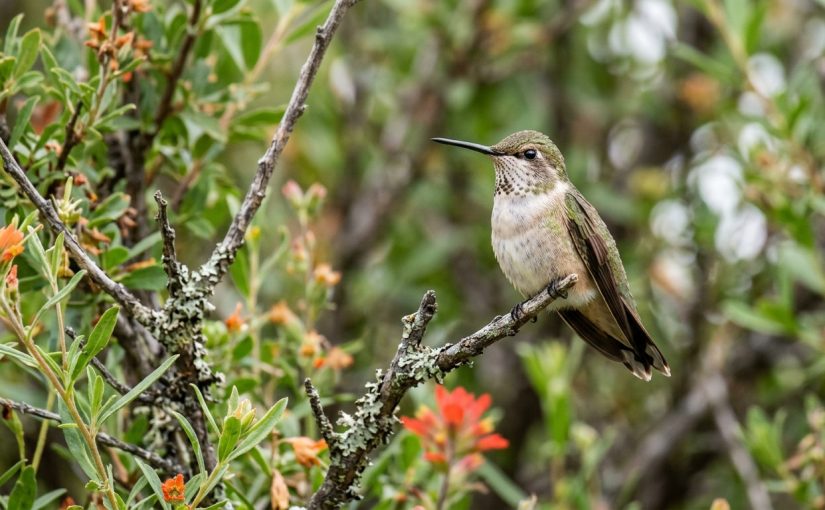
You’re watching a small bird hover at your feeder, its wings a blur. It’s definitely a hummingbird, but where are the brilliant reds, purples, or fiery oranges you expected? Instead, you see mostly green and white. You’ve likely spotted a female, and you’re about to learn exactly how to confirm it.
Female hummingbirds typically display green backs, white or buff underparts, and lack the vibrant throat patches of males. Successful identification requires observing size, tail patterns, flank coloring, and bill shape. Most backyard species share similar features, making location and subtle markings your best identification tools. Practice with common species first before attempting rare visitors.
Why females look so different from males
Male hummingbirds evolved their flashy colors for one reason: attracting mates. Those iridescent gorgets (throat patches) and bold crown colors serve as advertisements during breeding season.
Females don’t need this attention. They benefit from camouflage while sitting on nests for weeks at a time. Predators like jays, hawks, and even praying mantises hunt hummingbirds. A drab green back helps females blend into foliage.
This extreme difference between sexes is called sexual dimorphism. In hummingbirds, it’s dramatic. A male Ruby-throated Hummingbird sports a brilliant red throat. The female of the same species shows white underparts with no red at all.
The challenge for birdwatchers? Nearly all female hummingbirds across North America share the same basic color scheme. Green back, pale belly, some variation of spots or streaks on the throat.
The baseline female hummingbird appearance
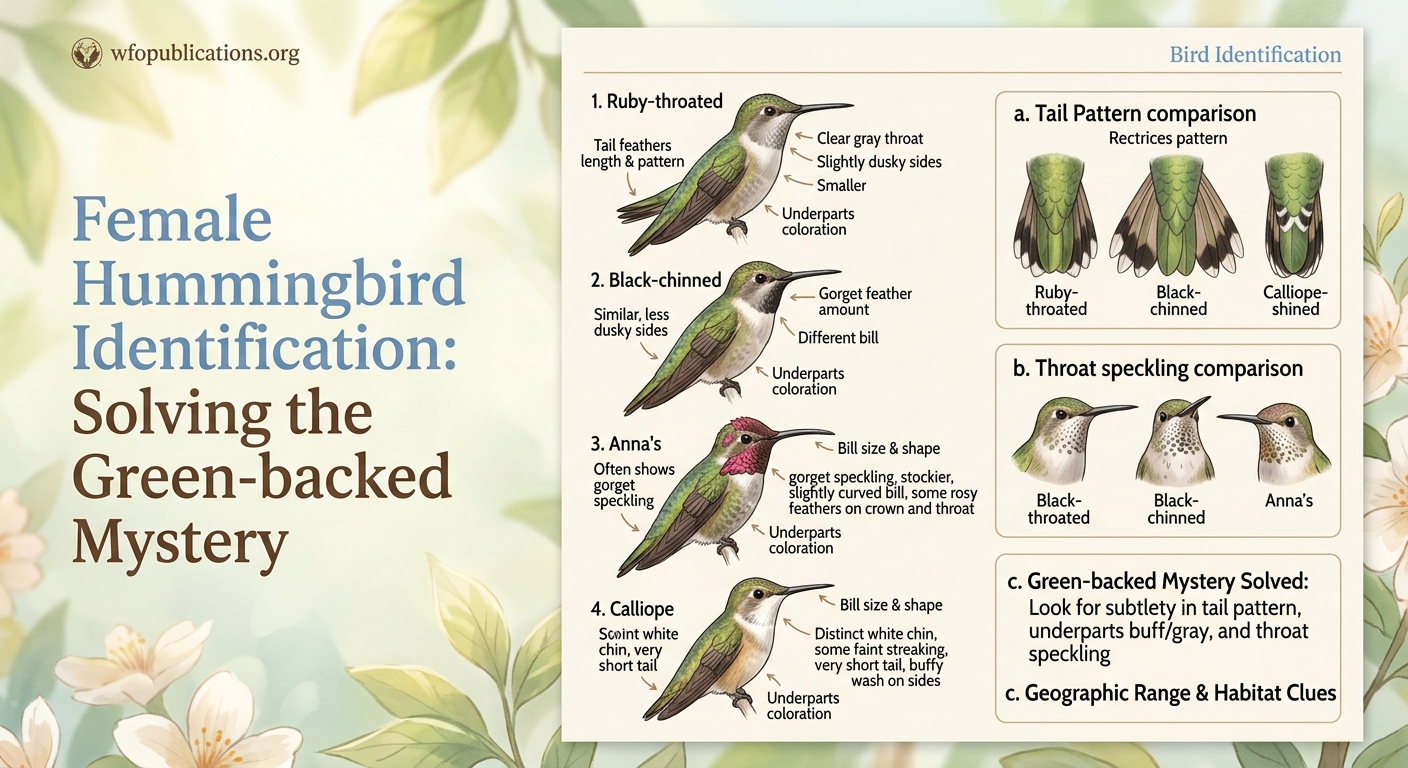
Before you can identify which species you’re seeing, learn what nearly all females have in common.
Upper parts: Metallic green covering the head, back, and upper tail. This green can range from bronze-green to emerald, but it’s always present.
Under parts: White, buff, or pale gray from chin to belly. Some species show a wash of cinnamon or rust on the sides.
Throat: Usually white or pale with fine dark spots or streaks. Never a solid, brilliantly colored gorget like males display.
Tail: Rounded or slightly notched (not deeply forked like some males). Tail feathers often show white tips or corners.
Size: Most North American hummingbirds measure 3 to 4 inches long. Females often appear slightly larger than males of the same species because they need body mass for egg production.
Step-by-step identification process
Follow this sequence every time you see a potential female hummingbird. Taking notes helps tremendously, even if they’re just mental notes.
-
Confirm it’s a hummingbird first. Watch the flight pattern. Hummingbirds can fly backward and hover in place. They beat their wings in a figure-eight pattern. No other North American bird does this.
-
Note your location. Geography eliminates most species immediately. Only one species regularly occurs east of the Mississippi River. Western states host a dozen or more.
-
Observe the tail closely. Look for white tips, rufous (reddish-brown) coloring, or black bands. Tail shape and color provide the most reliable field marks for females.
-
Check the flanks and sides. Some species show rufous, buff, or cinnamon coloring along the sides under the wings. Others remain pure white.
-
Measure the bill visually. Is it straight, slightly curved, or noticeably long compared to the head? Bill shape varies between species.
-
Listen for sounds. Males vocalize more, but females make chips and calls too. Each species has distinct vocalizations.
Geographic shortcuts for identification
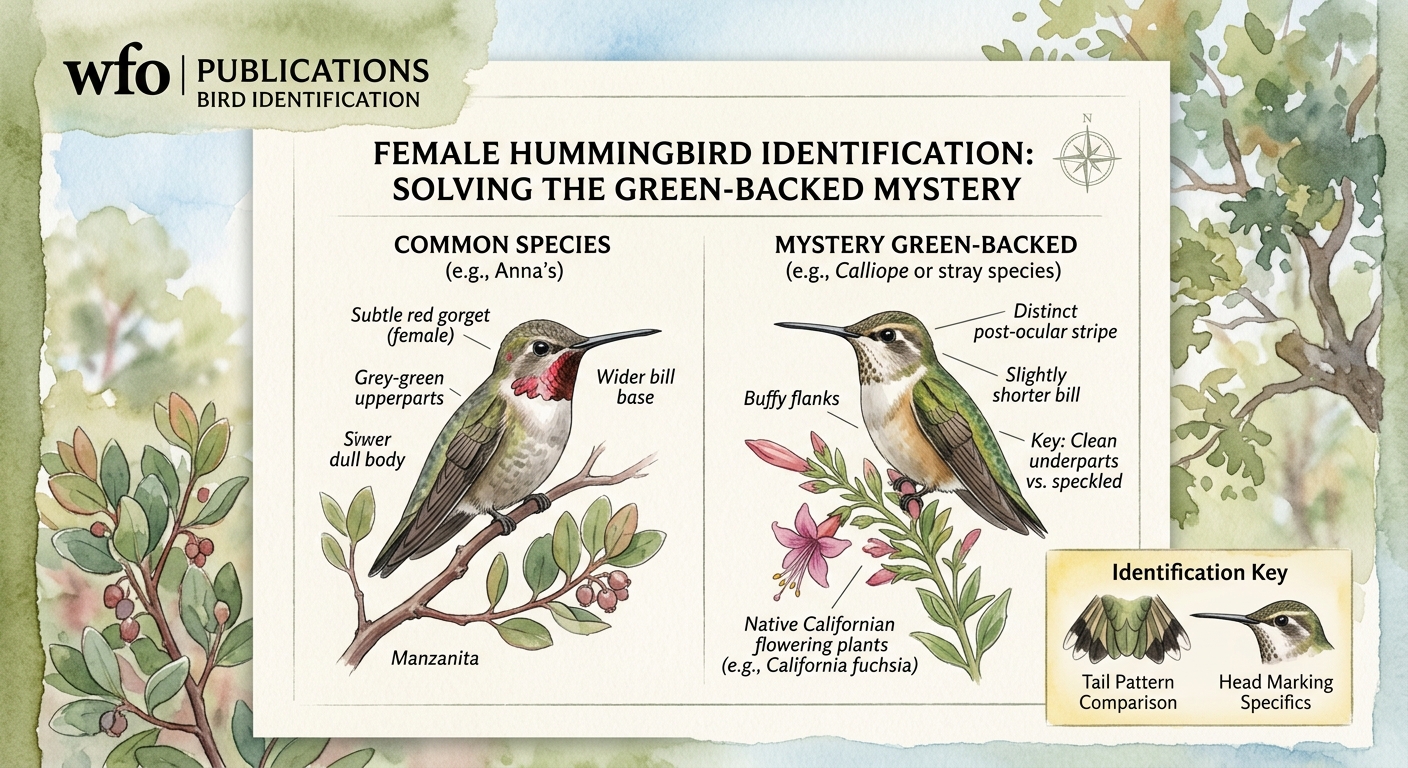
Your location solves half the puzzle before you even look closely at field marks.
Eastern United States: The Ruby-throated Hummingbird accounts for 99% of sightings. Females show white underparts, green backs, and white-tipped outer tail feathers. Occasional Rufous Hummingbirds appear during fall migration, especially along the Gulf Coast.
Pacific Coast: Anna’s Hummingbird dominates year-round. Females have gray-green underparts (not pure white) and lack rufous coloring. Allen’s and Rufous Hummingbirds migrate through, both showing extensive rufous on the tail and flanks.
Southwest deserts: Black-chinned, Costa’s, and Broad-tailed Hummingbirds overlap. Habitat preference helps here. Black-chinned prefers riparian areas. Costa’s loves true desert. Broad-tailed favors mountain meadows.
Rocky Mountains: Broad-tailed, Rufous, and Calliope Hummingbirds share territory during summer. Size differences become important. Calliope is noticeably smaller than the other two.
The most common species and their females
Let’s break down the species you’re most likely to encounter.
Ruby-throated Hummingbird
Range: Eastern North America, from Canada to Gulf of Mexico.
Female features:
– Clean white throat and breast
– Green crown and back
– Rounded tail with white tips on outer three feathers
– No rufous anywhere on the body
This is the default female hummingbird for most North American birdwatchers. If you live east of the Great Plains and see a green-backed hummingbird without red on the throat, it’s almost certainly this species.
Anna’s Hummingbird
Range: Pacific Coast, year-round resident.
Female features:
– Dingy gray or gray-green underparts (not bright white)
– Small red spots often present on throat
– Tail lacks white tips
– Stockier build than Ruby-throated
Anna’s females occasionally show small iridescent red feathers on the throat. These aren’t organized into a gorget but appear as scattered spots.
Rufous Hummingbird
Range: Pacific Northwest breeding, migrates through Western states.
Female features:
– Extensive rufous on tail base and outer feathers
– Rufous wash on flanks
– Green back with some rufous mixed in (variable)
– White breast with rufous spots on throat
The rufous tail color is the giveaway. Both Allen’s and Rufous females look nearly identical and require expert-level observation to separate.
Black-chinned Hummingbird
Range: Western mountains and foothills.
Female features:
– Very similar to Ruby-throated (they’re closely related)
– Slightly longer bill
– Tail pattern nearly identical to Ruby-throated
– Requires range confirmation for confident ID
If you see a Ruby-throated lookalike in the West, it’s probably Black-chinned. These two species replace each other geographically.
Calliope Hummingbird
Range: Mountain West, migrates to Mexico.
Female features:
– Noticeably smaller than other species (barely 3 inches)
– Short bill
– Peachy or cinnamon wash on flanks
– Tail extends beyond wingtips at rest
The tiny size stands out immediately when Calliope appears at a feeder with other species.
Field marks that actually matter
Some identification guides overwhelm you with details. Focus on these proven field marks for female hummingbird identification.
| Feature | What to Look For | Why It Matters |
|---|---|---|
| Tail color | Rufous, black bands, or white tips | Single most reliable mark for females |
| Flank color | White, buff, rufous, or gray | Separates similar species |
| Throat pattern | Clean white, spotted, or small gorget | Some females show minimal color |
| Overall size | Compare to known species | Calliope noticeably smaller |
| Bill length | Short, medium, or long relative to head | Eliminates some possibilities |
| Tail projection | Does tail extend past wings at rest? | Helpful for Calliope and others |
Common identification mistakes
Even experienced birdwatchers make these errors. Knowing them helps you avoid false conclusions.
Assuming all green-backed hummingbirds are female: Juvenile males look identical to females until they molt into adult plumage. Young males may show the first hints of gorget color as scattered iridescent feathers.
Expecting females to lack color entirely: Anna’s, Broad-tailed, and other species’ females can display small amounts of iridescent throat color. It won’t form a complete gorget but appears as spots.
Ignoring time of year: Migration timing eliminates species. Rufous Hummingbirds appear in the East only during fall and winter, never in spring or summer.
Relying on a single field mark: Lighting affects color perception dramatically. Confirm identification with multiple features.
Confusing worn plumage with species differences: Late summer birds show faded, worn feathers. Fresh fall plumage looks brighter and more defined.
Photographing for later identification
You can’t always identify a hummingbird in real time. Photos preserve details for careful study.
Aim for these specific shots:
- Spread tail from below: Captures tail pattern and any white tips or rufous coloring
- Side profile at rest: Shows flank color, bill length, and overall proportions
- Throat close-up: Documents any spots, streaks, or iridescent feathers
- Back and wings: Confirms green coloring and checks for any rufous in the back
Even blurry photos help if they show the tail pattern clearly. That single feature often clinches the identification.
Use burst mode if your camera has it. Hummingbirds rarely stay still for more than a second or two.
Behavioral clues worth noting
How a hummingbird acts provides supporting evidence for identification.
Feeding preferences: Some species prefer certain flower colors or shapes. Anna’s Hummingbirds readily use feeders year-round. Calliope often feeds lower in the understory.
Territorial behavior: Females defend feeding territories less aggressively than males but still chase intruders. The intensity varies by species.
Perching habits: Some species perch in the open on bare twigs. Others hide in dense foliage. Note where your bird rests between feeding bouts.
Flight style: Rufous Hummingbirds fly with more direct, purposeful flight. Anna’s often hover and investigate objects closely.
None of these behaviors alone confirms species, but they add supporting details.
When to call it an identification challenge
Sometimes you simply can’t make a certain identification. That’s fine. Honest uncertainty beats false confidence.
“The hardest thing for beginning birdwatchers to accept is that some birds leave without giving you enough looks for a positive ID. Female hummingbirds in particular can vanish before you’ve seen the critical field marks. Note what you did see, and move on.” – Field ornithologist perspective
Situations that warrant caution:
- Brief sighting with no tail view
- Backlighting that obscures color
- Distant bird that won’t approach closer
- Unusual vagrant far outside normal range
- Worn plumage obscuring key marks
Report these as “hummingbird species” rather than guessing. Your field notes might help later if the bird returns.
Tools that improve your success
Certain equipment and resources make female hummingbird identification significantly easier.
Binoculars: 8×42 or 10×42 models work well. You need close focus capability (under 6 feet) because hummingbirds often feed very close to observers.
Field guide: Choose one with range maps and multiple illustrations showing variation. Digital guides on phones work great because you can check them instantly.
Notebook: Record date, time, location, and specific features you observe. These notes become valuable over time as you learn patterns.
Feeder placement: Position feeders where you can observe from 10 to 15 feet away. Too close and you can’t use binoculars. Too far and you miss details.
Camera with zoom: Even a smartphone with decent zoom helps. Review photos later when you have time to study field marks carefully.
Building your identification skills over time
Nobody becomes expert at female hummingbird identification overnight. The skill builds through repeated observation.
Start with your most common local species. Learn that female perfectly. Study every individual that visits your yard. Notice the variation within a single species.
Then add one new species at a time. If you live where Rufous Hummingbirds migrate through, focus on separating them from your resident species.
Keep a yard list with notes about when different species appear. Patterns emerge. You’ll learn that certain species arrive during specific weeks each year.
Join local birding groups. Experienced birders share knowledge generously. They’ll point out field marks you’ve been missing.
Submit photos to identification forums or apps. Getting feedback from experts accelerates learning.
Your next backyard hummingbird
The green-backed hummingbird at your feeder isn’t a mystery anymore. You know to check the tail for white tips or rufous coloring. You’ll note the flank color and compare the bill length to the head size. Your location eliminates most possibilities before you even raise your binoculars.
Female hummingbird identification takes practice, but every sighting builds your skills. That plain-looking bird represents a female perfectly adapted to survive and raise the next generation. Her camouflage serves a purpose just as important as any male’s flashy colors. Now you have the knowledge to appreciate both.