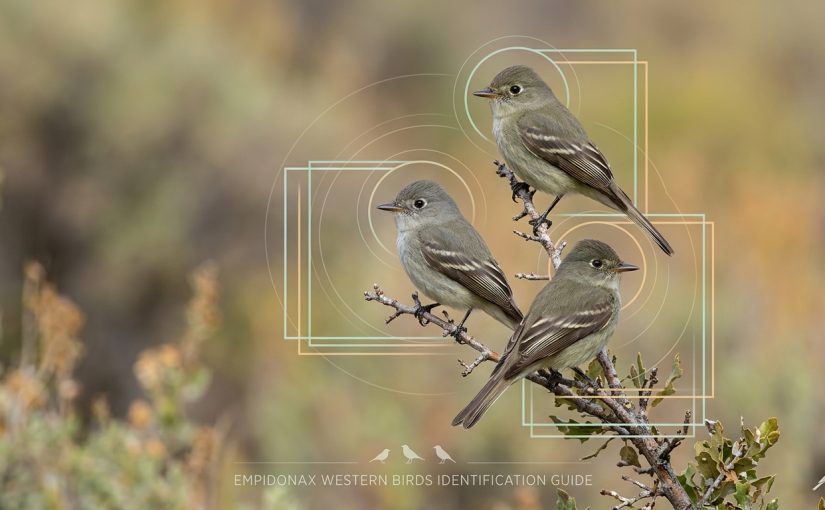
Standing in a willow thicket at dawn, you watch a small gray-green flycatcher perch on a branch. It flicks its tail, pumps its wings, and sallies for an insect. But which Empidonax is it? That question has frustrated birders for generations. These small tyrant flycatchers look maddeningly similar, and even experienced observers can struggle to separate them in the field. The good news is that with the right combination of field marks, behavior, voice, and habitat context, you can confidently identify most Empidonax species you encounter in western North America.
Empidonax flycatcher identification requires multiple clues working together. Vocalizations provide the most reliable field mark, but plumage details like eye-ring shape, wing bar contrast, and primary projection help narrow possibilities. Habitat and elevation preferences eliminate unlikely species. Behavioral cues including tail-flicking patterns and foraging style add supporting evidence. Mastering these layered identification techniques transforms frustrating “empid” encounters into confident species determinations across western North America’s diverse flycatcher communities.
Why Empidonax flycatchers confuse everyone
Eleven Empidonax species breed in North America, with nine occurring regularly in the West. Evolution shaped them into ecological specialists occupying different niches, but convergent evolution gave them remarkably similar appearances. Most share olive-gray upperparts, pale underparts, white eye-rings, and two pale wing bars.
The challenge stems from overlap. Plumage variation within a single species often exceeds differences between species. A bright Dusky Flycatcher can look more colorful than a drab Hammond’s. Fresh fall birds show crisper patterns than worn breeding adults. Age and sex add further variation.
Field guides traditionally emphasized subtle plumage differences. Primary projection, bill shape, and eye-ring thickness do matter. But relying solely on these marks leads to misidentification. The most skilled observers use a holistic approach combining multiple data streams.
Vocalizations as your primary tool
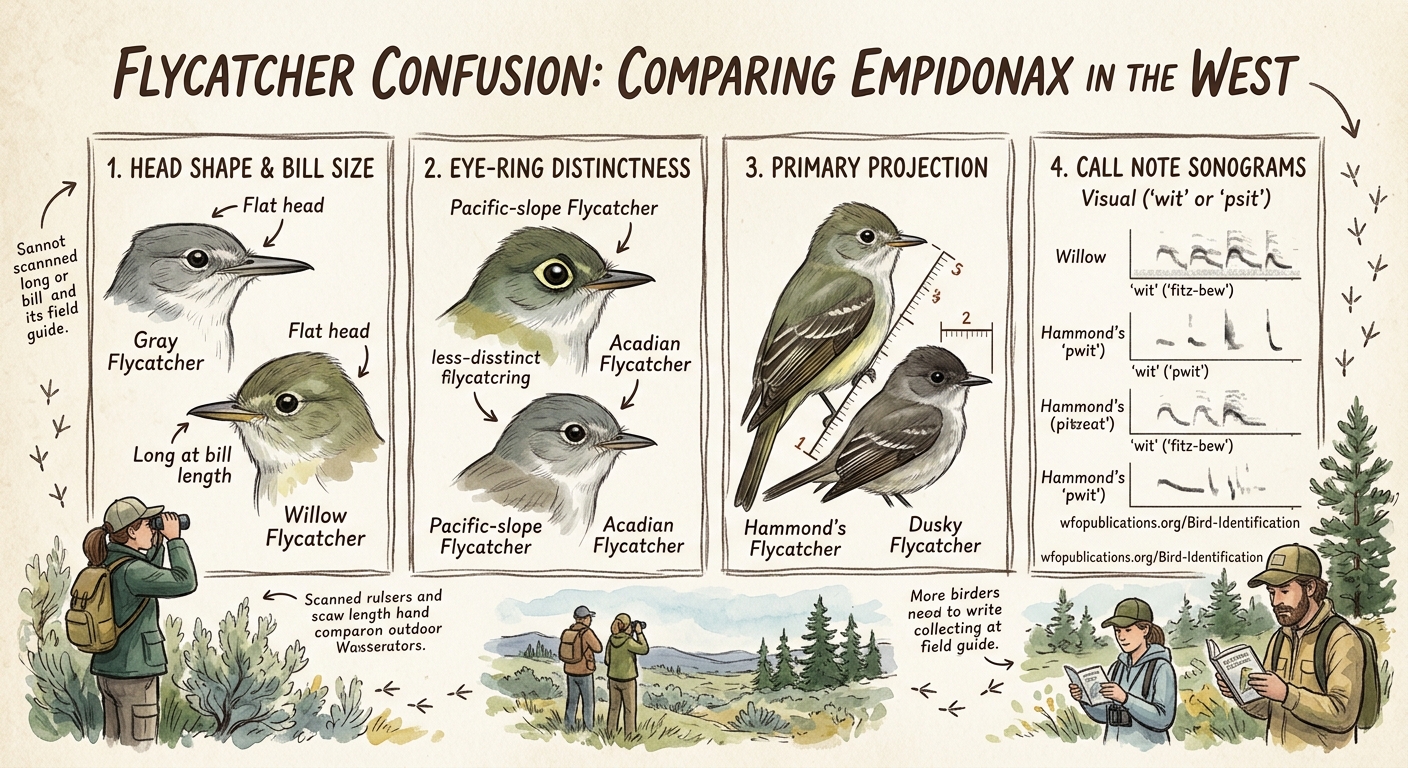
Song and call notes separate Empidonax species more reliably than any visual field mark. Each species has distinctive vocalizations shaped by sexual selection and the need to avoid hybridization with close relatives.
Learning these voices takes effort, but the investment pays dividends. A singing Cordilleran Flycatcher announces itself with a two-part “pseet-tsurp” phrase. Pacific-slope Flycatcher delivers an upslurred “pseet” followed by a thin “tseet.” Gray Flycatcher sings a vigorous two-part “chi-wit, chi-wip” with the second syllable dropping in pitch.
Call notes matter equally. Willow Flycatcher gives a liquid “fitz-bew.” Alder Flycatcher offers a burry “fee-bee-o” with emphasis on the middle syllable. Dusky Flycatcher produces a soft “whit” or “dull-ip.” Hammond’s delivers a sharp “peek.”
“If an Empidonax is vocalizing, you can identify it. If it’s silent, you can make an educated guess based on everything else, but sometimes you just have to let it go.” — Kenn Kaufman
Recording apps on your phone let you capture unfamiliar songs for later analysis. Memorizing the common species in your region builds a mental library. During migration, expect silent birds. That’s when other clues become essential.
Structural features that actually help
While plumage color varies, structural proportions stay relatively consistent. Primary projection, the distance wingtip feathers extend beyond the tertials on a folded wing, differs among species.
Hammond’s Flycatcher shows long primary projection, often two-thirds the length of the exposed tertials. The wingtip looks pointy. Dusky Flycatcher has shorter primaries, creating a more compact wing profile. Gray Flycatcher shows intermediate projection.
Bill structure provides another clue. Willow and Alder flycatchers have broader, flatter bills adapted for aerial hawking in open areas. Hammond’s sports a shorter, thinner bill for gleaning insects from foliage. Pacific-slope and Cordilleran show broader bills with pale orange lower mandibles.
Tail length relative to wing length creates different silhouettes. Gray Flycatcher has a notably long tail it dips slowly downward. Dusky shows a shorter tail it flicks upward. Hammond’s appears compact and round-headed.
| Species | Primary Projection | Bill Shape | Tail Behavior |
|---|---|---|---|
| Hammond’s | Long (2/3 tertials) | Short, thin | Occasional flick |
| Dusky | Short (1/2 tertials) | Medium | Brisk upward flick |
| Gray | Medium | Medium, bicolored | Slow downward dip |
| Willow | Medium | Broad, flat | Subtle movement |
| Pacific-slope | Medium-long | Broad, orange base | Moderate flick |
Plumage details worth noting
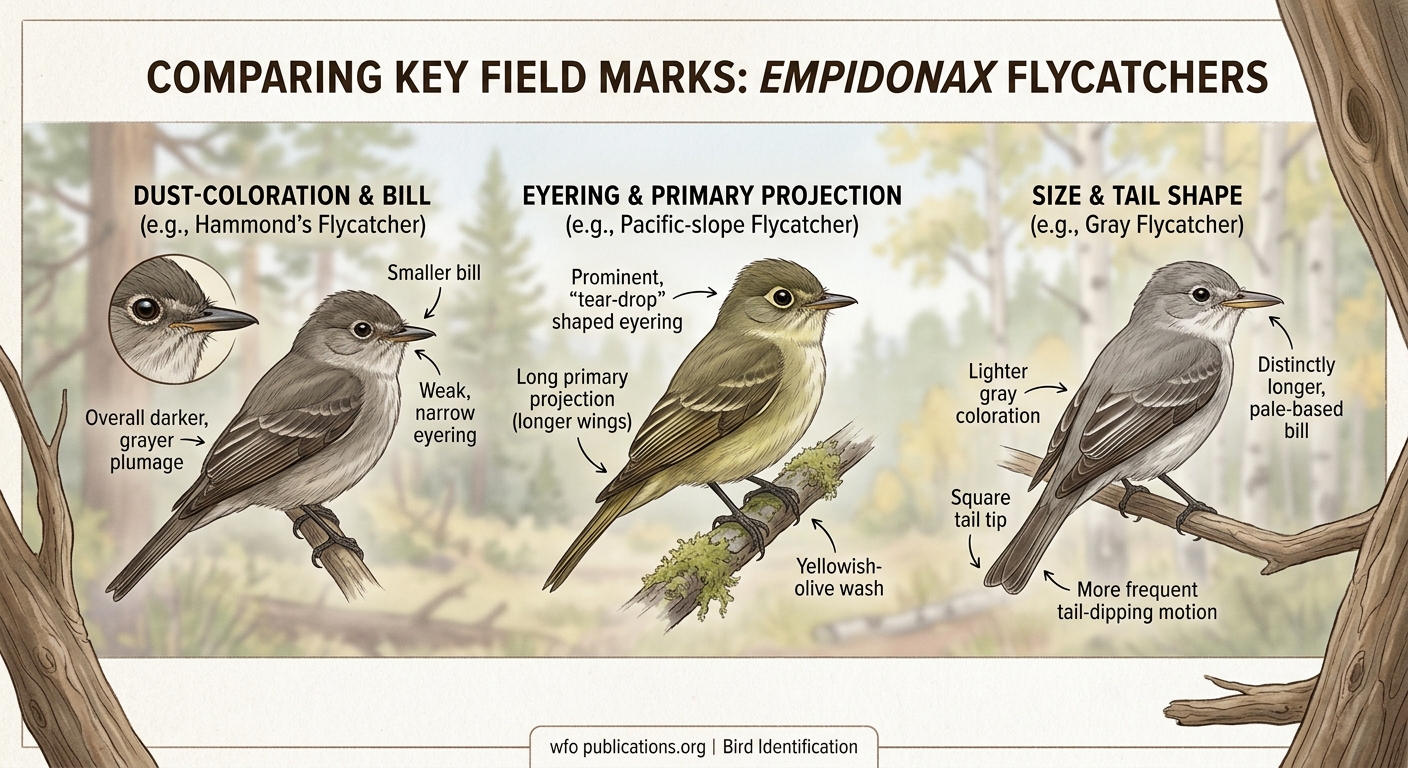
Eye-ring shape separates some species pairs. Hammond’s typically shows a teardrop eye-ring, slightly wider behind the eye. Dusky often displays a more uniform, bold eye-ring. Gray Flycatcher has a thin, delicate eye-ring that may appear broken.
Wing bar contrast helps in good light. Fresh Hammond’s shows crisp white wing bars contrasting sharply with dark wing feathers. Dusky has buffy or pale yellow wing bars with less contrast. Cordilleran and Pacific-slope display yellowish wing bars.
Throat color provides a subtle clue. Gray Flycatcher usually shows a whiter throat contrasting with a grayish breast. Dusky has a more evenly colored throat and breast. Hammond’s often appears darker overall with less throat contrast.
Underpart color ranges from white to yellow. Western species generally show less yellow than eastern counterparts. Pacific-slope and Cordilleran display the most yellow, especially on the belly and undertail coverts. Hammond’s appears grayer. Gray Flycatcher looks the palest.
Habitat narrows the possibilities
Each Empidonax species prefers specific breeding habitats, and recognizing these associations eliminates unlikely candidates.
- Hammond’s Flycatcher breeds in mature coniferous forests, especially at higher elevations with spruce, fir, and hemlock.
- Dusky Flycatcher occupies mountain shrublands, often in chaparral, sagebrush, or young aspen stands between 5,000 and 10,000 feet.
- Gray Flycatcher selects dry, open pinyon-juniper woodlands and sagebrush with scattered trees, typically below 8,000 feet.
- Cordilleran Flycatcher nests along mountain streams in mixed conifer forests, often near water features.
- Pacific-slope Flycatcher prefers moist coastal forests and riparian woodlands from sea level to mid-elevations.
- Willow Flycatcher inhabits dense willow thickets and wet shrubby areas, often in valleys and foothills.
During migration, habitat becomes less diagnostic. Empids appear in city parks, desert oases, and coastal scrub. But in breeding season, a flycatcher in sagebrush is far more likely to be Dusky or Gray than Hammond’s.
Elevation provides additional context. Finding a singing empid at 9,000 feet in a spruce forest points strongly toward Hammond’s. The same habitat at 6,000 feet might host Dusky in adjacent shrubby openings.
Behavioral clues that support identification
Foraging style varies subtly among species. Hammond’s typically hawks insects from mid to upper canopy levels, making short flights from a perch. Dusky forages lower, often in shrub layers, with more hovering and gleaning. Gray Flycatcher hunts from low perches, frequently dropping to the ground for prey.
Tail movements create distinctive impressions. Gray Flycatcher’s slow, downward tail dip becomes obvious once you know to watch for it. Dusky gives brisk upward flicks. Hammond’s flicks less frequently. These movements happen constantly, providing behavioral signatures.
Perch height preferences differ. Pacific-slope and Cordilleran often perch in shaded understory or mid-canopy near streams. Hammond’s selects higher, more exposed perches in tall conifers. Willow stays low in dense shrubs.
Wing-flicking accompanies tail movements in some species. Dusky often flicks both wings and tail. Hammond’s shows more restrained movements. These behavioral tics become recognizable with experience.
Tackling the toughest confusion pairs
Some species pairs cause particular trouble. Pacific-slope and Cordilleran flycatchers were considered one species until 1989. They remain nearly identical visually, separating reliably only by voice. Pacific-slope occurs along the coast and western mountain slopes. Cordilleran breeds in interior mountains. Their ranges meet in British Columbia and the northern Cascades, where hybrids occur.
Willow and Alder flycatchers present another classic challenge. Alder breeds farther north and at higher elevations in the West, favoring alder thickets near streams. Willow occupies lower elevation willow habitats. Voice provides the only reliable field mark. Alder’s “fee-bee-o” contrasts with Willow’s “fitz-bew.” Silent birds often go unidentified.
Hammond’s versus Dusky confuses many observers. Focus on primary projection first. Hammond’s shows longer wingtips. Check the eye-ring. Hammond’s teardrop shape differs from Dusky’s bolder, rounder ring. Listen for calls. Hammond’s “peek” sounds sharper than Dusky’s “whit.” Note the habitat. Hammond’s prefers tall conifers while Dusky likes shrubby areas.
Building your identification process
Developing a systematic approach improves accuracy. Start with what you can determine most reliably.
- Listen first. If the bird vocalizes, you may have an instant identification.
- Note the habitat and elevation. This eliminates several species immediately.
- Observe behavior. Watch tail movements, foraging height, and perch selection.
- Study structure. Evaluate primary projection, bill shape, and overall proportions.
- Examine plumage last. Check eye-ring shape, wing bar color, and underpart tone.
Avoid anchoring on a single field mark. That crisp eye-ring might suggest Dusky, but if the bird is singing Hammond’s song in a tall spruce, it’s a Hammond’s with a bold eye-ring. Multiple clues pointing toward the same species build confidence.
Photograph birds when possible. Images let you study details at home, measure primary projection accurately, and consult with other birders. But don’t rely solely on photos. Silent birds in atypical habitats during migration may remain unidentifiable.
Common mistakes to avoid
| Mistake | Why It Happens | Better Approach |
|---|---|---|
| Identifying silent migrants by plumage alone | Field guides emphasize visual marks | Accept uncertainty, use “Empidonax sp.” |
| Ignoring habitat context | Focus on the bird, not surroundings | Consider habitat before plumage |
| Relying on a single field mark | Wanting a simple answer | Use multiple supporting clues |
| Misidentifying worn birds | Plumage varies by season | Factor in date and feather condition |
| Forcing rare species | Excitement over unusual finds | Expect common species first |
Worn summer birds look different from fresh spring arrivals. By July, many flycatchers show abraded feathers, faded colors, and indistinct wing bars. A worn Hammond’s may lack its typical crisp appearance. Recognizing seasonal plumage variation prevents misidentification.
Rare species attract attention, but most empids you see will be common local breeders. That bird in coastal Oregon is far more likely to be Pacific-slope than Cordilleran. Probability matters.
Regional patterns across the West
Western North America’s varied geography creates distinct regional empid communities. Learning which species occur in your area focuses your identification efforts.
Pacific Northwest coastal areas host Pacific-slope Flycatcher in forests, with Willow in lowland wetlands. Hammond’s breeds in mountain conifers. Dusky appears in higher elevation shrublands.
The interior Northwest features Cordilleran in mountain riparian zones, Hammond’s in conifer forests, Dusky in mountain brush, and Gray in dry pine-juniper woodlands. Willow occupies valley willow thickets.
The Southwest adds variety. Cordilleran breeds in mountain canyons. Dusky and Hammond’s occupy appropriate elevations and habitats. Gray Flycatcher becomes common in pinyon-juniper. Buff-breasted Flycatcher appears in southeastern Arizona and southwestern New Mexico canyons.
California’s diversity is exceptional. Pacific-slope dominates coastal forests. Willow breeds in valley wetlands. Hammond’s and Dusky occupy Sierra Nevada elevations by habitat. Gray appears in eastern Sierra and Great Basin habitats.
Seasonal timing and migration
Breeding season offers the best identification opportunities. Males sing persistently from late May through July, advertising territories. Habitat associations are strongest. Behavior is most typical.
Spring migration brings challenges. Birds move through rapidly, often silently. They appear in atypical habitats. A Hammond’s might spend a morning in a city park before continuing to mountain breeding grounds. Identifying silent spring migrants requires careful attention to structure and plumage.
Fall migration presents the toughest conditions. Birds are silent. Juveniles show fresh but sometimes atypical plumage. Species mix in the same habitats. Many experienced birders leave fall empids unidentified unless circumstances are exceptional.
Arrival and departure dates provide clues. Pacific-slope arrives earlier in spring than Hammond’s in many areas. Gray Flycatcher departs earlier in fall than Dusky. Knowing local phenology helps assess likelihood.
Practicing your skills
Improvement comes through repeated observation. Visit known breeding sites during peak song season. Watch territorial males for extended periods. Note how individuals vary in appearance. Memorize songs and calls.
Record your observations. Write detailed notes describing what you see and hear. Sketch field marks. This active engagement builds neural pathways stronger than passive watching.
Study spectrograms of empid vocalizations. Visual representations of sound help distinguish similar calls. Apps like Merlin Sound ID can analyze recordings, but learning to recognize songs yourself provides deeper understanding.
Connect with local experts. Join birding groups. Ask experienced observers to point out empids and explain their identification process. Different people notice different clues.
Accept uncertainty. Even experts encounter birds they cannot identify. A silent empid in migration, backlit in dense foliage, may remain a mystery. That’s part of the challenge and the appeal.
Taking your skills into the field
Confidence with Empidonax flycatcher identification opens new dimensions in your birding. These common but challenging species appear throughout western forests, mountains, and wetlands. Each encounter becomes an opportunity to test your skills and refine your understanding.
Start with your local breeding species. Master those thoroughly before tackling rare vagrants or difficult migrants. Build from a foundation of solid knowledge about common birds. That Hammond’s singing in your neighborhood spruce forest teaches you more than a dozen photos of rarities.
Carry a notebook or use a birding app to record details. Date, location, habitat, behavior, and vocalizations all matter. Reviewing these notes later reinforces learning and helps you recognize patterns.
Most importantly, enjoy the process. Empid identification is genuinely difficult. The challenge is real, not a reflection of your abilities. Each species you confidently identify represents genuine achievement. Each mystery bird teaches you something. Over time, those confusing gray flycatchers transform into distinct individuals with recognizable voices, behaviors, and personalities. That transformation makes every willow thicket and mountain forest richer with possibility.