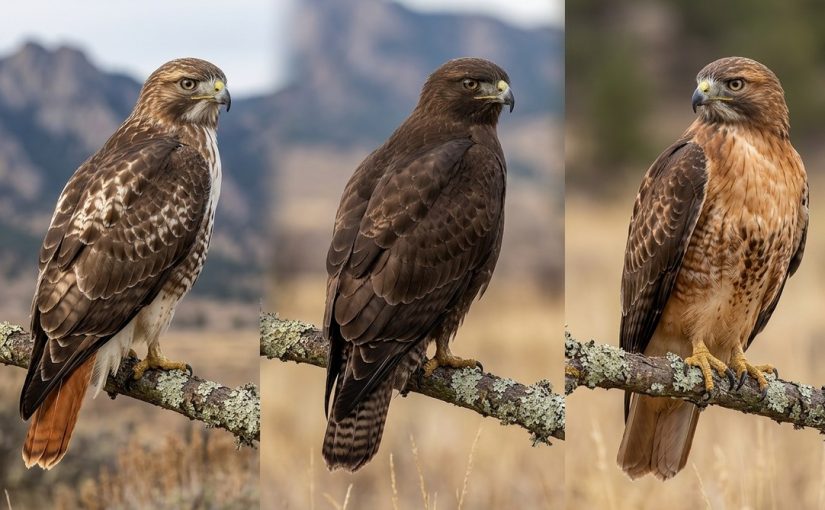
You’re watching a large buteo soar overhead, tail glowing russet in the afternoon sun. But something feels different. The belly band looks darker than usual, or maybe the bird seems paler overall. You start to wonder if this is just a typical red-tailed hawk or one of the many subspecies that roam across the continent.
Red-tailed hawks comprise 14 recognized subspecies across North America, each with distinct plumage variations, size differences, and regional ranges. Western populations show the most dramatic color morphs, from nearly white to chocolate brown, while eastern birds display more consistent patterns. Accurate identification requires attention to belly bands, patagial marks, tail color, and geographic location combined with an understanding of individual variation within each subspecies.
Understanding the Subspecies Framework
The red-tailed hawk species contains more variation than almost any other North American raptor. Scientists recognize 14 subspecies based on size, plumage patterns, and geographic distribution.
These subspecies aren’t just academic categories. They represent real differences you can observe in the field.
The eastern red-tailed hawk (Buteo jamaicensis borealis) serves as the baseline most birders learn first. This is the classic hawk with a white chest, dark belly band, and brick-red tail. But step west of the Great Plains and the rules change completely.
Western populations show a spectrum of color morphs that can make identification genuinely challenging. Light morph, dark morph, and intermediate forms all occur within the same subspecies, sometimes even within the same breeding population.
Eastern Subspecies and Their Ranges
The eastern red-tailed hawk dominates from the Atlantic coast to the Great Plains. Adults show consistent patterns: dark patagial marks on the leading edge of the underwing, a variable belly band, and that signature red tail.
Juvenile eastern birds lack the red tail entirely. They show multiple thin dark bands on a gray-brown tail instead.
The northern subspecies (B. j. abieticola) breeds across Canada and Alaska. These birds tend toward larger body size and darker overall plumage. The belly band often appears heavier and more extensive than in southern populations.
Florida hosts B. j. umbrinus, a smaller, paler subspecies adapted to subtropical conditions. These birds show reduced belly bands and lighter overall coloration, an adaptation that likely helps with thermoregulation in hot climates.
Western Color Morphs Change Everything
Western red-tailed hawks (B. j. calurus) present the greatest identification challenge. This single subspecies produces light, dark, and intermediate morphs in varying proportions across its range.
Light morph calurus resembles the eastern subspecies but often shows a richer, more rufous wash on the underparts. The belly band may appear more diffuse or broken into streaks rather than forming a solid band.
Dark morph birds look completely different. The entire body appears chocolate brown to nearly black, with only the tail remaining red. Some individuals show such dark plumage that even the tail color becomes obscured.
Intermediate morphs fall somewhere between these extremes. You might see a bird with a dark chest but lighter belly, or heavy rufous coloring throughout the underparts with a visible but indistinct belly band.
The proportion of morphs varies geographically. In parts of the Great Basin and Intermountain West, dark morphs make up 20% or more of the population. Coastal populations tend toward lighter morphs.
Southwestern Desert Specialists
The southwestern United States hosts several distinctive subspecies adapted to arid environments.
Buteo jamaicensis fuertesi occupies the southwestern deserts and northern Mexico. These birds show pale overall coloration with reduced markings, helping them blend with desert landscapes. The tail often appears more orange than red.
Fuertes’s red-tailed hawk was once considered a separate species. Modern genetic analysis confirms subspecies status, but the birds remain visually distinctive enough to warrant attention.
B. j. hadropus ranges through parts of the Southwest and into Mexico. This subspecies shows intermediate characteristics between eastern and western forms, with moderate belly bands and variable rufous tones.
Great Plains and Prairie Populations
Krider’s red-tailed hawk (B. j. kriderii) represents one of the most striking pale morphs. These birds breed in the northern Great Plains and show remarkably white plumage.
Adult Krider’s hawks often appear almost ghostly. The head, chest, and underparts show extensive white with minimal markings. The tail may appear pale pink rather than deep red, and some individuals show white tails with faint reddish tones.
These birds migrate south in winter, sometimes appearing as far as Texas and Oklahoma. Spotting a Krider’s hawk among typical eastern birds creates a memorable moment. The contrast is striking.
Harlan’s hawk (B. j. harlani) occupies the opposite end of the spectrum. Breeding in Alaska and northwestern Canada, these birds show extremely dark plumage overall.
Adult Harlan’s hawks often lack the red tail entirely. Instead, the tail appears white, gray, or mottled with dark barring. Some individuals show subtle reddish tones, but many appear completely dark-bodied with a pale tail.
Harlan’s hawks migrate through the central United States in winter. They occasionally appear alongside other subspecies, creating excellent comparison opportunities. If you see a very dark red-tailed hawk with a pale, mottled tail, you’re likely looking at a Harlan’s.
Island and Coastal Variations
Several subspecies occupy islands and coastal regions, showing adaptations to maritime environments.
The Alaskan subspecies (B. j. alascensis) breeds along the coast and shows characteristics intermediate between calurus and harlani. These birds tend toward darker plumage but maintain red tails in most cases.
Caribbean and Central American islands host additional subspecies with restricted ranges. These populations show reduced size and distinctive plumage adaptations, though most North American birders won’t encounter them without traveling south.
Field Identification Strategy
Identifying red-tailed hawk subspecies requires a systematic approach. Start with these steps:
- Note your geographic location and the current season. Range eliminates many possibilities immediately.
- Assess overall plumage tone: pale, typical, or dark. This narrows the field considerably.
- Examine the tail color carefully. Red, pale, white, or mottled patterns provide crucial clues.
- Look for the belly band and note its intensity, whether solid, broken, or absent.
- Check the patagial marks on the underwing leading edge. Dark and prominent versus pale or absent matters.
- Estimate size if other raptors are present for comparison. Subspecies show measurable size variation.
Remember that individual variation exists within every subspecies. Not every eastern red-tailed hawk shows a perfect belly band. Not every calurus displays textbook field marks.
Age complicates identification further. Juveniles of all subspecies lack red tails and show different plumage patterns than adults. A juvenile Harlan’s hawk looks very different from an adult of the same subspecies.
Key Field Marks by Subspecies
| Subspecies | Range | Tail Color | Belly Band | Notable Features |
|---|---|---|---|---|
| Eastern (borealis) | Eastern North America | Bright red | Moderate, variable | Classic pattern, dark patagials |
| Western (calurus) | Western North America | Red (all morphs) | Variable by morph | Multiple color morphs common |
| Northern (abieticola) | Canada, Alaska | Red | Heavy, extensive | Larger size, darker overall |
| Krider’s (kriderii) | Northern Great Plains | Pale pink to white | Minimal or absent | Very pale overall plumage |
| Harlan’s (harlani) | Alaska, NW Canada | White to mottled | Often obscured | Very dark body, pale tail |
| Fuertes’s (fuertesi) | Southwest deserts | Orange-red | Light | Pale desert adaptation |
Common Identification Mistakes
The biggest error birders make is forcing every red-tailed hawk into a subspecies category. Many birds show intermediate characteristics or fall within the normal variation of their subspecies.
Lighting conditions create false impressions. A typical eastern bird in harsh midday sun may appear much paler than the same individual in softer morning light. The tail color especially shifts based on light angle and intensity.
Molt complicates matters. Hawks replacing tail feathers may show a mix of red adult feathers and brown juvenile feathers, creating confusing patterns.
Assuming range equals certainty leads to mistakes. While most red-tailed hawks stay within typical ranges, vagrancy happens. A Krider’s hawk can appear in New England. A dark morph calurus might wander east. If you spot something unusual, documenting your rare bird sighting with photos and detailed notes helps confirm the identification later.
Hybridization between subspecies occurs where ranges overlap. These birds show blended characteristics that don’t fit neatly into any category.
Seasonal Movement Patterns
Many red-tailed hawk subspecies migrate, creating seasonal identification opportunities. Northern breeders move south in fall, concentrating at traditional hawk watch sites.
September through November offers the best chances to compare multiple subspecies side by side. Major flyways like the Atlantic coast, Great Lakes, and Rocky Mountain ridges see thousands of red-tailed hawks passing through.
Harlan’s hawks appear in the central United States primarily from November through March. Finding one requires patience and sorting through many typical red-tails.
Krider’s hawks winter across the southern Great Plains and occasionally wander farther. January and February provide peak viewing opportunities.
Western populations show more complex patterns. Some calurus migrate to Mexico while others remain resident year-round. Dark morphs and light morphs don’t necessarily follow the same movement strategies.
Plumage Variation Within Subspecies
Even after correctly identifying the subspecies, individual variation creates a spectrum of appearances. Eastern red-tailed hawks range from birds with minimal belly bands to individuals with extensive dark underparts.
Rufous tones vary considerably. Some birds show rich cinnamon coloring on the legs and belly while others appear clean white below.
“The key to mastering red-tailed hawk identification is accepting that not every bird fits the field guide perfectly. Learn the typical pattern for each subspecies, then study the variation around that average. The outliers teach you as much as the textbook examples.” — Field ornithologist studying raptor populations across North America
Tail color shows surprising variation even among adults. Some birds display deep brick-red tails while others show orange or pale reddish tones. Wear and sun exposure fade tail color over the course of a year.
Juvenile Identification Challenges
Young red-tailed hawks of all subspecies lack the red tail that makes adults relatively straightforward to identify. Instead, juveniles show brown tails with multiple dark bands.
Juvenile plumage patterns often exaggerate the characteristics of their subspecies. A juvenile Krider’s appears even paler than the already pale adult. A juvenile Harlan’s shows extensive dark plumage but with a banded tail rather than the adult’s pale tail.
The belly band in juveniles often appears as heavy vertical streaking rather than a solid horizontal band. This streaking can cover much of the underparts, making even light morph birds appear quite dark.
Juvenile western red-tails show the same morph variation as adults. A juvenile dark morph calurus appears almost entirely chocolate brown below with heavy streaking throughout.
These young birds retain juvenile plumage through their first year. By the following summer, they begin molting into adult plumage, creating birds with mixed characteristics that challenge even experienced observers.
Using Habitat and Behavior as Clues
While plumage provides the primary identification criteria, habitat preferences and hunting behavior offer supporting evidence.
Krider’s hawks favor open grasslands and agricultural areas, rarely appearing in forested regions. If you’re in dense woods, that pale bird is more likely an unusually light eastern red-tail than a true Krider’s.
Harlan’s hawks often hunt in more open country during winter, favoring prairies and agricultural fields. They perch lower than some other subspecies, frequently using fence posts and small trees.
Desert subspecies like fuertesi prefer arid landscapes with scattered vegetation. Finding one in lush eastern forests would be extraordinary.
Hunting style varies somewhat between populations. Western birds in mountainous terrain often hunt from higher perches and make longer stoops than prairie-dwelling subspecies.
Photography and Documentation Tips
Capturing diagnostic photos of red-tailed hawk subspecies requires patience and strategy. The tail color needs clear documentation, which means photographing the bird from behind or below when the tail is spread.
Underwing patterns matter enormously for separating subspecies. Get shots of the bird in flight showing the full spread wing from below. The patagial marks, belly band, and overall tone all show clearly in these images.
Side profiles help document body size and proportions. Including environmental context helps confirm habitat and location.
Light conditions affect color accuracy significantly. Shoot in even lighting when possible, avoiding harsh midday sun that washes out subtle tones.
Multiple angles tell the complete story. A single photo rarely captures all the diagnostic features needed for confident subspecies identification.
Range Expansion and Vagrant Records
Red-tailed hawk subspecies occasionally appear far outside their typical ranges. Climate change and habitat modification may be shifting some traditional boundaries.
Harlan’s hawks now appear more regularly in eastern states during winter than historical records suggest. Whether this represents increased observation effort or actual range expansion remains debatable.
Dark morph calurus occasionally wander east, sometimes appearing among eastern populations. These birds generate excitement and confusion in equal measure. Unusual sightings like these sometimes appear alongside other unexpected vagrant species that show up outside their normal ranges.
Northern subspecies may be shifting breeding ranges northward as boreal forests expand. Tracking these changes requires long-term monitoring and careful documentation.
Putting Knowledge Into Practice
Understanding red-tailed hawk subspecies transforms casual bird watching into engaged observation. Every soaring buteo becomes an identification puzzle worth solving.
Start with the birds in your local area. Learn their typical patterns thoroughly before attempting to identify unusual visitors. This baseline knowledge makes the exceptions stand out clearly.
Visit hawk watch sites during migration to see multiple subspecies in a short time. The concentrated passage of hundreds or thousands of birds provides unmatched learning opportunities.
Keep detailed notes on every red-tailed hawk you observe carefully. Date, location, lighting conditions, and specific plumage details all matter. These records build your personal reference library over time.
Accept that some birds will remain unidentified to subspecies. The honest answer “red-tailed hawk, subspecies uncertain” demonstrates more understanding than forcing a bird into the wrong category.
The diversity within this single species reflects the varied landscapes of North America. From Arctic tundra to desert Southwest, from Atlantic coast to Pacific shore, red-tailed hawks have adapted to nearly every habitat the continent offers. Each subspecies tells a story of evolution and adaptation, visible in the field marks you can observe through binoculars on any given day.