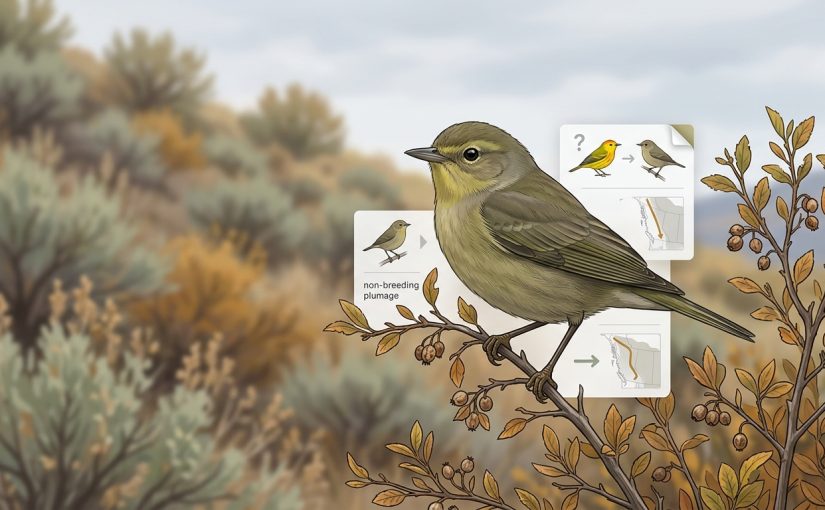
Fall migration brings a puzzle to every birder who watches the trees. Those bright yellow warblers from spring now wear olive and gray. The bold black masks have faded. Even experienced watchers pause longer with their binoculars, flipping through field guides with furrowed brows.
Identifying fall warblers requires shifting focus from bold colors to subtle field marks like wing bars, eye rings, tail spots, and undertail patterns. Behavior and habitat provide crucial context. Most fall warblers show olive or gray tones with yellowish undertail coverts. Learning juvenile and female plumages helps separate confusing species during autumn migration across western North America.
Why fall warblers look so different
Spring male warblers wear their best. Breeding plumage attracts mates and defends territory. Those colors matter for reproduction.
Fall changes everything. Males molt into basic plumage after nesting. Females and juveniles never had bright colors to begin with. The result is a forest full of birds that look remarkably similar.
Most fall warblers share common features. Olive or grayish backs. Pale undersides. Yellowish undertail coverts. Faint wing bars. This convergence happens because these colors provide camouflage during migration.
Your brain wants to see that spring Yellow Warbler. But the bird in front of you might be an Orange-crowned, a Tennessee, or even a young Hermit Warbler. The challenge is real, and every birder faces it.
The three-step approach to fall warbler identification
Successful identification follows a process. Random guessing wastes time and builds frustration. A systematic method builds confidence.
- Note the overall color tone and contrast patterns before the bird moves.
- Look for specific field marks in order: face pattern, wing bars, tail spots, and undertail coverts.
- Consider habitat, behavior, and range to narrow possibilities.
This sequence works because warblers rarely sit still. You need to gather information fast. Starting with overall impression creates a mental framework. Specific marks confirm or reject species. Context eliminates unlikely options.
Critical field marks that separate species
Some marks matter more than others. Learning which features to prioritize saves time in the field.
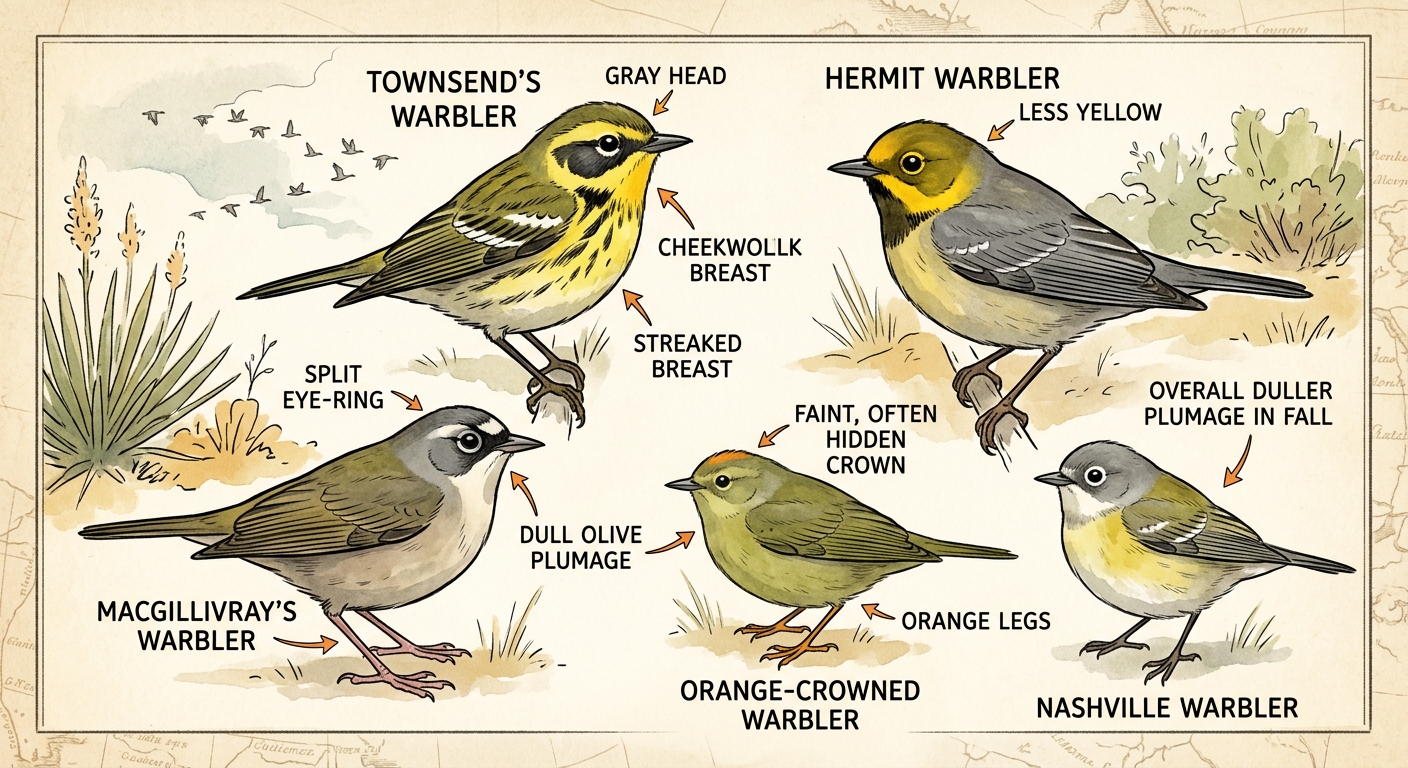
Face patterns tell stories. Eye rings, eye lines, and spectacles separate many confusing species. A complete eye ring suggests Nashville or Connecticut. A broken eye ring with a pale crescent points toward MacGillivray’s. No eye ring at all? Consider Orange-crowned or Tennessee.
Wing bars provide instant clues. Two bold white wing bars appear on many species but vary in thickness and contrast. Faint or absent wing bars narrow your options considerably. Tennessee Warblers lack wing bars entirely in fall. Orange-crowned Warblers show very faint bars that barely register.
Undertail patterns deserve close attention. White tail spots flash when warblers fly. Their size, shape, and position differ by species. Yellow-rumped Warblers show extensive white. Townsend’s Warblers display smaller white patches. Wilson’s Warblers have no white at all.
Undertail coverts often hold the key. These feathers under the tail show color even when the rest of the bird looks drab. Bright yellow undertail coverts appear on many species. White or pale undertail coverts help identify others.
Common fall warblers in western habitats
Geography matters. Western North America hosts different species than the East. Some warblers pass through in large numbers. Others appear rarely.
Yellow-rumped Warblers dominate fall migration. Both Audubon’s and Myrtle subspecies occur, though Audubon’s predominates in the West. Look for the yellow rump patch, which shows even on dull juveniles. They forage at all levels and often catch insects in mid-air.
Orange-crowned Warblers lack obvious field marks, which becomes their field mark. Dull olive overall with a faint eye line and yellowish undertail coverts. The orange crown rarely shows. They skulk in dense brush and often feed low.
Townsend’s Warblers breed in Pacific Northwest forests and migrate through the interior West. Fall birds show a dark cheek patch, yellow breast, and streaked sides. The pattern persists even in dull plumages, making them easier to identify than many species.
Wilson’s Warblers wear their black caps in spring, but fall birds show reduced or absent caps. Females and juveniles appear as small, active, entirely yellow warblers with no wing bars or tail spots. They constantly flick their tails while feeding.
MacGillivray’s Warblers present identification challenges. Fall birds show a grayish hood that’s much paler than spring males. The broken eye ring with white crescents above and below the eye provides the best mark. They stay in dense undergrowth.
Behavior patterns that confirm identity
How a bird moves reveals its identity. Behavior provides context when plumage confuses.
- Tail flicking: Wilson’s Warblers constantly pump their tails. Most other warblers do not.
- Foraging height: Yellow-rumped Warblers feed at all levels. Orange-crowned prefer low brush. Townsend’s work high in conifers.
- Wing drooping: Some warblers droop their wings while foraging. This posture helps separate species.
- Hover-gleaning: Certain species hover to pick insects from leaves. Others never hover.
- Flock association: Yellow-rumped Warblers often join mixed flocks. Some species travel alone.
Watch a warbler for 30 seconds. Its movements narrow the possibilities before you even see every field mark.
The comparison table for confusing species
| Species | Eye Ring | Wing Bars | Undertail Coverts | Behavior Clue |
|---|---|---|---|---|
| Orange-crowned | Faint broken | Very faint | Yellow | Skulks low in brush |
| Tennessee | None | None | White | Active, nervous movements |
| Nashville | Complete white | Faint | Yellow | Bobs tail occasionally |
| MacGillivray’s | Broken, bold crescents | None | Yellow | Stays in dense cover |
| Wilson’s | None | None | Yellow | Constant tail flicking |
| Yellow-rumped | Partial or broken | Bold white | Yellow or white | Catches flies, all heights |
This table addresses the most common confusion points. Print it or save it to your phone for field reference.
Habitat context narrows your options
Where you find a warbler matters as much as what it looks like. Species show habitat preferences even during migration.
Riparian corridors concentrate migrants. Cottonwoods, willows, and alders along streams host the highest diversity. Check these areas first during peak migration in September and early October.
Coniferous forests attract different species. Townsend’s and Hermit Warblers prefer pines and firs. Yellow-rumped Warblers feed in both deciduous and coniferous trees.
Brushy hillsides hold skulkers. Orange-crowned and MacGillivray’s Warblers stay low in dense vegetation. You’ll hear them more often than see them.
Urban parks serve as migrant traps. Even small green spaces in cities attract tired warblers. They concentrate in limited habitat, making observation easier.
Dealing with juvenile plumage complications
Young birds add another layer of difficulty. Juveniles wear their own plumage distinct from both adult males and females.
Juvenile warblers often show:
– Buffier tones than adults
– Less distinct markings
– Softer, blurrier patterns
– Shorter tails relative to body size
These differences fade as fall progresses. Early migrants in August include more juveniles. Late September and October bring more adults in basic plumage.
Some juveniles look nearly identical across species. A young Orange-crowned and a young Tennessee can stump experts. Range and habitat become more important when plumage fails you.
Voice and call notes as identification tools
Warblers vocalize during migration, though less than in spring. Call notes help confirm visual identification or alert you to hidden birds.
Chip notes vary by species. Some sound sharp and metallic. Others seem soft and lisping. Learning these calls takes time but pays dividends.
“I identify more fall warblers by call notes than by sight. Once you learn the sounds, you’ll notice birds you would have walked past. The chip note becomes as diagnostic as any field mark.” — Field ornithologist studying western migration patterns
Recording apps help you learn calls at home. Listen repeatedly until the sounds stick. Then test yourself in the field.
Some warblers sing sporadically during fall migration. These songs are usually incomplete or subdued compared to spring, but hearing even a fragment can clinch an identification.
Tools and techniques that improve success
The right equipment and methods increase your identification rate.
Binoculars matter more in fall. You need good optics to see subtle field marks. Close focus capability helps when warblers feed nearby. Bright, clear images reveal faint wing bars and eye rings.
Field guides with multiple plumages are essential. Not all guides show fall plumages well. Choose references that illustrate juveniles, females, and basic plumages. Digital guides on your phone provide instant access.
Photography aids learning. Even poor photos capture field marks you missed in real time. Review images at home with field guides open. You’ll train your eye for next time.
Notebooks build pattern recognition. Sketch what you see, even crude drawings. Write descriptions in words. This process forces careful observation and builds memory.
Patience beats rushing. Fall warblers often forage in loose flocks. If you miss identifying one bird, another will appear. Wait and watch rather than chasing every movement.
Regional variation across western migration routes
Western North America is vast. Migration patterns differ between coastal, interior, and mountain regions.
Pacific Coast migrants follow a narrow corridor. Species diversity can be high in coastal scrub and riparian zones. Vagrant eastern warblers sometimes appear here, adding exciting possibilities.
Interior mountain ranges channel migrants through passes and valleys. Elevation matters. Some species concentrate at mid-elevations while others prefer lowlands.
Desert oases become critical stopover sites. Isolated springs, streams, and planted areas in arid regions attract concentrated numbers. These hotspots can produce amazing diversity in a small area.
Timing varies by latitude. Southern California sees peak warbler migration in September. Northern locations like Washington and British Columbia peak earlier, in late August and early September.
Common mistakes and how to avoid them
Everyone makes identification errors. Learning from common mistakes speeds improvement.
Mistake: Focusing only on color. Fall warblers lack bold colors. Structure, pattern, and behavior matter more.
Mistake: Ignoring range and habitat. Some species simply don’t occur in certain areas or habitats. Check range maps before making unlikely identifications.
Mistake: Rushing the observation. Watch longer. Warblers move constantly, revealing different angles and marks. Ten seconds rarely suffices.
Mistake: Trusting memory over notes. Write down or photograph what you see immediately. Memory fails quickly when dealing with subtle differences.
Mistake: Skipping females and juveniles in field guides. Many birders only study male breeding plumages. Fall requires knowing all plumages.
Building confidence through practice
Skill develops through repetition. Each fall season builds on the last.
Start with common species. Master Yellow-rumped, Orange-crowned, and Wilson’s Warblers before tackling rarities. Confidence with abundant species creates a foundation.
Accept uncertainty. Sometimes you can’t identify a bird. Note what you saw and move on. Obsessing over one mystery bird wastes time better spent observing others.
Compare birds directly when possible. Seeing two species side by side reveals differences invisible when viewing them separately. Size, structure, and behavior contrasts become obvious.
Study specimens if you have access. Museums with study skins allow close examination impossible in the field. You’ll see variation within species and understand which marks stay consistent.
Join experienced birders. Learning from skilled observers accelerates your progress. They’ll point out marks you miss and explain their thought process.
When field marks fail
Some warblers defy identification. Worn plumage, poor light, brief views, or truly intermediate birds happen.
Leave some birds unidentified. Recording “warbler species” is honest and acceptable. Your data remains accurate, and you avoid false confidence.
Photograph unknowns when possible. Post images to identification forums or social media groups. Collective expertise often solves puzzles that stumped you alone.
Return to the same location. Migrants sometimes linger for days. A bird you couldn’t identify today might give better views tomorrow.
Focus on learning rather than listing. Each observation teaches something, whether you name the species or not. The process matters more than the result.
Making fall warbler watching rewarding
The challenge of identifying fall warblers creates its own satisfaction. Spring birding offers instant gratification. Fall demands patience and skill.
Celebrate small victories. Correctly identifying a dull juvenile warbler feels better than finding a bright spring male. You earned that identification through careful observation.
Track your progress. Note which species confused you last year but seem clear now. Improvement happens gradually, but reviewing past notes reveals growth.
Appreciate the birds beyond their names. Watch how they forage, interact, and move through habitat. Behavior and ecology matter as much as identification.
Fall migration represents survival. These small birds travel thousands of miles, navigating by instinct and memory. Their dull plumages serve them well, even if they frustrate birders.
Your next morning in warbler habitat
September mornings in western riparian zones hum with activity. Warblers move through willows and cottonwoods, pausing to refuel before continuing south.
You’ll hear chip notes first. Then movement catches your eye. A small olive bird with faint wing bars and a broken eye ring. You watch its behavior, note the yellow undertail coverts, and consider the habitat. MacGillivray’s Warbler. Confidence builds.
The next bird shows no wing bars and constantly flicks its tail. Wilson’s Warbler. Easy now.
A third bird feeds higher, showing a yellow rump patch as it flies. Yellow-rumped Warbler, Audubon’s subspecies based on the yellow throat.
You’ve identified three species in five minutes. Last fall, you would have called them all “little yellow birds.” The practice paid off. The field marks make sense now. The puzzle pieces fit together.
Fall warblers still challenge you, but the challenge feels manageable. You know what to look for and where to look. Each bird teaches you something. Each morning brings new opportunities to refine your skills and enjoy these remarkable migrants passing through western landscapes.