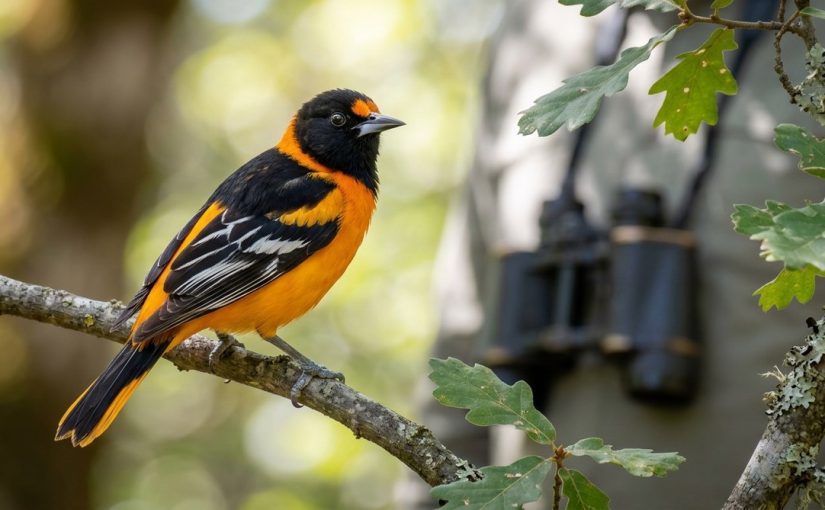
In the spring of 2026, birders across Oregon were buzzing about a sighting that nobody expected. A flash of black and yellow in a backyard feeder in Jackson County turned out to be the first recorded Black-backed Oriole in the state. For a community used to celebrating Bullock’s Orioles and the occasional Hooded Oriole, this was a seismic event. It wasn’t just a rare bird. It was a first state record for a species that belongs to the dry interior of Mexico. How did it get here? And what does it mean for the future of birding in the Pacific Northwest?
Oregon’s first Black-backed Oriole, documented in May 2026, represents a remarkable vagrant event for the state. The identification hinged on subtle differences in plumage, bill shape, and vocalizations compared to the similar Bullock’s Oriole. Birders who act quickly and document sightings thoroughly can help confirm future rarities and contribute valuable data to ornithological science.
A Bird That Belongs Far South
The Black-backed Oriole (Icterus abeillei) is a resident of western Mexico, from Jalisco down to Oaxaca. It favors arid scrub, oak woodlands, and thorn forests. Unlike its migratory cousins, this species rarely moves far from its home range. Only a handful of records exist north of the border, most from Texas and a single bird in Pennsylvania back in 2017. So when a birder in Medford spotted an oriole that didn’t match the field guide for Bullock’s, the alarm bells went off.
The bird was first seen on May 19, 2026, at a private residence known for its reliable seed and fruit offerings. The homeowner posted photos to a local birding group. Within hours, the chatter turned to excitement. “That’s not a Bullock’s,” said one commenter. “Look at the solid black hood and the white wing panel.”
How to Tell It Apart from Bullock’s Oriole
The biggest challenge with a vagrant Black-backed Oriole is separating it from the abundant Bullock’s Oriole, which breeds throughout Oregon. Both species are orioles with orange underparts, black backs, and white wing bars. But the differences become clear once you know what to look for.
| Feature | Black-backed Oriole | Bullock’s Oriole |
|---|---|---|
| Black hood | Extends down the throat and upper chest, forming a solid black bib | Only covers the crown, nape, and throat, leaving the chest orange |
| Wing panel | Bright white patch on the coverts stands out against black wing | Smaller, often buffy white, less contrast |
| Bill shape | Slightly thicker and more curved, almost like a Hooded Oriole | Straight and narrower |
| Tail pattern | Black outer rectrices with a thin yellow edge | Yellow outer rectrices with black bases |
| Song | A series of rich whistles, slower and more deliberate | Faster, more jumbled notes |
These differences are subtle, especially in poor light. That’s why the first Oregon sighting was confirmed by multiple experienced birders and later accepted by the Oregon Bird Records Committee. As one committee member put it:
“The photographs were clear, and the field notes matched every key feature. When you see a male Black-backed Oriole in direct sunlight, the solid black hood and white wing slash are unmistakable. But you have to be patient and study the bird for more than a few seconds.”
Following the Discovery
Once the word spread, birders flocked to the Medford yard. The homeowner, gracious and bird aware, allowed visitors on a schedule. Over the next three days, dozens of people saw the oriole as it visited a jelly feeder and an orange half. It appeared to be a healthy adult male in full breeding plumage.
3 Steps to Confirm a Vagrant Oriole in the Field
If you think you’ve found a Black-backed Oriole in Oregon, follow this process to maximize the chance of a correct identification and a state record.
- Document everything. Take as many photos as possible from multiple angles. Capture the back, the throat, the wing, and the tail. A short video of the bird calling is gold. Upload your files to eBird or iNaturalist with detailed notes.
- Compare side by side. Use a field guide or a trusted app like the Merlin Bird ID to compare with Bullock’s and Hooded Orioles. Pay close attention to the hood shape and the white wing panel size. If you’re unsure, don’t guess. Wait for another observer.
- Alert the community. Post your sighting on local rare bird alerts, Facebook groups, and the Oregon Birders email list. Include your photos and a clear location. Be ready to verify with the records committee.
What This Sighting Tells Us About Vagrancy
The Black-backed Oriole in Oregon is not a fluke isolated incident. It fits a larger pattern of Mexican and Central American birds appearing in the West during spring overshoots. Similar species like the Flame-colored Tanager and the White-eared Hummingbird have shown up from Arizona to California. Climate shifts and changing wind patterns may be pushing these birds farther north.
For a deeper look at why some species wander, check out our piece on what makes a bird rare in western North America. And if you’re planning to chase the next rarity, our guide on essential gear every serious birder needs will help you stay prepared.
What to pack when chasing a rarity:
– Binoculars with a close focus distance
– A camera with a long zoom lens or a phone scope adapter
– A field notebook and pen (even in the digital age)
– Snacks and water (you may be standing still for hours)
– Sun protection and layers (Oregon weather changes fast)
The Community’s Role in Confirming First State Records
Oregon’s first Black-backed Oriole is a victory for citizen science. It started with one person noticing something different. That observation was shared, vetted, and ultimately accepted. The process works because birders care about accuracy and because we have the tools to document and share sightings immediately.
If you’re new to submitting records, our article on how to document and report your rare bird sighting like a pro walks you through the exact steps. And for real time alerts, check out the best apps and resources for rare bird alerts that we’ve tested in the field.
A New Chapter for Oregon’s Birding History
The arrival of a Black-backed Oriole in Oregon is more than a one day wonder. It is a reminder that we are living in a dynamic era for bird distribution. As the climate changes and vagrancy patterns shift, birders on the West Coast will continue to be surprised. The key is to stay observant, to document everything, and to share what you see with the community.
Next time you see an oriole that doesn’t quite look right, take a second look. Get a photo. Ask a friend. It might be the next first state record. And if it is, you’ll be part of a story that birders will talk about for years.
Happy birding, and keep your eyes on those feeders.