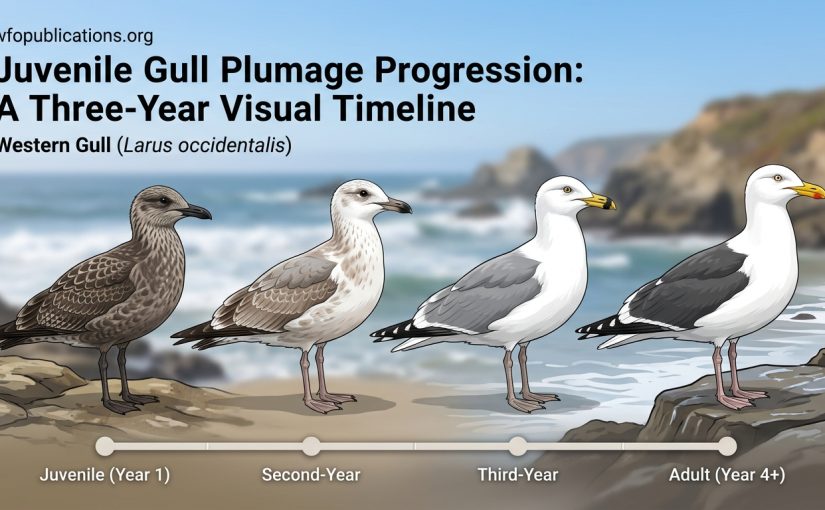
Watching a juvenile gull transform into an adult is like witnessing a slow-motion metamorphosis. Those scruffy brown youngsters you see at the beach will spend years cycling through distinct plumage stages before they earn their crisp adult feathers. Understanding juvenile gull plumage progression helps you identify not just the species, but the exact age of the bird in front of you.
Juvenile gulls undergo a three-year transformation from mottled brown fledglings to adult plumage through predictable molt patterns. Each year brings distinct feather changes: first-cycle birds show uniform brown tones, second-cycle gulls display patchy gray backs, and third-cycle individuals nearly match adults. Recognizing these stages requires observing wing patterns, mantle color, tail bands, and bill markings across seasons.
Why Gull Age Identification Matters
Most birders can identify an adult Herring Gull or Ring-billed Gull without much trouble. The challenge begins when you encounter immature birds.
Juvenile gulls look nothing like their parents. They wear cryptic brown plumage that protects them during their vulnerable first months. This camouflage makes them harder for predators to spot among rocks and driftwood.
But these young birds don’t stay brown forever. They molt into new feathers on a predictable schedule, creating distinct age classes that experienced observers can recognize at a glance.
Learning these patterns transforms gull watching from frustrating guesswork into satisfying detective work. You’ll stop lumping every brown gull into the “juvenile” category and start pinpointing whether that bird hatched this year or three summers ago.
The Three-Year Timeline for Large Gulls
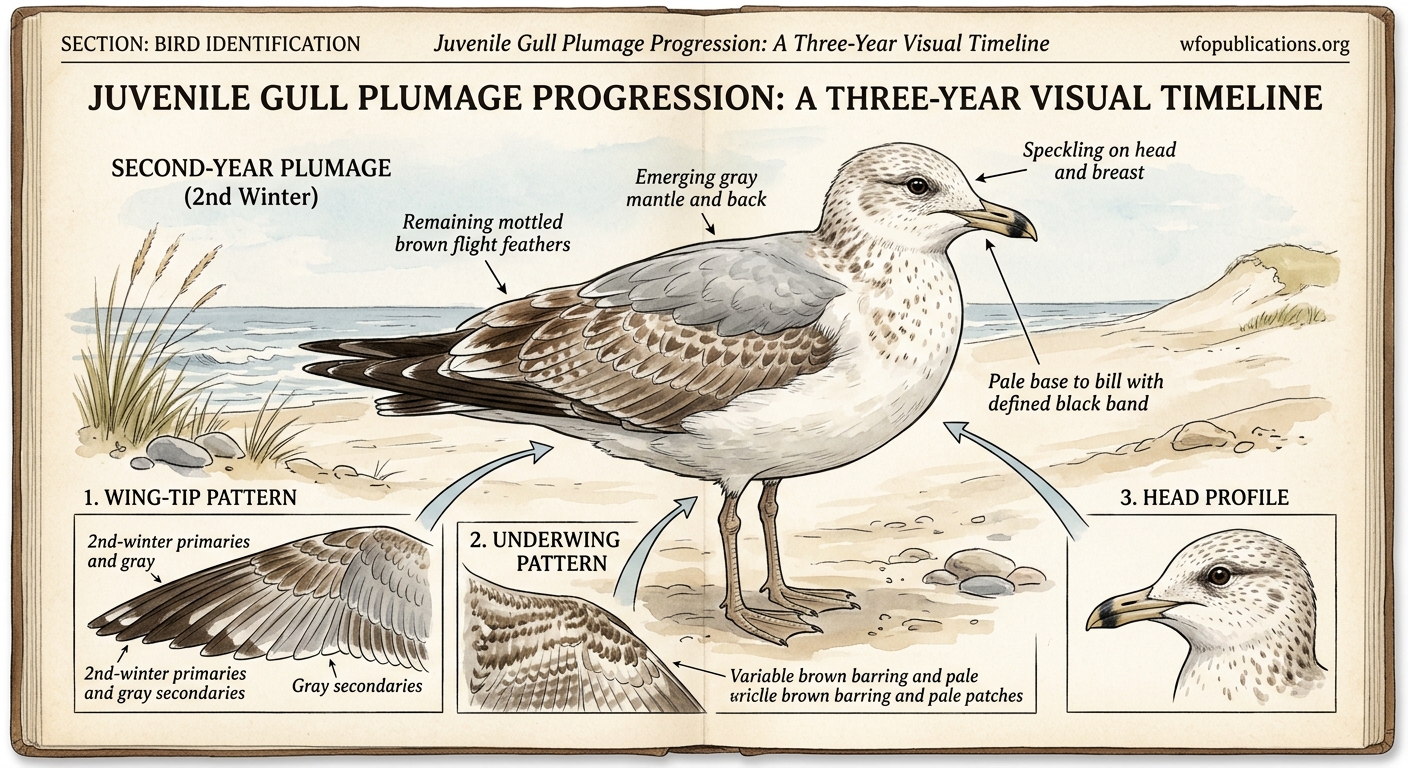
Most large gull species follow a three-year maturation schedule. This includes familiar species like Herring, Ring-billed, and California Gulls.
Smaller species like Black-headed and Bonaparte’s Gulls reach adult plumage in just two years. Larger species like Great Black-backed and Glaucous-winged Gulls may take four years.
For this guide, we’ll focus on the three-year pattern since it applies to the gulls you’re most likely to encounter at North American beaches, lakes, and parking lots.
Here’s what happens during each cycle:
-
First cycle (Year one): The bird hatches in late spring or early summer and wears juvenile plumage through its first winter. By spring, it begins molting into first-summer plumage.
-
Second cycle (Year two): The gull continues replacing feathers throughout its second year, showing a mix of juvenile-like and adult-like features.
-
Third cycle (Year three): The bird closely resembles an adult but may retain subtle immature markings. By the end of this cycle, it achieves full adult plumage.
First-Cycle Plumage Characteristics
Newly fledged gulls wear their most uniform plumage during their first few months. These birds show consistent patterns that make them easier to age than older immatures.
Fresh Juvenile Appearance
Right after leaving the nest, young gulls display:
- Dark brown feathers with pale edges creating a scaly pattern
- Uniformly dark primaries (wing tips) without white spots
- Dark tail with a crisp terminal band
- All-dark bill, usually black or dark gray
- Dark eyes (in species that develop pale eyes as adults)
This fresh plumage looks neat and tidy. The feather edges haven’t worn down yet, giving the bird a well-groomed appearance despite the drab coloring.
First-Winter Changes
By late summer and fall, these juveniles begin their first prebasic molt. They replace body feathers but keep their juvenile wing and tail feathers through the winter.
First-winter birds show:
- Paler head and underparts compared to fresh juveniles
- Gray feathers appearing on the back (mantle)
- Retained brown wing feathers showing wear
- Bill may begin showing pale at the base
- Overall messier appearance as feathers wear
The contrast between fresh gray back feathers and worn brown wing feathers creates a distinctive two-toned look.
First-Summer Plumage
As spring arrives, first-cycle birds continue molting. They’re now over a year old but still far from adult appearance.
Key features include:
- More extensive gray on the mantle
- Extremely worn and faded wing feathers
- Bleached tail band, often appearing white rather than dark
- Bill showing more pale coloration
- Ragged, tired appearance overall
First-summer gulls often look their worst. Their juvenile wing feathers have endured a full year of sun, salt, and wear. These birds are easy to age because they look so bedraggled compared to fresh juveniles or more advanced immatures.
Second-Cycle Transformation
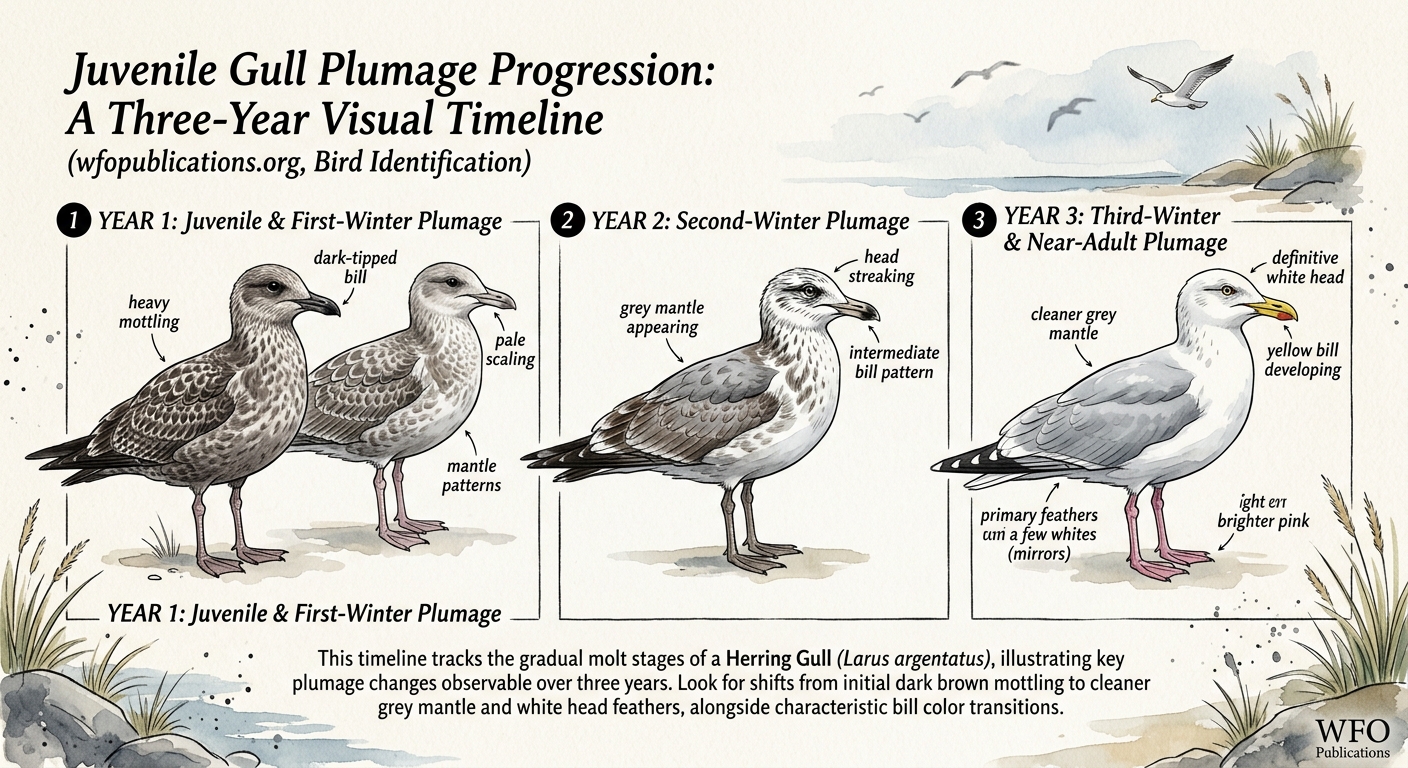
The second year brings dramatic changes. These birds finally replace their juvenile flight feathers and start resembling adults from a distance.
Second-Winter Patterns
During their second prebasic molt (late summer of their second year), these gulls replace their wing and tail feathers for the first time since fledging.
Second-winter birds display:
- Extensive gray mantle matching adult tone
- New primaries with limited white mirrors
- Tail showing reduced dark markings
- Bill developing adult color pattern
- Eyes beginning to pale (in applicable species)
The wing pattern becomes crucial for identification. Second-cycle birds show less black on the primaries than adults, and their white “mirrors” (spots near the wingtips) are smaller or absent.
Second-Summer Appearance
By their second spring and summer, these gulls look increasingly adult-like. Many birders mistake them for adults at a casual glance.
Look for these telltale immature signs:
- Residual dark markings in the tail
- Black on the bill (especially near the tip)
- Brown markings in the wing coverts
- Slightly messier head streaking than adults
- Reduced white in the primary tips
The bird’s overall structure and behavior also help with aging. Second-cycle gulls often associate with other immatures and may show less confidence around adults at feeding sites.
Third-Cycle Near-Adults
Third-year birds achieve near-adult plumage. Separating them from true adults requires careful observation of subtle field marks.
Third-Winter Plumage
These birds have completed most of their transformation. They’ve replaced all their feathers multiple times and wear plumage that closely matches breeding adults.
Remaining immature features include:
- Trace amounts of black on the bill
- Small dark marks in the tail (often just a few spots)
- Slightly reduced white in primary tips
- Occasional brown feather in the wing coverts
Many third-cycle gulls are functionally indistinguishable from adults in the field. Only close examination reveals their age.
Third-Summer and Beyond
By their third summer, most gulls have achieved full adult plumage. They’re now ready to breed and will maintain this appearance for the rest of their lives.
Adults undergo annual molts but don’t change their basic pattern. They alternate between breeding (alternate) plumage in spring and summer and non-breeding (basic) plumage in fall and winter.
Key Features for Age Determination
Certain body parts provide the most reliable aging clues. Focus your attention on these areas when examining an unknown gull.
| Feature | First-Cycle | Second-Cycle | Third-Cycle | Adult |
|---|---|---|---|---|
| Mantle | Brown to gray mix | Mostly adult gray | Adult gray | Adult gray |
| Primaries | All dark brown | Dark with small mirrors | Near-adult pattern | Clean adult pattern |
| Tail | Dark terminal band | Reduced dark markings | Trace dark marks | Clean white |
| Bill | All dark | Developing adult color | Nearly adult | Full adult color |
| Eyes | Dark | Lightening | Pale | Pale |
Wing Pattern Details
The wings tell the most complete aging story. Each molt cycle changes the primary feathers in predictable ways.
- Primary wear: First-cycle birds show extremely worn, faded primaries by summer
- Mirror size: White spots near wingtips increase with each molt
- Black extent: Amount of black on outer primaries decreases with age
- Covert pattern: Brown feathers in wing coverts indicate immaturity
Bill and Leg Color Changes
Bare parts change color as gulls mature. These changes follow species-specific patterns but share common trends.
Most species transition from:
- Dark bills to pink, yellow, or red bills with markings
- Pink or gray legs to yellow, pink, or flesh-colored legs
- Dark eyes to pale yellow, white, or pale gray eyes
The bill transformation happens gradually. Second-cycle birds often show a two-toned bill with dark near the tip and pale at the base.
Molt Timing and Regional Variation
Gull molt schedules vary by latitude and local conditions. Birds breeding in northern regions may molt on different schedules than southern populations of the same species.
Prebasic Molt Schedule
The prebasic molt (body and flight feathers) typically occurs in late summer and fall. This is when gulls replace their most visible feathers.
Adult gulls usually complete this molt before winter. Immature gulls may take longer, sometimes continuing their molt into early winter.
Prealternate Molt Patterns
Many gull species undergo a limited prealternate molt in late winter or early spring. This molt primarily affects head and body feathers, giving birds their breeding appearance.
Immature gulls show less extensive prealternate molts than adults. First-cycle birds may skip this molt entirely or replace only a few feathers.
Geographic Considerations
Gulls in milder climates may molt earlier or later than those in harsh environments. Food availability and weather conditions influence molt timing.
Vagrant gulls appearing outside their normal range may show molt patterns that don’t match local birds. This can add another layer of complexity to identification.
Common Identification Challenges
Even experienced birders struggle with certain juvenile gull scenarios. Recognizing these pitfalls helps you avoid misidentification.
Faded Versus Fresh Plumage
A faded first-summer gull can look paler than a fresh first-winter bird. Don’t assume pale equals older.
Check feather condition rather than just color. Worn, ragged feathers indicate an older bird in the same plumage cycle, while crisp, neat feathers suggest recent molt.
Hybrid Gulls
Gulls hybridize frequently where species overlap. Hybrid offspring show mixed characteristics that don’t fit standard identification patterns.
If a bird’s features don’t add up, consider the possibility of hybrid parentage. This is especially common with Herring × Glaucous-winged and Herring × Lesser Black-backed combinations.
Abnormal Plumage
Some gulls show leucism (abnormal white patches), melanism (excessive dark pigment), or other color abnormalities.
These birds may appear to be a different age or even a different species. Look for structural features and behavior to confirm identification.
Focus on the overall pattern rather than any single feature. A bird showing mostly second-cycle characteristics with one anomalous feature is probably a second-cycle bird with unusual plumage, not a mystery species.
Practical Field Techniques
Successful gull aging requires systematic observation. Develop a consistent approach to examining each bird.
The Four-Step Aging Method
Use this sequence every time you encounter an unfamiliar gull:
- Assess overall color (brown, gray-brown mix, mostly gray, or adult gray)
- Examine wing pattern (all dark, developing mirrors, or adult pattern)
- Check tail pattern (dark band, reduced markings, or clean)
- Note bare part colors (bill, legs, eyes)
This systematic approach prevents you from fixating on one feature while missing others that provide crucial context.
Photography for Later Review
Gull identification often improves with study time. Photograph unknown birds from multiple angles.
Capture these key views:
- Standing bird showing full body and wing coverts
- Spread wing showing primary pattern
- Close-up of head and bill
- Rear view showing tail pattern
Review your photos at home with field guides and online resources. Many identifications that stump you in the field become clear with careful photo analysis.
Comparative Observation
Whenever possible, compare your mystery gull to nearby birds of known age. Direct comparison reveals subtle differences invisible when viewing birds in isolation.
Adult gulls often loaf near immatures at beaches and landfills. Use these adults as reference points for mantle color, wing pattern, and overall size.
Species-Specific Variations
While the three-year pattern applies broadly, each species shows unique characteristics during its immature stages.
Ring-billed Gull Progression
Ring-billed Gulls are among the easiest large gulls to age. Their progression follows predictable patterns with distinctive field marks at each stage.
First-cycle Ring-bills show:
- Pink legs (not dark like many other species)
- Sharply defined tail band
- Medium-brown overall tone
Second-cycle birds develop the namesake black ring on the bill earlier than some other features reach adult appearance.
Herring Gull Development
Herring Gulls take longer to develop adult characteristics than Ring-bills. Their immature plumages show more variation and can be trickier to pin down.
These birds show:
- Darker, more mottled first-cycle plumage
- Slower bill color development
- More extensive dark in the tail through second cycle
- Greater individual variation at all ages
California Gull Maturation
California Gulls bridge the gap between Ring-billed and Herring Gulls in size and maturation rate. Their progression shows intermediate characteristics.
Watch for:
- Greenish or gray-green legs at all ages
- Dark eyes retained longer than other species
- Distinctive bill pattern with both red and black marks in adults
- Relatively neat appearance even in first-summer plumage
Building Your Gull Identification Skills
Mastering juvenile gull plumage progression takes time and repeated exposure. Nobody becomes an expert overnight.
Start with common species in your area. Learn one species thoroughly before adding others to your repertoire. Ring-billed Gulls make excellent study subjects because they’re widespread and follow predictable patterns.
Visit gull hotspots regularly throughout the year. Watching the same population over months reveals how individual birds change through molt cycles.
Join local birding groups or online forums where experienced gull watchers share observations. The gull identification community is passionate and welcoming to learners.
Keep detailed notes and photos of birds you can’t immediately identify. Return to these records as your skills improve. You’ll be surprised how many “mystery gulls” become obvious once you’ve gained more experience.
Watching Gulls Grow Up
The three-year journey from brown juvenile to pristine adult represents one of nature’s most gradual transformations. Each molt brings these birds closer to their final appearance, replacing cryptic camouflage with bold adult patterns.
Learning to read these changes turns every gull flock into a living timeline. You’ll spot the fresh juveniles taking their first flights, the scruffy second-years testing their independence, and the nearly adult third-years ready to breed. This knowledge deepens every beach walk, every landfill visit, every moment spent watching these adaptable birds navigate our shared spaces.